
Blair chaplains donate anti-choking devices
Group distributes LifeVac tool to local first responders
Trending
Not long ago, a local child choked to death. Afterward, the Blair Emergency Services Chaplains Platoon held a debriefing for first responders who were unable to save the child, to help them deal with the trauma and stress.
One of the virtues the chaplains promote is resilience -- the ability to bounce back from a distressing result, so as not to "waste the pain" -- and in this case, it resulted in identifying, obtaining and distributing to local emergency response organizations a device that could save the lives of victims of similar choking incidents.
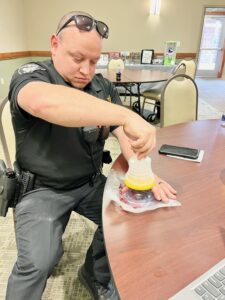
The LifeVac anti-choking tool consists of a mask that seals around the victim's mouth and nose and a plunger that connects to a nozzle on the mask, with a check valve preventing air from pushing the object farther in when the plunger is depressed, but which then releases to create suction when the plunger is pulled up, according to information presented at a news conference in Hollidaysburg on Tuesday.
The distribution of about 65 of the devices to police departments and other first response organizations in Blair County is an example of "hunt(ing) for the good stuff" in the aftermath of misfortune, said Mike Blackie, chief chaplain of the platoon.
An average of 14 people in the U.S. die each day from choking, Blackie said.
The device so far has saved nearly 5,000 people, according to the LifeVac website.
When breathing stops, there's not much time to provide help, according to the website.
Brain damage becomes possible after four minutes and probable after six minutes -- with death becoming probable after 10 minutes, according to the website.
The average time for emergency responders to arrive is seven to 12 minutes, according to the site.
The device came to the attention of the platoon when one member told the rest that they'd bought a set for their kids, Blackie said.
The North Woodbury Police Department has had LifeVac for two years, according to Police Chief Lance Morris.
He learned about the device through an email ad that arrived one day in his inbox, he said.
He researched it and liked what he saw.
There is one of the devices in each of the township's police cars, in its road crew trucks and in the office, Morris said.
The device is to be used as a backup, after people trying to help a choking victim follow established protocols: calling 911; recognizing there is a complete airway obstruction, based on the victim being unable to speak and perhaps holding their throat and nodding when asked if they need help; encouraging them to cough forcefully; followed by five forceful slaps in their back between their shoulder blades, followed by five abdominal thrusts inward and upward, with fists held together under the ribcage, thumb side in, while standing behind the victim (the Heimlich maneuver); followed then by five attempts with the device, according to a video from a CPR expert on the website.
The company that makes the device donated 60 of the 65 that the platoon has distributed, Blackie said.
Ambulance agencies may choose not to carry LifeVacs because they have specialized equipment and skills for dealing with choking patients, according to paramedic Jacob Reilly of the Hollidaysburg American Legion Ambulance Service.
Paramedics can look down the throat of such victims and extract the obstruction with hemostats, Reilly said.
As a last resort, paramedics can also perform a cricothyrotomy, cutting into the airway and inserting a tube to allow the victim to breathe, he said.
Ambulances that don't have a paramedic on board might be able to benefit from carrying the suction device, he said.
Mirror Staff Writer William Kibler is at 814-949-7038.