
First-hand account of 9/11 leaves lasting impact
Trending
I was about two months shy of my fourth birthday when the terrorist attacks on Sept. 11, 2001, occurred. I have no memory of that day, but I know where I was from speaking with my parents about where they were at that time.
My mother was in Pittsburgh with a colleague for a work-related event and, about three days after United Airlines Flight 93 crashed into a Somerset County field, my father was one of the first responder volunteers who drove from Patton to help clean up the site.
I was at my sitter's, probably napping or playing with toys, when the attacks occurred.
It really wasn't until 2018, when I became a correspondent for the Daily American in Somerset, that I became intrigued with the story of what happened aboard Flight 93.
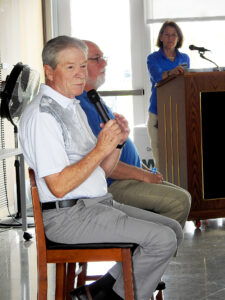
In August 2018, the Friends of Flight 93, a nonprofit supporting partner of the Flight 93 National Memorial, held a speaker series program at the memorial's learning center, which featured John Werth, the Cleveland-based air traffic controller who was the first person to realize that the flight had been hijacked as part of the 9/11 terrorist attacks.
During the program, Werth said he remembered his first few transmissions with the plane and was certain he wasn't speaking with the crew after the terrorist pilots said they had a bomb on board and asked people to sit down, a message that was intended for the passengers in the cabin but was received by Werth in Cleveland.
Werth responded, "Calling Cleveland Center, you're unreadable. Say again slowly."
Werth started to contact other aircraft that also heard the message on the frequency. It became a process of elimination to see who was and wasn't responding, he said, noting Flight 93 was the only aircraft that would not return his call.
Werth said he felt anger, frustration, sadness and loss when the crash was confirmed.
Werth, 74, passed away on Oct. 2, 2021.
Hearing his story stuck with me in a way that I assume is similar to how many Americans will never forget where they were when the terrorist attacks occurred on our country's soil.
In 2019, I took a visual communication seminar at Pitt-Johnstown and visited the Flight 93 National Memorial for an assignment.
If you've never been there, the memorial certainly conveys a strong emotional experience and is designed to transport visitors back in time to that day.
Large walls covering the visitor center block the view of the boulder marking the impact site until you reach the flight path overlook. The sidewalk leading to the overlook is timestamped with the events of that day. The roads leading to and from the memorial are curved, giving visitors a sense of the plane's wings being rocked back and forth in the sky.
Inside the visitor center, you can listen to three voicemail recordings left by passengers Lauren Catuzzi Grandcolas and Linda Gronlund and flight attendant CeeCee Ross Lyles, as they call home to say goodbye to their loved ones. Their voices will live on forever.
It's a surreal feeling to listen to the audio. It gave me goosebumps.
But as Friends of Flight 93 Executive Director Donna Gibson told me, there are more than
100 million Americans who have been born since that day, and as people who were directly involved with the events of 9/11 start to pass away, it's arguably more important now than ever to share your experiences with friends and family members.
As someone who has no memory of that day, I invite readers to record -- written or video -- what they remember of 9/11. As the Alan Jackson song puts it, "Where were you when the world stopped turning on that September day?"
Mirror Staff Writer Matt Churella is at 814-946-7520.