At an impasse: Lakemont Park management group files suit against commissioners
Lakemont Partnership claims commissioners have falsely accused firm of violating lease
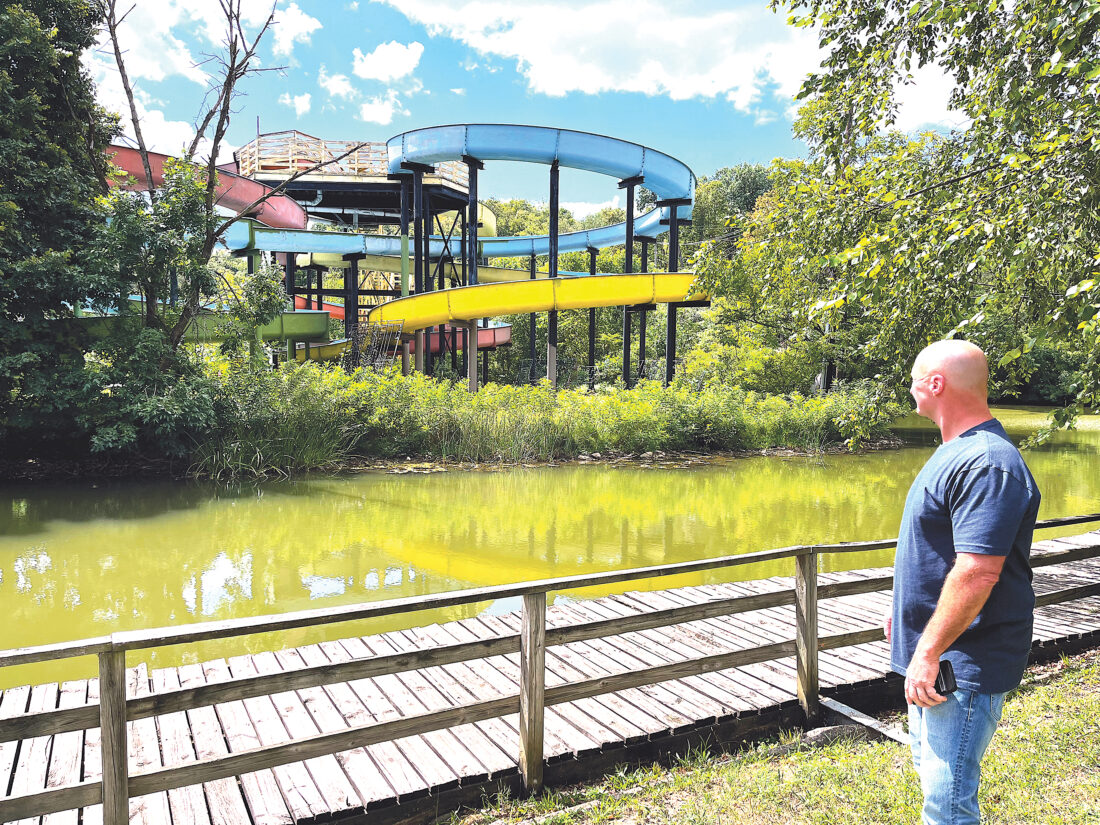
Blair County Commissioners’ Chairman Dave Kessling looks over the water at the now defunct water slides at Lakemont Park during a tour of the park on Wednesday. Mirror photo by William Kibler
The organization that leases the 83-acre property that includes Lakemont Park from Blair County on Friday sued the county and its commissioners, alleging they have falsely accused the organization of violating the lease, besmirching the organization’s reputation — allegations that are part of a filing that reveals the commissioners have been working with a separate group to establish a sports complex at the park.
The Lakemont Partnership, which has operated the park and leased the ground where Peoples Natural Gas Field, Galactic Ice, The Casino and the Boyertown-era offices are located since 1988, has asked the county court to rule that the partnership is not violating the lease, which runs until 2066 — or if it is, to say how to make it right; and to declare the partnership is no longer obligated to operate amusement rides there, based on the lease and its amendments.
Less than a year ago, the county asked what it would take to buy out the lease, and the partnership responded with a proposal that “accounted for the millions of dollars in capital investments and debt” that it had incurred over the years “in reliance on the long-term lease remaining in place” — so that the partnership could recoup its costs.
Subsequently, the group that has proposed the sports complex offered $800,000 to take over the lease for the whole complex, an offer that came far short of just the debt obligations, according to the lawsuit.
“The county’s interest is in changing to a new owner, while accommodating an amicable transition,” the county’s solicitor stated in a later communication, according to the lawsuit.
Because the partnership has resorted to the lawsuit, there would be no comment, said Commissioners’ Chairman Dave Kessling, whom the lawsuit singled out repeatedly, in contrast to his colleagues Amy Webster and Laura Burke.
“We are not litigious and were very reluctant to file a lawsuit in light of Lakemont Partnership’s longstanding relationship with the county,” Cohen stated in a news release that accompanied the lawsuit. “But the county’s threats leave us no alternative.”
The partnership needs “the court’s guidance,” she stated.
The main controversy centers around the idling in recent years of the amusement rides that largely characterized the park through much of the 20th century.
Despite the closure of the rides, “(the) partnership believes it continues to meet its obligations under the lease,” states the news release.
The partnership has invested more than $30 million into the overall property, the news release states.
Some of that investment went toward the fenced-in former amusement park, “which currently includes expansive green spaces, pavilions for public and private events, two stages and numerous recreational activities, including four batting cages, four full-sized basketball courts, two sand volleyball courts, two 18-hole miniature golf courses and various yard games,” and which also hosts activities like Holiday Lights on the Lake, the release states.
The original lease drafted following the partnership’s predecessor’s purchase of the lease out of the Boyertown bankruptcy in 1988 was not absolute in its requirement to take care of the amusement rides, according to the lawsuit.
Instead, that lease called for the partnership to take “reasonable steps to preserve and maintain the historical significance that Lakemont Park holds for the people of Blair County, including the preservation and maintenance of The Casino, Leap the Dips, flower gardens and memorials, so long as said preservation and maintenance is economically feasible and in keeping with the requisite safety standards imposed by the various governmental bodies,” according to the lawsuit.
It is no longer financially feasible to operate the amusements, according to the lawsuit.
The factors that helped make it unfeasible include an unspecified misfortune that scotched a proposed upgrade loan around 2017 and the spending of $2 million the next year for upgrades that were shortly followed by COVID, which led to park closure and supply chain disruptions, followed by social distancing that limited patronage, according to the lawsuit.
It became “difficult or impossible to make continued improvements to the park on top of the previous significant expenditures and general maintenance costs,” the lawsuit states.
Perhaps reflecting a realization that the continued support of the amusement rides would be phased out, a 2006 amendment to the lease agreement dropped the term “amusement park” for the fenced-in area where those rides were located, replacing it with the term “public park and recreational facility,” the lawsuit states.
Leap the Dips obligation near end
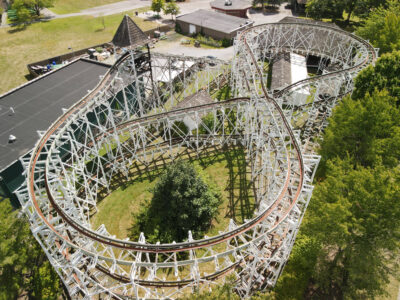
The 1902 Leap the Dips roller coaster is a special case, with special obligations.
But those too are nearing an end, according to the lawsuit.
A nonprofit organization, the Leap the Dips Preservation Foundation, was formed in 1995 to restore the coaster, which had fallen into disrepair in the 1970s, according to the lawsuit.
The foundation obtained a $550,000 loan from the Small Business Administration and a $100,000 loan from the Southern Alleghenies Planning and Development Commission, with the partnership as guarantor, according to the lawsuit.
The foundation completed its mission in 1999, but defaulted on the loans in 2004, according to the lawsuit.
As guarantor, the partnership then assumed responsibility for the loan repayments and the operation, as well as maintenance and insurance on the coaster, and two years later, entered into an agreement with the county under which it would “maintain, repair, administer and operate” the coaster through Oct. 8, 2011, according to the lawsuit.
After that 2011 date, operating the coaster became optional, but the partnership was still obligated “to preserve and maintain the architectural and historical integrity” of the coaster through Oct. 8, 2025, according to the lawsuit.
After that date — six weeks from now — if the partnership determines that continued preservation is insupportable, it must provide the county with 60 days notice whereby the county may agree, “at its sole discretion, to thereafter assume all responsibility costs and obligations to maintain and … preserve” the coaster, the lawsuit states, citing the agreement with the county.
‘Reimagining’ park use
In 2021, prior to the animosity between the parties, the partnership approached the county to discuss “options for reimagining the use of all or portions of the leased property to ensure long-term viability of the park,” according to the lawsuit.
The following year, the group that is interested in developing the sports complex brought that idea to the partnership.
The partnership subsequently shared that idea with the county.
The sports complex proposal, and the county’s interest in it, has caused confusion for the partnership, according to the lawsuit.
Some of that confusion has resulted from the county’s independent discussion with the promoters of the complex — without the partnership’s involvement, according to the lawsuit.
Some has resulted from the county’s interest in the complex, while still retaining interest in reviving the amusement rides, according to the lawsuit.
It seems that the two would be mutually exclusive on the park property, according to the lawsuit.
The discussions about the sports complex led to the commissioners’ proposal to buy out the partnership’s lease.
Lawsuit filed ‘to gain clarity’
The alleged freezing out of the partnership has gone further, according to the lawsuit:
Led by Kessling, the commissioners have also “separately commenced direct discussion” with the owner of the Altoona Curve to discuss potential extension of its ballpark lease, which expires after the 2026 season, the lawsuit states.
The partnership has expressed its “willingness to collaborate” with the county, according to the lawsuit.
The county has responded with a series of “threat letters” that don’t accept the partnership’s justifications for its actions over the years, according to the lawsuit.
“Important parts of the park have been closed and the uses available for public enjoyment are substantially shrunken,” stated one such letter, according to the lawsuit.
“We are beyond disappointed that Blair County and its commissioners would apparently prefer to terminate our lease than to work together as partners, as we have for more than 35 years, to reinvent the park for the betterment of the Blair County community,” Cohen stated in the news release. “We filed this lawsuit to gain clarity.”
Mirror Staff Writer William Kibler is at 814-949-7038.
Local News

Close-knit flock: Underhill Farm’s unique sheep yield high-quality yarn
Salvation Army warming center opens again
The Salvation Army is opening its doors to serve as a warming center as temperatures are expected to drop once ...
Death under investigation
An investigation is underway in Cambria County after the body of man was found near the Blair-Cambria county line ...
Central Cambria Middle School receives honor
EBENSBURG — Central Cambria Middle School was recently designated one of the 2025-26 Don Eichhorn Schools: ...

Claysburg-Kimmel assessment scores show continued improvement