
Bee swarm generates quite a buzz
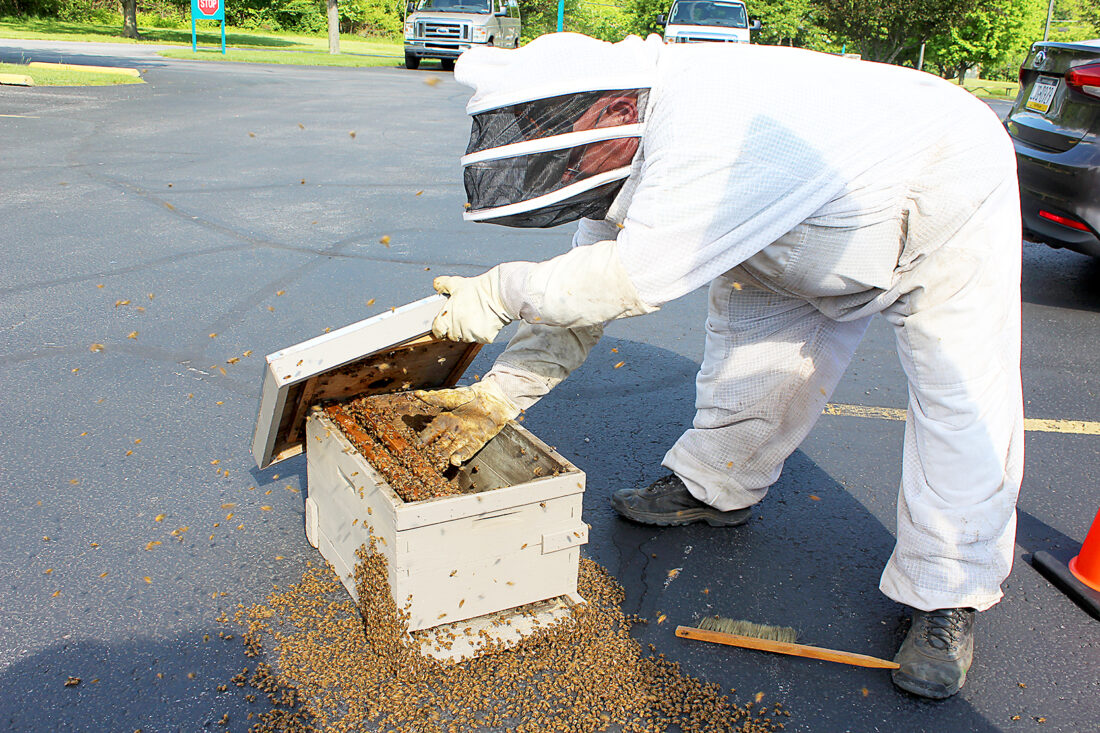
Bryan Musselman of Claysburg uses a brood box to remove a swarm of honey bees that appeared in the middle of the Altoona Mirror employee parking lot on Thursday afternoon. Mirror photo by Holly Claycomb
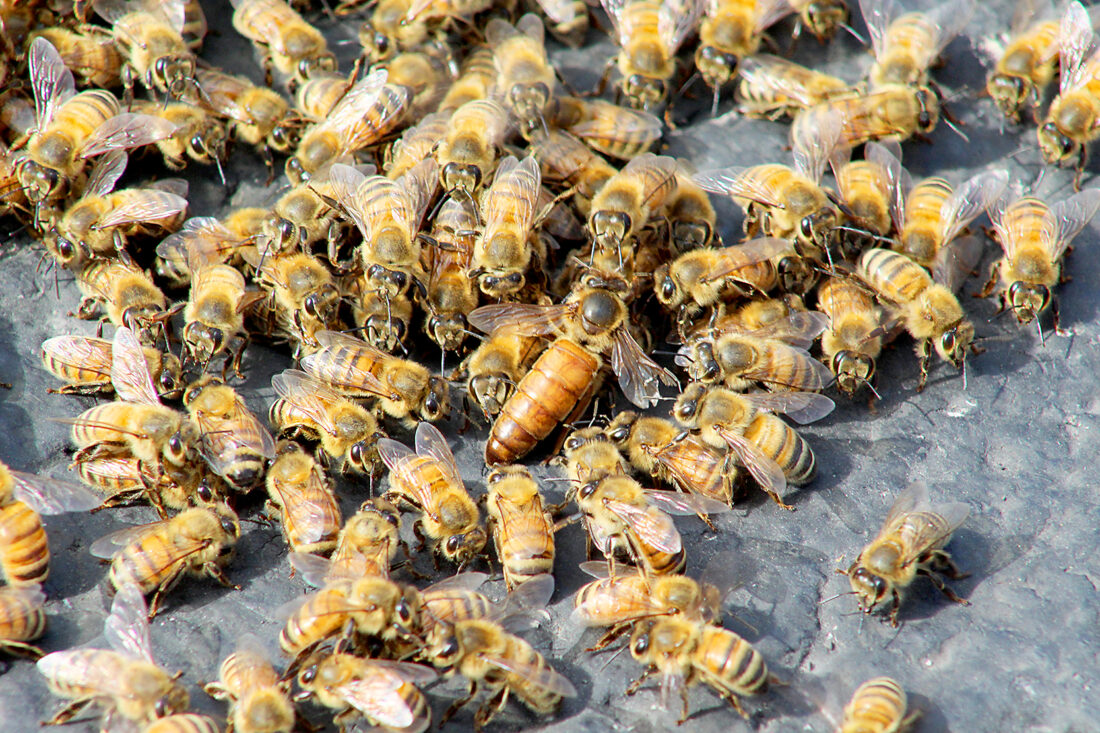
The queen bee of the swarm can be seen at center surrounded by worker bees. Swarms like the one that appeared Thursday at the Mirror occur when a nearby hive becomes overcrowded, said Bryan Musselman of Claysburg. Mirror photo by Holly Claycomb
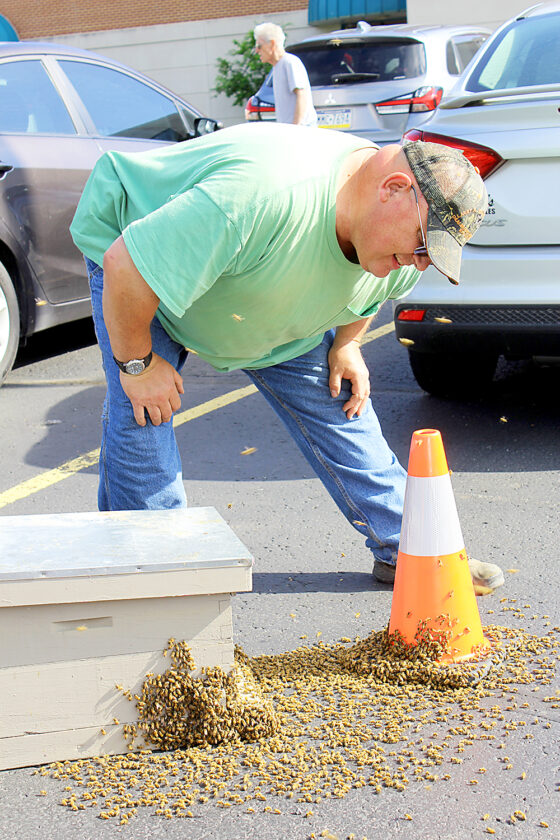
Beekeeper Bryan Musselman of Claysburg inspects a bee swarm in the parking lot of the Altoona Mirror on Thursday. Mirror photo by Holly Claycomb
Bryan Musselman of Claysburg uses a brood box to remove a swarm of honey bees that appeared in the middle of the Altoona Mirror employee parking lot on Thursday afternoon. Mirror photo by Holly Claycomb
The queen bee of the swarm can be seen at center surrounded by worker bees. Swarms like the one that appeared Thursday at the Mirror occur when a nearby hive becomes overcrowded, said Bryan Musselman of Claysburg. Mirror photo by Holly Claycomb
Beekeeper Bryan Musselman of Claysburg inspects a bee swarm in the parking lot of the Altoona Mirror on Thursday. Mirror photo by Holly Claycomb
Trending
A honeybee swarm in the middle of the employee parking lot of the Altoona Mirror on Thursday afternoon created quite a buzz among the workforce.
Initially, the discovery of the approximately five-foot diameter swarm of tannish insects led to management calling an exterminator, who suggested that calling a beekeeper for a rescue was a better option -- and who provided contact information for Bryan Musselman of Claysburg.
While waiting for Musselman, Mirror custodian John Figart placed traffic cones around the swarm to keep employees from driving over it and what Musselman identified as the queen bee, a creature that was continually mobbed by other bees climbing over and around.
Generally, the bees were docile, showing no inclination to sting the people hovering around.
Musselman said that was because they really didn't have anything to protect, as they were looking for a new home.
That new home arrived with Musselman, as he placed a rectangular brood box -- a cube of about two feet -- on the ground next to the swarm.
It immediately started attracting the bees, due to beekeeping residue in the box.
"Bees attract bees," Musselman said.
Still, the actual migration from the asphalt into the box, which had an opening low to the ground, was slow.
To speed the process, Musselman gently shook hundreds of bees that had begun to colonize one of the cones over the box, while gently encouraging others that had congregated to the side toward the box entrance with a tool that resembled a snow brush for windshields. The aim is to get the queen into the box so the others would follow, he said.
Swarms like the one that appeared Thursday at the Mirror occur when a nearby hive becomes overcrowded, Musselman said.
The worker bees in the overcrowded hive quit feeding their queen and start chasing her around, so that her egg supply diminishes, he said.
Becoming less gravid, the queen is able to fly, he said.
Meanwhile, the worker bees generate a new queen, by feeding a bee "royal jelly," a light, creamy substance, he said.
Having gorged themselves on honey, a majority of the worker bees in the hive -- mainly the more experienced ones -- then depart with the old queen, leaving the less experienced workers with their new queen to repopulate the old hive.
The departed bees then swarm, as a minority of their number -- "scout bees"-- search for a potential new home in a hollow tree or other promising cavity, according to a video from the Arkansas Division of Agriculture.
Why the Mirror bees ended up in the middle of the parking lot may be due to the queen not being able to fly further, he said.
When those scouts find something worthwhile, they return to the swarm and do a "waggle dance," wiggling their back ends, facing in the direction of the new prospective location, according to the video, and Musselman, who pointed out the "wiggling" bees to those gathered to watch the swarm make their way into their new home.
Musselman was at the Mirror from about 4:15 p.m. to about 7:30 p.m.
Before he left, the bees themselves had removed others that were dead from the area of the swarm.
They're meticulous housekeepers, according to Musselman.
There were a few bees not in the box when he left, but he got as many as he could, Musselman said.
Bees that are left behind generally return to their old hives.
The bees transported from the Mirror lot were to spend overnight Thursday in the box in the bed of Musselman's pickup, and would be transferred to a new hive box Friday morning, he said.
That could be done quickly by transferring a few frames from the first box to the second, he said.
Musselman has been a beekeeper for three years.
He got into it because he had been afraid of bees and grew tired of succumbing to that fear, he said.
He waxed eloquent about his sweet addiction.
"They're the most exasperating and the funnest things," he said. "(They're) fascinating."
Mirror Staff Writer William Kibler is at 814-949-7038.