A positive force: Former soldier reflects on how local background, Army molded character during Armed Forces Day celebrations
Former soldier reflects on how local background, Army molded character
-

- Members of the Jaffa Shriners Highlanders play during the Armed Forces Day celebration at Van Zandt VA Medical Center Saturday. Mirror photo by William Kibler
-
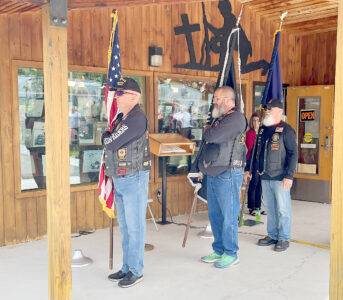
- Members of the Blair County Legion Riders prepare to retire the “colors” at the conclusion of the Armed Forces Day celebration at Van Zandt VA Medical Center Saturday. Mirror photo by William Kibler
-
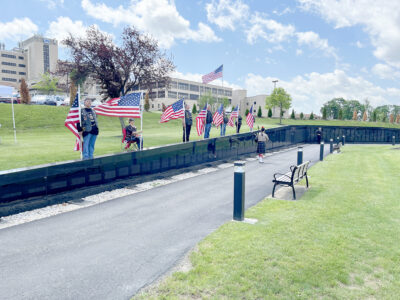
- The Blair County Legion Riders hold flags behind the replica Vietnam War Memorial wall at Van Zandt VA Medical Center as a member of the Jaffa Shriners Highlanders, playing Amazing Grace, walks past the wall during the hospital’s Armed Forces Day celebration Saturday. Mirror photo by William Kibler

Members of the Jaffa Shriners Highlanders play during the Armed Forces Day celebration at Van Zandt VA Medical Center Saturday. Mirror photo by William Kibler
John Harlow was raised in a trailer park in Tyrone alongside other kids who ended up on drugs or in jail, but thanks to a father figure, he found his life’s calling in radio, helping to draw him away from what might otherwise have been the path of a juvenile delinquent.
Civilian radio careers, however, didn’t pay a living wage, and it took an uncle to inform Harlow that a broadcast career in the military would allow him to work in his chosen profession, but in a financially sustainable fashion.
So Harlow joined the Army, where he came into his own — ironically enough — by becoming part of an organization where it’s never about yourself, but rather about the good of the whole, he said Saturday at at Van Zandt VA Medical Center Armed Forces Day celebration, where he was keynote speaker, having recently retired as Van Zandt’s chief of public affairs.
When he was young, Harlow did “the dumb stuff kids did back then — out after curfew, running around, nothing (really) bad,” he said.
The father figure was Cary Simpson, owner of WTRN radio in Tyrone, and the connection came from Simpson’s son, Ted, whom Harlow met when his family moved to a different neighborhood in the Tyrone area, shifting him to a different elementary school.
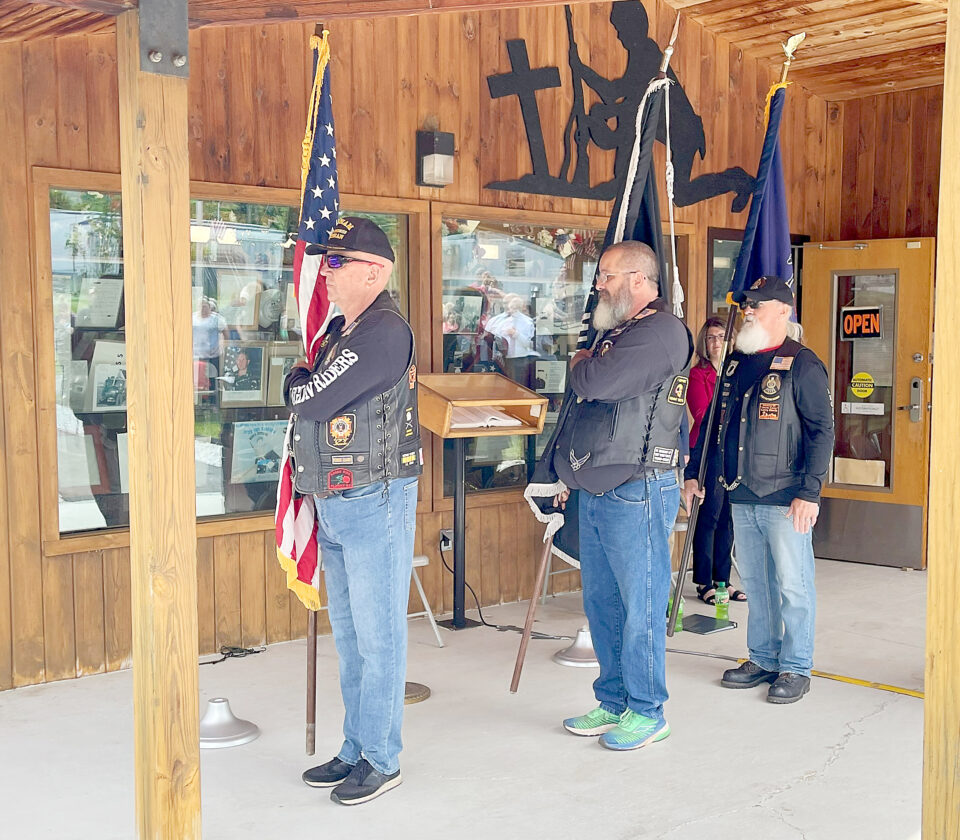
Members of the Blair County Legion Riders prepare to retire the “colors” at the conclusion of the Armed Forces Day celebration at Van Zandt VA Medical Center Saturday. Mirror photo by William Kibler
Ted, who’s still a friend, and Harlow pestered Simpson to allow them on the radio, and Simpson finally relented, on condition they find a sponsor.
So they convinced Morris Levine of Morris Levine Family Shoe Store in Tyrone to provide support, and on Jan. 2, 1981, when they were 14, they started the Tyrone Teen Review top 20 countdown, which included local news and sports and ran from noon to 2 p.m. on Saturdays.
When they reached legal working age at 16, they became official employees of the station, and Harlow performed weekday shifts.
But by 1988, when Harlow was 21, he realized that he was unlikely to be able to make a living as a radioman, given that the typical pay was the minimum wage of $3.35 an hour.
His Uncle John Watkins’ advice to join the military turned out to be the “fork in the road,” redirecting him away from a dead end and giving him entry into something bigger than himself — and ultimately, “an amazing life,” he said.
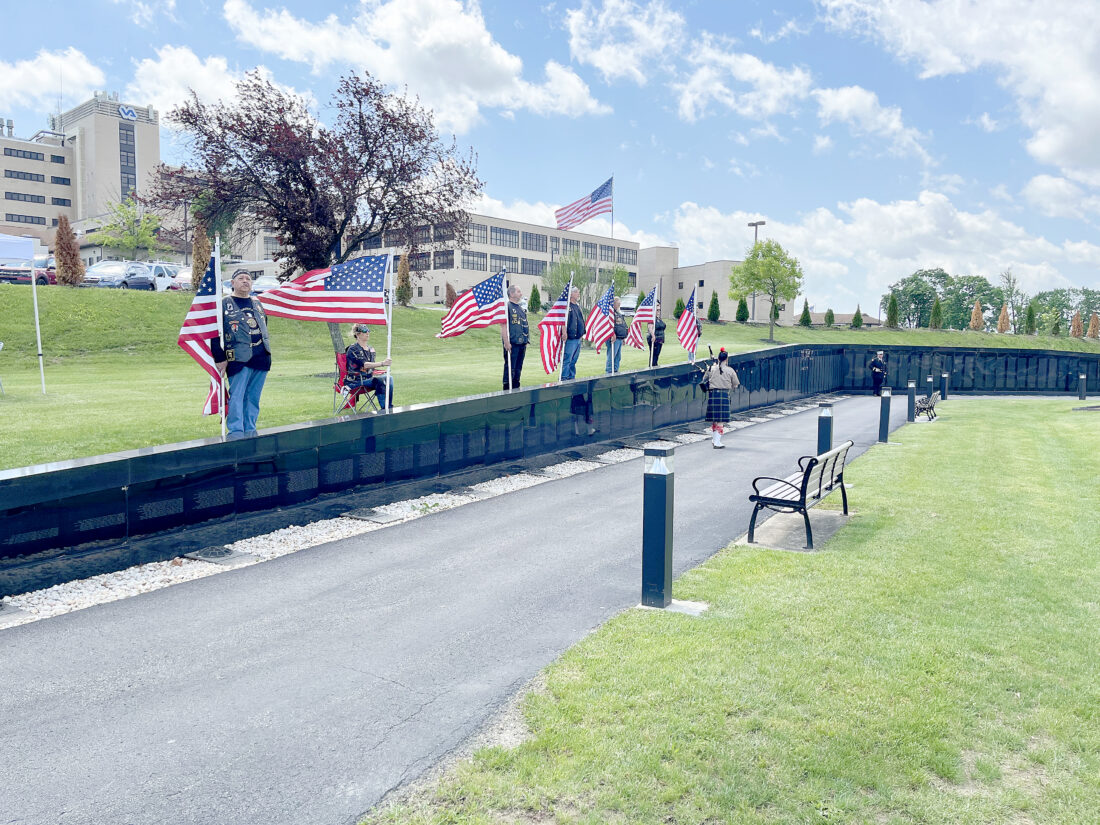
The Blair County Legion Riders hold flags behind the replica Vietnam War Memorial wall at Van Zandt VA Medical Center as a member of the Jaffa Shriners Highlanders, playing Amazing Grace, walks past the wall during the hospital’s Armed Forces Day celebration Saturday. Mirror photo by William Kibler
He enlisted as a communications specialist, serving from 1988 to 1992, then from 1993 to 1997, then served as a civilian employee of the Army for 21 years.
His background as a kid from the trailer park was the “chip on his shoulder” that motivated, even as it kept him humble, while the military ethos he absorbed became “the identity that shaped me,” he said.
He learned that ethos in basic training, where there was collective punishment for recruits messing up — for example, pushups for all, if someone failed at something he was required to do.
That enforced the notion that “you’re only as strong as the weakest link,” Harlow said. “It helped everybody realize that if some guys were not up to standard, you had to help them get there.”
One of several influential commanders he encountered during his career was the late Maj. Gen. Harold Greene, his boss at the U.S. Army Natick Soldier Systems Center in Massachusetts.
Greene’s mantra was “mission first, people always.”
That meant that “the mission must be accomplished, but you can’t do that if you don’t take care of your people,” Harlow said.
“(Greene was) the kind of guy you always want to be,” Harlow added.
“You can’t pour from an empty cup,” said Rachel Prichard, a public affairs specialist at Van Zandt who used to work under Harlow, reflecting on Harlow’s style of leadership.
Harlow had one near encounter with death as a soldier.
It was during Operation Desert Storm, the U.S. response to Iraq’s invasion of Kuwait, in 1991.
He was an editor for the Army’s Combat Camera Team and would edit footage both for the edification of military leaders and for public news consumption.
On Feb. 25, he conducted an interview at a makeshift U.S. military barracks located in a former warehouse in Dhahran, Saudi Arabia, and after the interview, he went across the street to a grocery store for doughnuts to bring back, when — about half an hour after he’d left the barracks — a Scud missile struck the barracks.
Harlow returned immediately and began shooting video, documenting the scene, as befitted his role.
The attack killed 28 soldiers and wounded 100 others, according to online information.
He still feels “survivor’s guilt” about the incident, Harlow said.
“It could easily have been me,” he said.
He commemorates it every Feb. 25, shutting himself in and considering what he has done to justify surviving it — “what I’ve done to make the world a better place,” he said.
Local News
Prison stabbing victim details alleged attack
Bear trap placed behind Hollidaysburg Area School District building
The Hollidaysburg Area School District announced that the state Game Commission has placed a bear trap in the ...
Central Cambria High School students test civics knowledge

Williamsburg Community School District faces $650K deficit
A brush with history: Catholic High alumnus visits Bishop Guilfoyle with original painting of St. Maximilian Kolbe