
Rising from ruins: McCrory’s building nearly finished with transformation into Center City Market
-
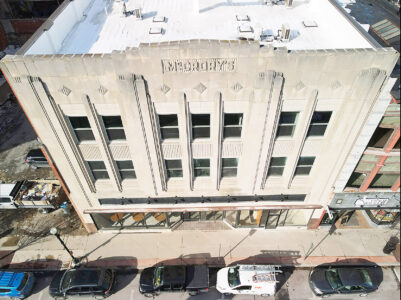
- The former McCrory’s building at 1306 11th Ave. in Altoona is the new home of Center City Market. Mirror photo by Patrick Waksmunski
-

- Center City Market developer Chris Cook looks through blueprints in the food court as the 1996 Altoona Area High School mural is seen behind him. Mirror photo by Patrick Waksmunski
-
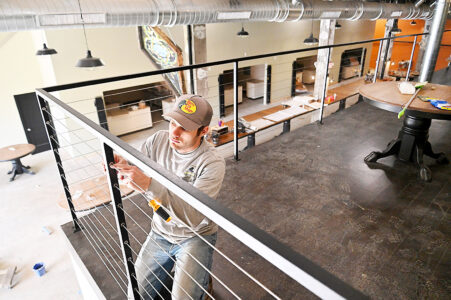
- Above, Evan Potter, owner of Potter Welding & Fabrication, Claysburg, works on the railing on the dining mezzanine at Center City Market. Mirror photo by Patrick Waksmunski
-

- Carpenter Charles Varner does chalking in one of the second floor apartment bedrooms at the Center City Market building downtown. Mirror photo by Patrick Waksmunski
-
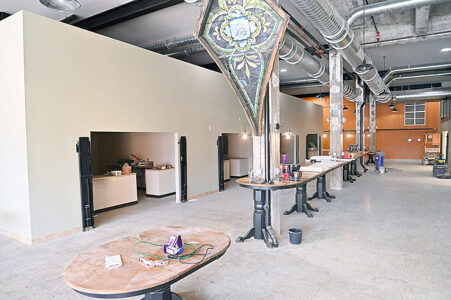
- in the former McCrory’s building. Mirror photo by Patrick Waksmunski
-
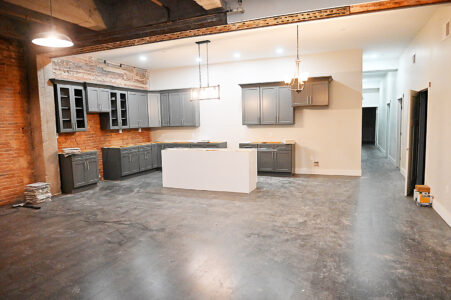
- The kitchen and living space is seen in a second floor 2,400-square-foot apartment. The building will offer two two-bedroom, one-bath apartments, at 1,100 square feet; four two-bedroom, two-bath apartments, at 1,400 square feet; and two four-bedroom, two-bath apartments, at 2,400 square feet. Mirror photo by Patrick Waksmunski
-
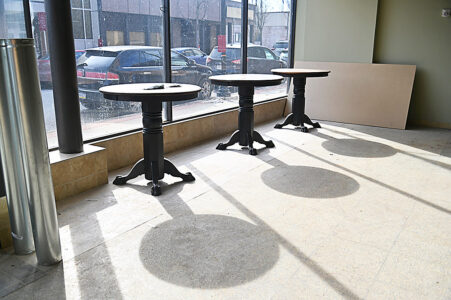
- Salvaged antique high and low tables will dot the food court. Mirror photo by Patrick Waksmunski
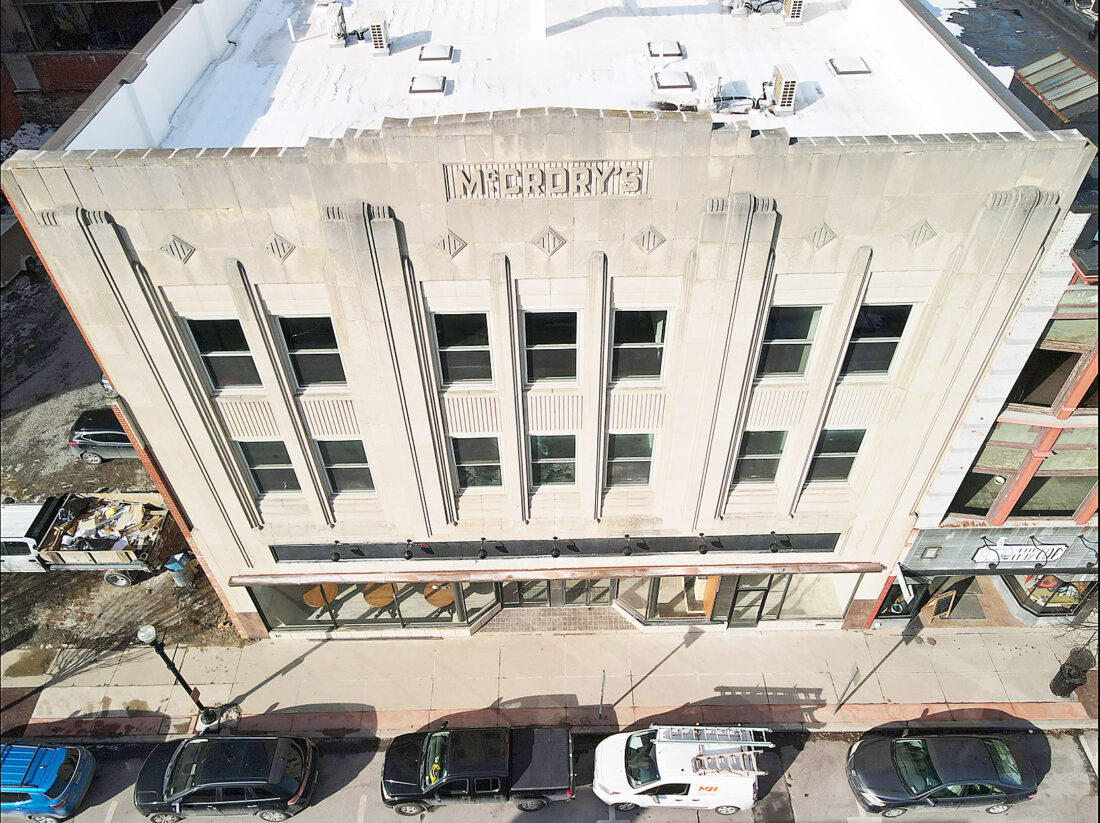
The former McCrory’s building at 1306 11th Ave. in Altoona is the new home of Center City Market. Mirror photo by Patrick Waksmunski
A major downtown building that first became vacant about 1989 — and that eventually became a troublesome burden on city government — is about to become an asset for Altoona once again.
Developer Christopher Cook expects to open a first-floor food court and upstairs apartments within a month in the former McCrory’s 5 & 10 — the result of a $2.5 million renovation.
The Center City Market food court will consist of seven businesses, while there will be four apartments on each of the two upper floors of the once-blighted building.
Despite owning about 100 properties and running 11 businesses, Cook was frequently discouraged and sometimes overwhelmed during the rehabilitation of the three-story structure with a basement, he admitted Thursday.
“But I feel really great about it now, now that it’s almost done,” he said.
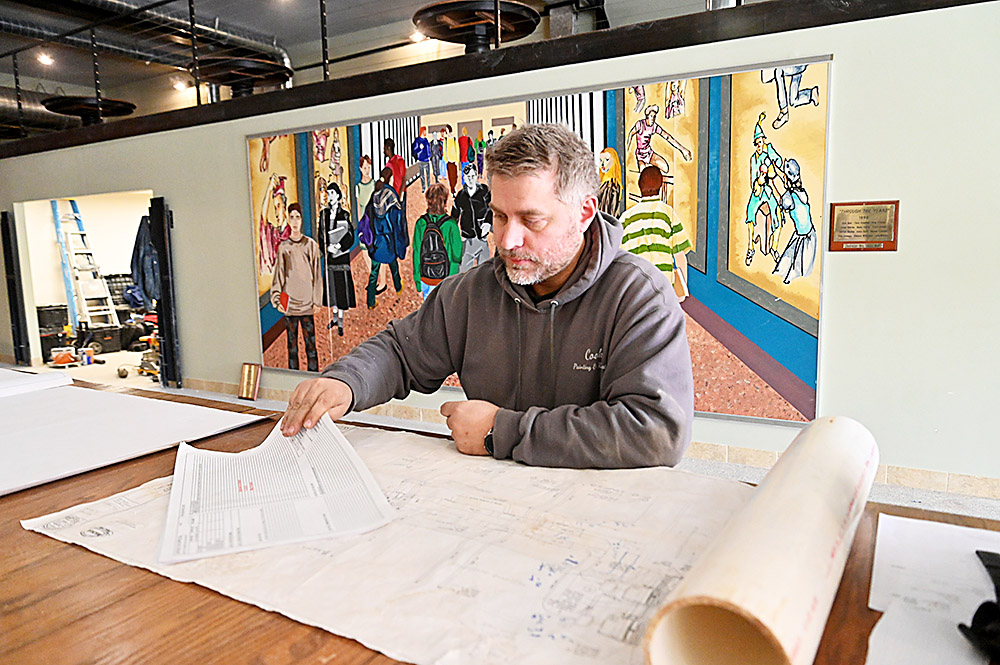
Center City Market developer Chris Cook looks through blueprints in the food court as the 1996 Altoona Area High School mural is seen behind him. Mirror photo by Patrick Waksmunski
Challenges included dealing with damage from roof leaks that had rotted all the rafters, all the surface flooring and significant portions of the subfloors and joists on the top two stories, he said.
He documented that damage with pictures he shared Thursday and previously posted on Facebook, showing the disarray and destruction.
It was also a challenge to be patient after the mess was cleared out and the framing was done to wait for the electrical, plumbing and HVAC work to be completed.
“I was feeling like (that) would never get done,” he said.
But after the drywall was installed, “everything changed,” he said.
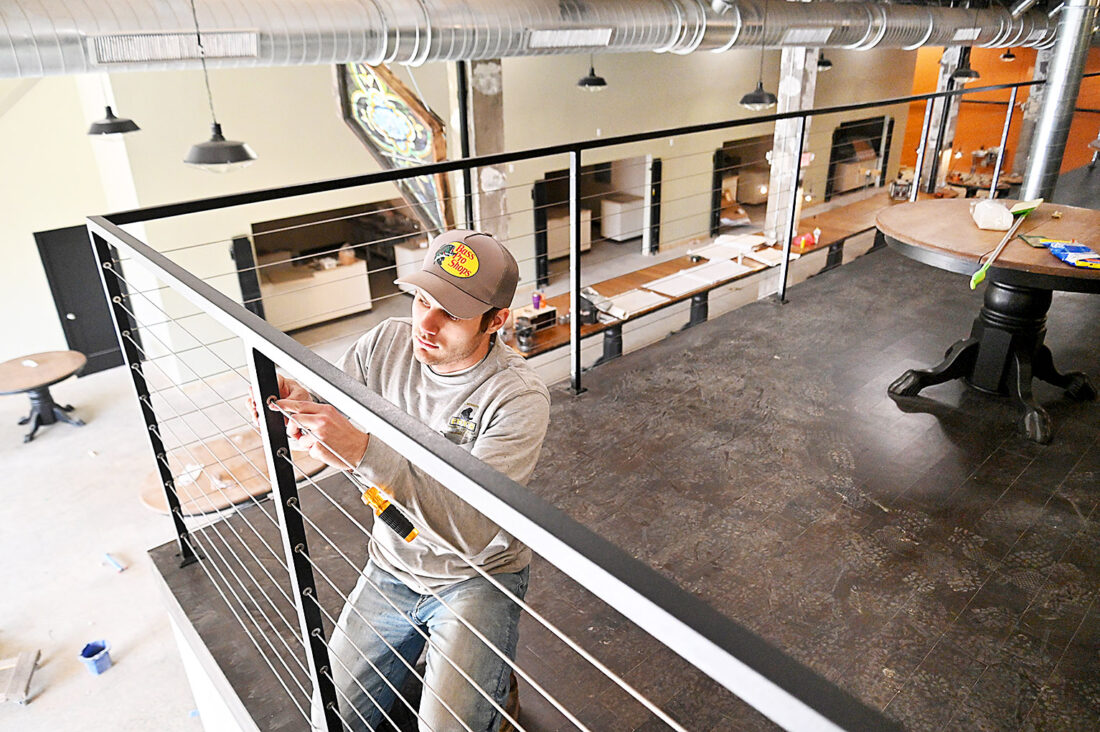
Above, Evan Potter, owner of Potter Welding & Fabrication, Claysburg, works on the railing on the dining mezzanine at Center City Market. Mirror photo by Patrick Waksmunski
His discouragement dissipated, and it seemed the project was well on the way.
There are always ups and downs in any major project, and the McCrory’s work occurred in what remains “a tough economy,” Cook said.
By the time he began the project, inflation had doubled the price of construction materials — forcing him to pay $20 a sheet for drywall, $50 a sheet for plywood and $50 a gallon for paint, he said.
“It shouldn’t have cost this much,” he said.
Even so, he could have done the work less expensively, but didn’t, because he wanted it to be “high-end,” he said.

Carpenter Charles Varner does chalking in one of the second floor apartment bedrooms at the Center City Market building downtown. Mirror photo by Patrick Waksmunski
Cook kept the 11-foot ceilings in the apartments.
He reinstalled hardwood flooring in the apartments, so that there are two inches of wood beneath tenants’ feet.
He kept the existing terrazzo on the first floor — a material that is virtually “indestructible,” he said.
The renovation cost as much as it would have to build an equivalent building from “scratch,” Cook said.
While a renovation provides an advantage because it begins with an existing structure, there are lots of things in those structures that aren’t plumb or level or square and that thus need to be altered or worked around.
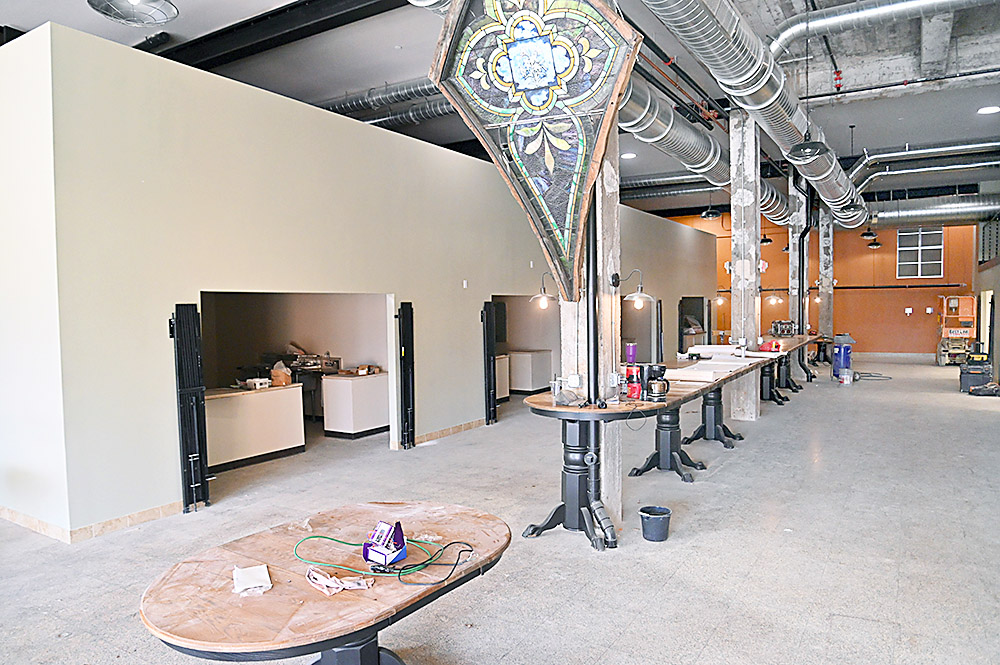
in the former McCrory’s building. Mirror photo by Patrick Waksmunski
Moreover, new construction doesn’t require demolition — like that required by the rotting of so many materials in the McCrory’s building, he said.
New construction also doesn’t require dealing with problems like the five-foot deep pool of water he found in the basement of McCrory’s — an issue that was created by groundwater.
He solved it the way that previous owners had solved it, by installing new sump pumps in holes that had been made for that purpose, he said.
With new construction, the builder has full control, Cook said.
With McCrory’s, all 42 windows had to be custom-made, including the 16 that went into openings that renovation workers cut through the masonry walls — which are two feet thick in front and 18 inches thick on the sides.
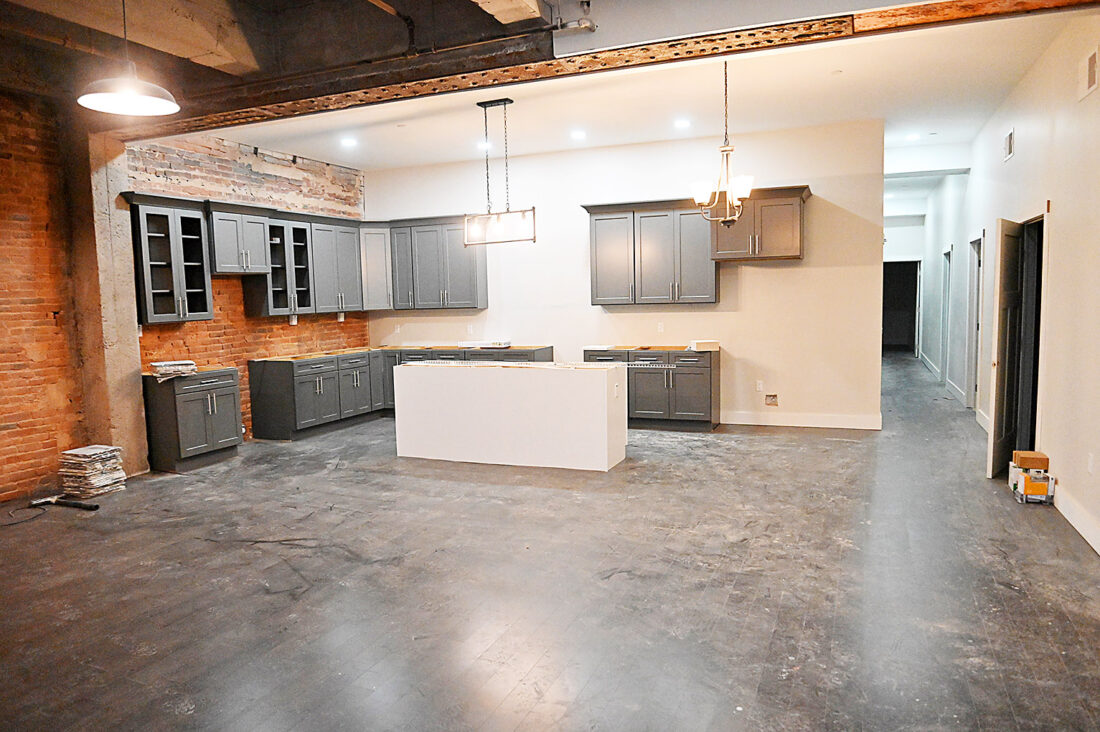
The kitchen and living space is seen in a second floor 2,400-square-foot apartment. The building will offer two two-bedroom, one-bath apartments, at 1,100 square feet; four two-bedroom, two-bath apartments, at 1,400 square feet; and two four-bedroom, two-bath apartments, at 2,400 square feet. Mirror photo by Patrick Waksmunski
Given the positioning of mortar joints and other factors, it wasn’t possible to fully standardize those cuts, he said.
“Properties like this are not for the faint of heart,” Cook said.
He was asked about the personal energy required to sustain momentum through such a project.
“God gave it to me,” he said. “It’s what’s in me.”
He had a vision for the market arrangement early on, realizing it on paper, using the skills developed as a theater set design major at Shenandoah University in Virginia.
The physical reality in the building corresponds closely to what he drew.
He also designed the apartment interiors.
An architect formalized all the designs to ensure they complied with code.
In addition to being “a visionary,” he is also a worker, he said.
He was sweeping the first floor prior to Thursday’s interview, as employees of his company worked on a mezzanine staircase and in a second-floor apartment.
Partway through the renovation project, Cook sought and received help from fellow developer Jeff Long, who now owns 51% of the project, with Cook owning 49%.
At the time he arranged for that help, Cook felt he had too much financial “exposure,” he said.
Long, who’s been at project development longer and has a larger portfolio of properties, has more “equity,” Cook said.
Despite Long’s ownership majority, Cook has the freedom to do the project as he sees fit, Cook said.
The project is privately financed, except for $175,000 in Historic Preservation Tax Credits.
Cook obtained the property in 2022 from the city Redevelopment Authority.
The renovation of the building is actually the third such (at least) for the structure, which was constructed in the 1880s as a four-story, but burned in the 1930s and was remodeled into a three-story at the time, Cook said.
Mirror Staff Writer William Kibler is at 814-949-7038.
In the Market
First floor
The Center City Market on the first floor of the former McCrory’s building will consist of:
PJ’s Food Shack, for burgers, fries and breakfast; PJ’s Subs and Salads; The Bowl Station, a Mexican restaurant; Philly Pretzel Factory, a bakery for soft pretzels; The Market Basket, owned by Cook, which was formerly LaJo’s in Little Italy, where production will remain; The Juice Shack, for smoothies, fruit bowls and freshly squeezed juices; and Woody’s Lodge Winery, for sales of wines made in that company’s Ashville location.
There is seating for 70 in the central common area at a long bar-style table constructed by linking the leaves of a set of circular tables with two-by-six frame structure.
The circular tables provide additional seating for 40 on a mezzanine on the right side of the main lobby floor.
The Center City Market will have a liquor license based on Woody’s, although only Woody’s will sell alcohol.
Upstairs
Two two-bedroom, one-bath apartments, each 1,100 square feet; four two-bedroom, two-bath apartments, each 1,400 square feet; two four-bedroom, two-bath apartments, 2,400 square feet.
All have central heat and air conditioning via heat pumps, with separate thermostats and hot water tanks.
The brick of the exterior walls has been left exposed where possible. Renovation workers cut skylights in the roof to provide additional natural lighting for the third-floor apartments.
Rents are $1,500, $1,750 and $2,000 per month, including all utilities, trash, high-speed internet, parking pass to the Transportation Center garage and appliances — including washers and dryers.
There are video doorbells and a keyless entry system, with fobs to get into the building and a numeric code to enter the apartments.
An elevator will be installed in a pre-existing shaft.
The 7,500-square-foot basement, which has a concrete floor, concrete walls and a concrete ceiling, may be rented by a business that doesn’t want to be identified yet.
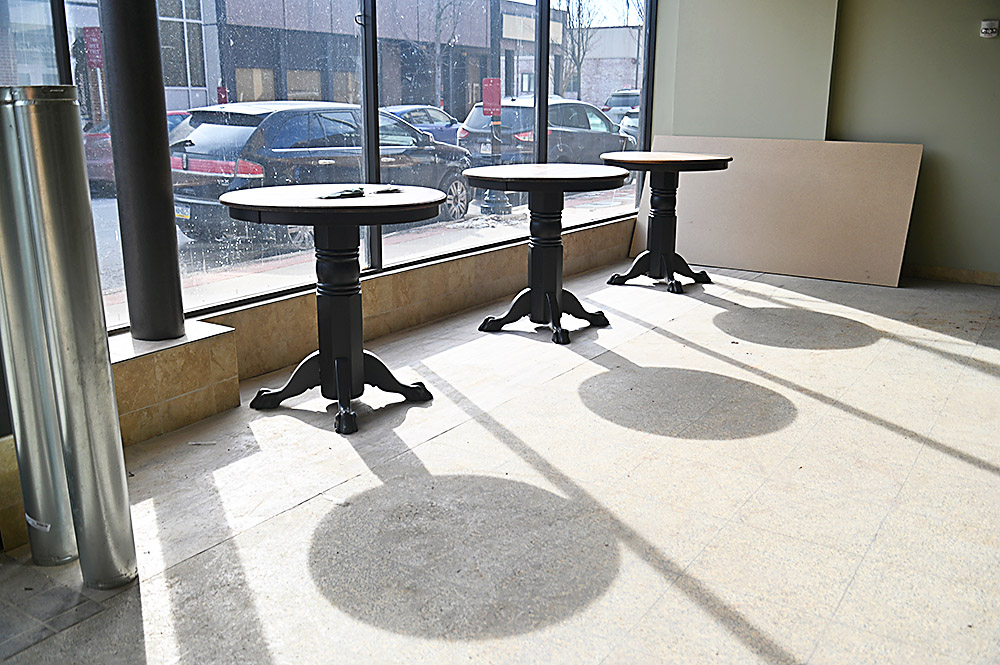
Salvaged antique high and low tables will dot the food court. Mirror photo by Patrick Waksmunski
Local News

Pedal pushers
Altoona Redevelopment Authority obtains first home through eminent domain in years
The Altoona Redevelopment Authority has obtained its first property by eminent domain in many years. It’s a ...
House bill would let drivers carry licenses on phones
Pennsylvania motorists would be able to use digital versions of their driver’s licenses and vehicle registration ...
Pedal pushers
Data center water measure clears Pennsylvania House panel
The House Environmental Resources and Natural Protection Committee approved legislation Monday requiring reporting ...
Pennsylvania Superior Court upholds conviction for child sex offender
The conviction and prison sentence imposed on a Huntingdon man for the sexual assault of an 11-year-old girl that ...