
Rapid response: Williamsburg, Geeseytown fire companies undergo ice rescue training
Williamsburg, Geeseytown fire companies undergo ice rescue training
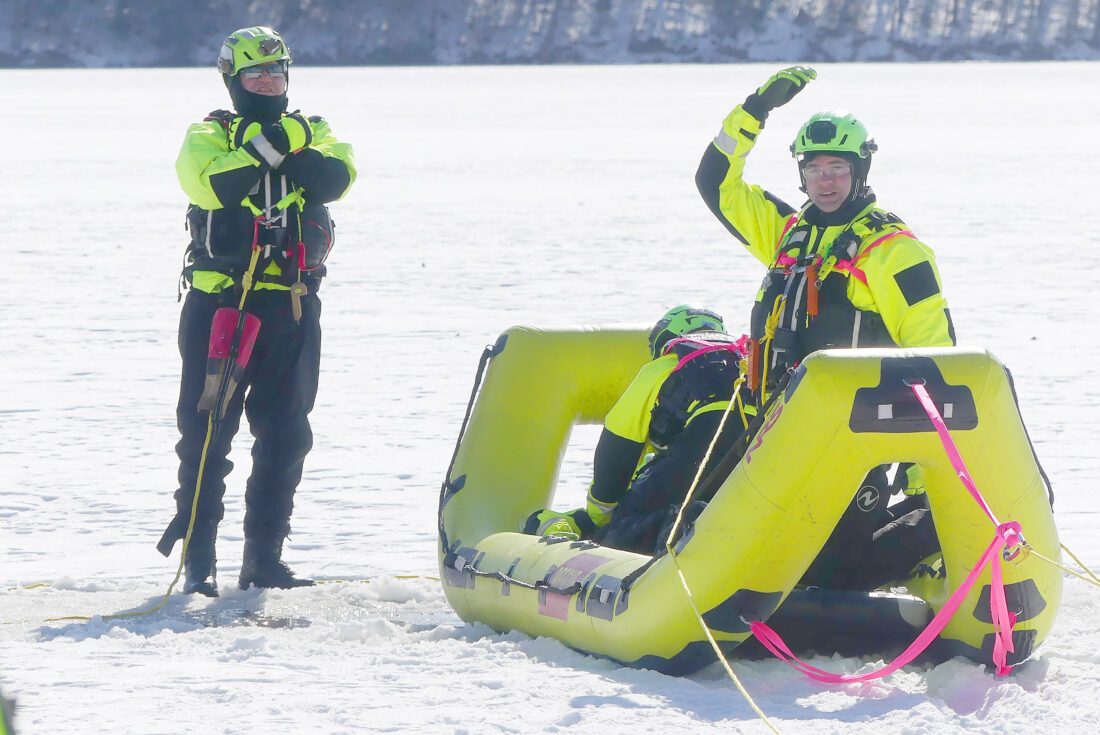
Instructor Scott Grahn (left) and Williamsburg Assistant Fire Chief Jonathan Isenberg (right) signal to not pull the rapid deployment craft ashore during the ice rescue training day for Geeseytown and Williamsburg fire companies at Canoe Creek State Park on Sunday. Mirror photo by Rachel Foor
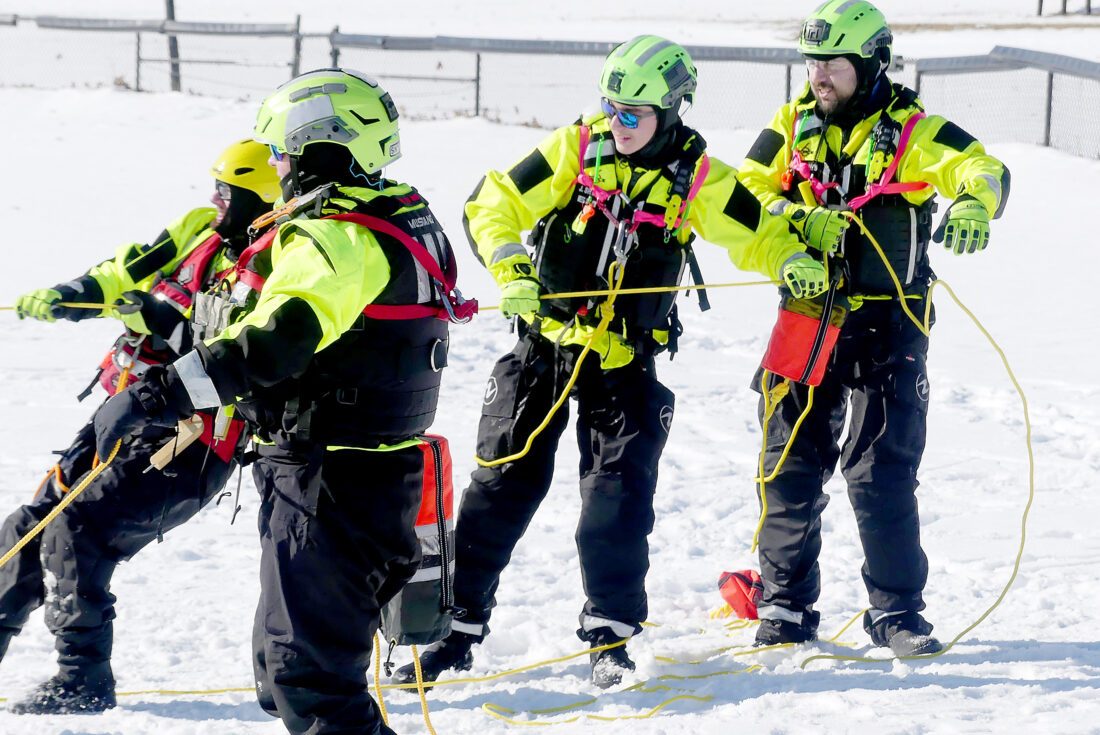
Members of the Geeseytown and Williamsburg Volunteer Fire Companies pull the rapid deployment craft ashore during their ice rescue training day at Canoe Creek State Park on Sunday. Mirror photo by Rachel Foor
Instructor Scott Grahn (left) and Williamsburg Assistant Fire Chief Jonathan Isenberg (right) signal to not pull the rapid deployment craft ashore during the ice rescue training day for Geeseytown and Williamsburg fire companies at Canoe Creek State Park on Sunday. Mirror photo by Rachel Foor
Members of the Geeseytown and Williamsburg Volunteer Fire Companies pull the rapid deployment craft ashore during their ice rescue training day at Canoe Creek State Park on Sunday. Mirror photo by Rachel Foor
Trending
CANOE CREEK -- If you ever fall through ice into freezing waters, knowing the one-ten-one rule can save your life -- and now so can the Geeseytown and Williamsburg Volunteer Fire Companies after undergoing ice rescue training at Canoe Creek State Park Sunday morning.
"It's one of those specialties where it's high risk, low volume," Geeseytown Captain Garrett Miller said. "So when it does occur, there's a huge, high risk to it, but it doesn't happen too often."
Scott Grahn, a swiftwater rescue instructor with the state Fish and Boat Commission, gestured toward Canoe Creek Lake, where ice fishers could be seen dotting the horizon. He said they usually aim to train teams before times like this because "as the season goes on and the warmer weather kicks in, what it does is, it attracts people."
During the team's training, each member took turns practicing pulling themselves out of a hole cut into the 10-inch-thick ice to safety. Once in the water, Grahn asked each person if they were okay several times before instructing them to "get out of bed" -- hook a foot on the ice behind them and roll flat onto the surface.
"Once you fall through ... it would be like going into a shower and turning on cold water," Grahn said. "You get that involuntary gasp."
That's the first "one" of the one-ten-one rule.
"It's one minute to gain your breath," said Jonathan Isenberg, assistant chief at Williamsburg.
Then you have 10 minutes of "viable movement" before the cold starts to affect your muscles, Grahn said, and after that, you have about one hour to survive. He noted survival can depend on the clothing the person is wearing and the one hour rule is if they have a personal flotation device.
The rescue team was outfitted with ice picks, for help pulling themselves out of the water, and throw bags, to be easier to reach or reach someone else.
"Then, if all else fails, what we tell them to do until help gets there is dunk your hands, your arms, in the water and freeze them to the ice, because you can still breathe as long as you're on top," Grahn said. "If you don't, and you fall through -- you can't breathe underwater."
Grahn said people will ask him how they can buy more time, to which he replies that buying more time "could be them blowing the siren on their way getting here for the people to realize help is coming."
Ice rescue training comes with many factors, such as their suits being thermally protected, Grahn said.
Williamsburg and Geeseytown obtained the ice rescue suits and equipment through the South Central Mountains Regional Task Force, which, in addition to Blair County, consists of Bedford, Centre, Fulton, Huntingdon, Juniata, Mifflin and Snyder counties. Isenberg said the suit and gear cost about $2,500 per member, Isenberg said.
"The task force is part of the state," Isenberg said. "Departments can get together that want to be involved with it and they're able to get equipment that they otherwise wouldn't be able to get."
Isenberg said the task force has an agenda and "spent five years trying to supply the area with water rescue equipment."
"They've met that need," Isenberg said. "Now they're trying to move on to technical rescue."
Miller said the task force also enables them to "pull assets from all those different counties" instead of only having one or two stations at their disposal.
About two or three years ago, in addition to the task force, the Williamsburg and Geeseytown fire companies decided to pool their resources to form a water rescue team -- the only one in Blair County, Miller said.
"When we have more resources, we can do a lot more," Miller said. "If something happens, we have backup. We have more manpower because something like this can take a lot of people."
Isenberg agreed, saying "you can't do it on your own."
"A typical call, you might get five or six from a department, depending on the time of day," Isenberg said. "So when you have more departments training together and coming together, you get a lot more people. You can't do this with six people."
It definitely took more than six team members to haul in the rapid deployment craft, an inflatable boat that can be used in an ice rescue. The Williamsburg Volunteer Fire Company received a PA Skills Charitable Giving grant for about $3,400 in August with the help of state Sen. Judy Ward, R-Blair, to fund the purchase of the craft.
To simulate an ice rescue, Miller would wait in the water while two team members would run toward him with the craft. They would then set the craft in front of Miller and, while one member secured Miller through an opening in the craft, the other member would wait before signaling to the members on shore to begin pulling the craft. Once Miller was out of the water, the scene would reset, with team members cycling through their positions.
When asked if he was cold from constantly going in and out of the water, Miller said "no, not at all," with Grahn adding the only thing that might get cold are their gloves.
"It doesn't just have to be used for ice rescue," Grahn said about the suits. "It can be used for different things other than water rescue, even though they're considered dry suits because they're thermally protected."
He pointed out that the boat was the same way, as it was durable enough to be connected "onto the back of a snowmobile and pull someone out of the mountains."
"So it makes (the team) more valuable, not only just to their own community, but to the region," Grahn said.
For more information on how to become a part of the water rescue team, reach out to your local station, Williamsburg or Geeseytown.
"Applications are always available," Miller said.
Mirror Staff Writer Rachel Foor is at 814-946-7458.