
Scientist’s startup blends family legacy, innovation
EcoIslands uses microorganisms to clean polluted ecosystems
Trending
From a small shop in his Altoona home, to his new workshop in Juniata and at dozens of sites across the country and even in orbit, environmental scientist Colin Lennox sees a bright future for his home-grown bioremediation company EcoIslands.
Founded in 2009 after his graduation from Penn State Altoona, the 501(c) for-profit startup is Lennox's life's work, focused on harnessing microorganisms to hasten natural metabolic cycles to cleanse polluted ecosystems.
Lennox's EcoIslands was inspired by the principle of a previous company he worked for, with key innovations that allow his distinct black remediation boxes to be applied in a wide variety of circumstances.
Family legacy
The unspoken presence in the room for Lennox is his father, John Lennox, a doctor of botany from the University of Chicago, who taught biology at Penn State Altoona for more than three decades. Lennox passed away in 2017.
He was a major influence during Lennox's formative years.
"He was an Eagle Scout and I got my Eagle Scout (award)," Lennox said.
His influence carried most explicitly into Lennox's work with EcoIslands, since the company relies on many of the same scientific principles his father studied.
"I essentially inherited the family business, which is biology and science," Lennox said. "Dad was also a member of the business all the way up to his passing, and his support, financially to a small part, intellectually to a large part, and as my pops, as the most important, gave me the fortitude to carry on."
As a scientist himself, Lennox said he values his father's contributions as a biologist and botanist. "He was as much of an educator as he was a researcher, and his major work was on teaching about biofilm," Lennox said, "and he taught me about biofilm science."
Biofilm is the collection of microorganisms and organic matter that cover most surfaces, but is typically too small to see with the naked eye.
"It covers every square inch of the planet, it goes miles deep into the crust and goes all the way up to the stratosphere," which makes up a substantial portion of the total biomass of the planet, Lennox said.
But crucially, biofilm is responsible for up to 99% of the biological cycling in the global ecosystem, such as how dead plants will be broken down into carbon products.
These microorganisms and the metabolic cycles they support are invaluable to the overall health of the environment, Lennox said.
By creating an oxygen-free climate inside the box, Lennox said he can promote biofilm growth to increase the efficiency of their metabolic cycles, which can be used to filter out pollutants from waterways.
This concept can be applied to both point-source and nonpoint-source pollutants, Lennox said.
A point-source is when the source of contamination can be tracked to a specific vector, such as a pipe leaking oil into the ocean. While nonpoint-source refers to when the source of pollution is diffused throughout an entire area, and cannot be constrained to an individual vector.
Stopping pollutants at a point-source is typically more straightforward, Lennox said.
"You want to stop point-source before it becomes nonpoint-source, it becomes much more difficult to treat once the cat is out of the bag," he said. "Water treatment is the exact same way."
Essentially, Lennox's boxes are a controlled environment that uses biofilm to enable a highly efficient version of the metabolic pathways found in nature to distill harmful pollutants from water.
"I'm just building wetlands in a box," he said.
One of the benefits of this control, Lennox said, is that the operator can choose which specific pollutant to filter out depending on when oxygen is introduced to the system, since different microorganisms work better or worse depending on an anaerobic or aerobic environment.
Science and design
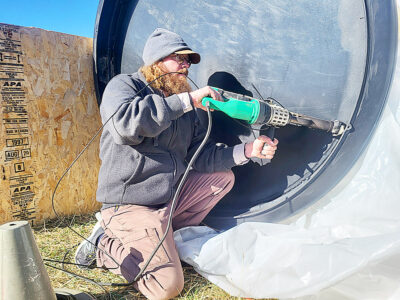
The fundamental component of the remediation box, Lennox said, is a cube formed from thermo-welded black plastic panels, filled with a proprietary organic filtration matrix and entry and exit pipes for water.
EcoIslands uses a naturally grown coir matrix harvested from coconut husks, as opposed to competitor products which use man-made materials, Lennox said.
The boxes are all built to order for each job EcoIslands is contracted for and vary in size and specific components for the requirements of the individual installation site, Lennox said.
They range from a single, smaller box placed next to a stream or a system of dozens of 5-foot-tall boxes scattered around an abandoned quarry.
This flexibility of design allows the boxes to be tailored to meet the specific needs of each site, and scaled up or down depending on the scope of the polluted area, Lennox said.
Since EcoIslands does the majority of its current business with the owners of commercial mining operations, Lennox said he has to spend a lot of time flying across the country to inspect and design the remediation system for each site.
The process can take more than three months, Lennox said, from the first meeting with a site owner to the final box installation, depending on the scale of the project.
The cost of a system can vary greatly, he said, but typically starts at about $10,000 for a smaller job.
Early years
It was a slow start for EcoIslands, Lennox said, since he was still developing his understanding of the science and figuring out the company vision.
For the first two years, EcoIslands was confined to small, local projects with floating boxes that could only process nonpoint-source pollution.
Lennox said he worked with the Altoona Water Authority on a number of small projects in the early days of EcoIslands, where he worked to prove his remediation technology.
At the time, Tobias Nagle was the manager of the Horseshoe Curve Water Treatment Plant, where he worked with Lennox.
According to Nagle, Lennox applied to provide an alternative water treatment system as a backup process in case the main process was interrupted or closed for maintenance.
"You need to have a plan B," Nagle said.
And while Lennox, ultimately, did not get the bid for the project, Nagle said he understood EcoIsland's vision.
"It's the nature, the physics, the science and the work he does just makes a place for it all to come together," Nagle said.
This wasn't Nagle's first encounter with the Lennox family, he said, as he had his father John as a lab instructor during his time as an undergrad at Penn State Altoona.
"I just know his dad is proud of him," Nagle said.
Floating to static
Lennox's big break came when a Department of Environmental Protection employee gave him the idea in 2011 to transition his floating boxes to static structures for use in larger cleanup projects, he said.
This change in format catalyzed an expansion for the company, Lennox said, allowing him to implement his technology at wastewater treatment facilities and a lucrative new market -- the commercial mining industry.
According to Lennox, mine owners have to meet strict federal DEP standards for the pollutants they release into the environment from mine drainage and runoff, so there is a continuous need for ways to control these pollutants.
The transition to focusing on mine waste cleanup versus wetland cleanup allowed EcoIslands to grow, finding new clients and taking on more jobs per year, Lennox said.
Having outgrown his home workshop, Lennox moved the EcoIslands headquarters to the refurbished silk mill building in Juniata this summer, and is currently outfitting the cavernous space to ramp up production capacity.
The roof of the facility will be fitted with a custom solar array from Groundhog Solar, to provide green power, Lennox said.
And while the workshop is still under construction, he has high hopes for its potential to grow the company.
According to Lennox, NASA is currently developing the next generation of biological life-support systems, which maintain the habitable environment for astronauts onboard spacecraft or orbital stations like the International Space Station, and longer missions to the moon or Mars.
Now that he has a firm grasp on the underlying science of biofilm-fueled metabolic cycling, Lennox said he is thinking about how this concept could be applied to a wider range of applications, including in orbit.
"We're basically an aerospace company these days, or trending toward that," Lennox said.
Mirror Staff Writer Conner Goetz is at 814-946-7535.