
Blair DA seeks pay fairness, equity
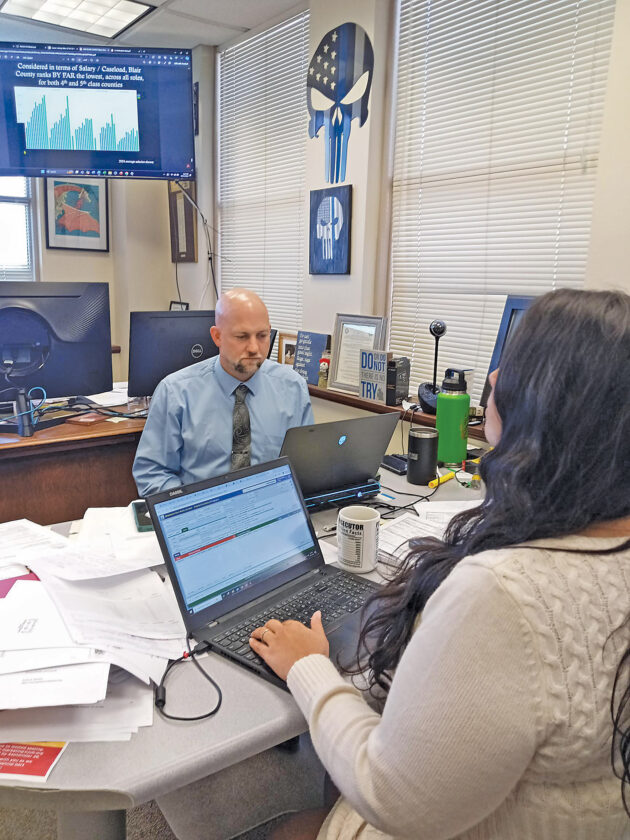
Blair County District Attorney Pete Weeks reviews salary study data with First Assistant Nichole Smith in office at the Courthouse. On the TV screen displaying the data, the lower bars represent the pay levels in the Blair County DA office, compared to other 4th and 5th class counties. Mirror photo by Kay Stephens
HOLLIDAYSBURG — Blair County District Attorney Pete Weeks said recently that he’s not asking county leaders to increase real estate taxes to address pay inequities that persist in his office.
“But our expectation is that they address our issues fairly,” Weeks said in his Blair County Courthouse office where he and First Assistant Nichole Smith shared the results of their office’s pay study.
The results showed those working in the DA’s office — attorneys, detectives, office manager, case manager, sentencing guidelines coordinator and other staff — are on the bottom or close to the bottom of pay levels in comparison to their counterparts in 13 counties ranked as fourth or fifth class, based on populations similar to or slightly larger than Blair County’s population.
The study also found Blair’s workload is heavier, too, based on higher amounts of criminal cases filed annually.
For years, county employees and department representatives have complained about low pay, something that prior commissioners tried to address with a $75,000 salary study and the introduction of job classifications and pay scales. But that study released in 2021, with data collected prior to the COVID-19 pandemic, continues to draw criticism and has been described as outdated.
About a year ago, commissioners set aside money in the 2024 budget for updating the county’s salary study, but in June, the commissioners board of Dave Kessling, Amy Webster and Laura Burke said they wouldn’t contract that work to an outside agency.
Instead, they asked for department heads and supervisors to collect and submit information for in-house reviews of employee pay.
The responses submitted included one from Weeks, who summarized the collected data in a 28-page document. On Tuesday, Kessling described the matter as “a complicated issue” that commissioners have been reviewing with staff from the finance and human resources departments.
He also drew support from Burke for allocating $2.14 million in three contingency funds that would be available to cover pay increases in 2025 for two groups of unionized employees whose contracts are expiring and for non-union employees, who for the last two years received annual pay increases in June.
Kessling, in supporting the allocation that is one factor contributing to a proposed 8% real estate tax increase for 2025, said that the county’s low pay and pay inequities are issues that the current board inherited from prior boards.
“Do we want to stay status quo or try to resolve an issue that’s been handed to this board?” he asked.
Webster, who referenced ongoing efforts to control spending and cut expenses, spoke of a potential fallout if those efforts are abandoned.
“If we’re unable next year to keep paring down some departments and save some money … then next year we’ll have to make cuts and departments will have to figure out how to live within that number,” Webster said Tuesday.
As for employee pay raises in 2025, amounts will depend on negotiated union contracts approved by the commissioners. Nonunion raises will fall to the county’s salary board — composed of commissioners, Controller A.C. Stickel and elected department heads — who will be expected to evaluate pay raise requests and consider the options.
Based on information in the DA’s study, that could require more work than just elevating bottom-range pay levels to middle-range pay levels because he’s also seeking equity.
For instance, the research inside the DA’s study shows the county’s court-appointed attorneys getting $250 to $500 for a case, while the prosecutors in the DA’s office — based on their salaries and heavy case levels — get $20 to $50 a case.
“That alone should send up a red flag,” Weeks said.
The study also revealed that the DA’s pair of detectives — while paid less than their counterparts in other fourth- and fifth-class counties — are also earning $25,000 or more less than what local law enforcement agencies are paying their detectives.
Another issue that has surfaced is the county’s use of grant money to award retention and recruitment bonuses to employees. During a September salary board meeting, the board approved $2,500 retention bonuses to two administrative assistants in the public defender’s office and a $2,000 recruitment bonus to a third office employee.
Weeks, who participated in that meeting by phone, referenced the lack of comparable pay rates for the staff in his office.
When acting on the public defender’s request, salary board members referenced the county’s receipt of an Indigent Defense Grant Program introduced by Pennsylvania to cover the bonuses.
“I’m not saying the county should just go out and spend a lot of money,” Weeks said. “But if you’re doing something with grant funds for one office, then why not do it for another?”
That debate has been going on for a long time in the DA’s office, where Weeks’ predecessor, Richard Consiglio, tried to get higher salaries for those who work in the victim/witness unit because grant money was available.
Prior county leaders declined to increase the victim/witness salaries based on perceptions about job duties. They also expected those equities would be addressed in the county’s salary study but they weren’t. Weeks said his office continues to return a portion of its available grant funding for the victim/witness employees because higher salaries have yet to be approved.
When Kessling spoke Tuesday of contingency funds in the 2025 budget for addressing pay raises, he mentioned that based on the information submitted by the department, their requests were not excessive.
“They’re asking to be equal to what other counties are paying,” the commissioner said.
Kessling also referenced his desire to curb the county’s high turnover of employees, thereby saving the effort and expense that goes into training new employees.
In reviewing the DA’s study, First Assistant District Attorney Nichole Smith spoke of a statewide survey identifying heavy caseloads and low pay as the most significant reasons for prosecutor resignations from district attorney offices.
Weeks counted six assistant district attorneys who have left Blair County’s employment since 2018 for higher-paying prosecution jobs in other counties or to work with nonprofit agencies.
“I’m not saying our county’s pay levels should be competitive with private law practices,” Weeks said. “But we should be competitive with other county DA offices our size and with nonprofit offices in our own community.”
The study identified Blair County’s starting prosecutor salary at $50,500 annually in 2024, based on the last union contract. In other fourth- and fifth-class counties, the average starting salary for an assistant DA is $62,463 annually.
Mirror Staff Writer Kay Stephens is at 814-946-7456.
Local News
Convicted killer appeals life-without-parole sentence in 2002 Altoona stabbing deaths
Altoona native William Darwin Thompson, 44, in a federal petition, last July challenged his conviction and life ...
Tyrone-area resident will stay on Blair County Planning Commission
HOLLIDAYSBURG — Tyrone-area resident Todd Lewis will retain his seat on the Blair County Planning Commission, as ...
Developer Long renovating Penn Central building downtown
Trump seeking $1.5 trillion for defense in budget
WASHINGTON — President Donald Trump has proposed boosting defense spending to $1.5 trillion in his 2027 budget ...
Senators target Pa. Turnpike toll scofflaws
Two Republican senators are drafting legislation to toughen penalties for repeat toll scofflaws on the Pennsylvania ...
Libraries get $11 million in grants from state
The Pennsylvania Department of Education Office of Commonwealth Libraries awarded more than $11 million to 27 ...