
Leaders to commemorate 50 years of Raystown Dam
Trending
HUNTINGDON -- More than 50 years ago, hundreds of people lost their homes and land when the U.S. Army Corps of Engineers built the Raystown Dam to mitigate flooding of the Raystown Branch of the Juniata River.
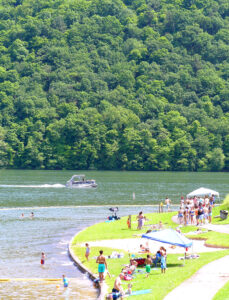
Today, the result of that dam -- Lake Raystown -- is a mecca for watersports and outdoor recreation, and brings tourism dollars to not only Huntington County, but Blair, Bedford and surrounding areas.
This week, the Army Corps of Engineers, along with state and local officials, will commemorate the 50th anniversary of the dam's dedication.
Dedicated on June 6, 1974, by then-Vice President Gerald Ford, the dam was constructed to disrupt the flow of the river and form Raystown Lake to help with flood mitigation downstream.
It was not the first dam constructed in Raystown, though, with the first sitting about 240 feet underwater and "pretty far back" from where the current dam stands, according to Margaret Skrivseth, executive director of the Huntingdon County Historical Society.
The first dam was built between 1909 and 1910 for hydroelectric power, when a group of businessmen from Huntingdon pooled money for its construction, Skrivseth said.
"It was probably about a quarter of the size that the current Lake Raystown is and many people had cottages along the lake for summer getaways," she said.
When a flood damaged the old dam in 1936, the U.S. Army Corps of Engineers began eyeing the site for a federal dam project. It wasn't until about 1968 that planning for the new Raystown dam would begin in earnest, with the government purchasing family farms, vacation cottages, homes and land that would be underwater once the lake was full.
Skrivseth estimated that between 300 to 400 properties were taken.
"People were paid for their properties, but there's still a lot of hard feelings for people whose land got eminent domained," Skrivseth said.
History of flooding
The first well-documented flood that devastated the area was in 1889, when the Johnstown Dam ruptured.
"That same flooding event caused the Juniata to flood here," Skrivseth said. "The next really bad flood was in 1936 and it was also, I believe, hurricane related."
The new dam's flood mitigation was put to the test when, in 1972, Hurricane Agnes swept through the area.
"There was huge flooding in the area and, even though the current dam wasn't complete, it really helped prevent a lot of damage further downstream," Skrivseth said. "So it definitely does what it is supposed to do."
Before construction on the new dam began, Skrivseth said a Paleo-Indian archaeological site was found and excavated by Penn State University in the late 1960s.
"They found a lot of stone tools and different things," Skrivseth said. "It was important in that it showed what kinds of animals people were eating and that people had been living here as far back as 12,000 years ago."
Once everything from the site was removed, the lake was able to be filled.
Recreation a focus
While possible recreational opportunities afforded by a larger Raystown Lake were secondary in the minds of the U.S. Army Corps of Engineers, it quickly became Huntingdon County's focus.
Lincoln Caverns' President and General Manager Patricia 'Ann' Dunlavy, whose family owns the show-caves, said they have been involved in the promotion of Raystown Lake for more than 50 years.
"While the lake was still under construction, a group of business people from the area met to form our first Tourist Promotion Area to market the lake and surrounding area," Dunlavy said. "Still a college student at the time, I was involved since the inception of this group."
Dunlavy said by the mid-1970s, Raystown Lake was attracting more tourists to Huntingdon County than ever and, as the region became "a vacation destination rather than just a stopover," Lincoln Caverns saw a steady increase in visitors.
"In fact, approximately 50 percent of the summer visitors to the caverns list Raystown Lake as their main destination," Dunlavy said.
In 1984, Dunlavy said the Caverns partnered with Seven Points Marina to offer a Halloween package tour for bus groups that would include a cruise on the lake and a haunted tour of the Caverns and Whisper Rocks.
The joint venture no longer exists, but the haunted tour is entering its 41st year and welcomes about 500 visitors a day over October weekends, Dunlavy said.
DelGrosso's Amusement Park and Laguna Splash Water Park has similarly been a part of the Huntingdon County Visitors Bureau for more than 20 years and keep the county's guides in their parks' information booths for guests to take, according to DelGrosso's Park President Carl Crider Jr.
"With Raystown Lake being the largest lake in the state and home to over 3,000 campsites, those visitors often will take a break from the lake and come spend a day or two at the park," Crider said.
The park also shares its own information in the Huntingdon County Visitors Guide and takes part in the Raystown Wake Up Receptions that the bureau hosts. These receptions occur throughout the summer months and afford businesses and tourist destinations the opportunity to put on a mini showcase of activities and locations that are available in the region, Crider said.
"Camping guests attend these receptions and have a chance to see some of the great places they can visit just miles from the lake," Crider said.
At the Huntingdon County Arts Center, the Arts Council is holding an exhibit based on the theme "50 Years of Lake Raystown." Running until June 8, the exhibit features a variety of artwork, from quilting to photography to oil on canvas to digital drawing.
There are 34 pieces on display at the Arts Center, the largest being a paper mural of Raystown Lake created by the students of Standing Stone Elementary School.
Events slated
Matt Price, executive director of Huntingdon County's Visitors Bureau, said that while he didn't grow up in the Raystown area, his dad and grandparents grew up in Altoona.
"My grandpa would rent a boat and take it out on the lake for a day," Price said.
That made them a part of the roughly 1.6 million visitors going to Lake Raystown every year, recorded by the Corps of Engineers.
"The Corps of Engineers defines visitors differently," Price said. "Anyone who crosses onto the property -- they have car counters and formulas to count these things and the visitors bureau would define it as someone who travels at least 50 miles."
Price said by the visitors bureau's estimations, the lake attracts about 2.4 million visitors to the county, with swimming as its main activity. There are also venues to lease for events such as weddings.
For more adventurous types, there's scuba diving, although Price warned that visibility is poor past a depth of 10 feet.
"The original dam -- the old dam -- is under the new dam and any scuba diver would need deep water certification," Price said. "There are Raystown divers that do have that certification and have made multiple dives and mapped out under the water."
Price said the 50th anniversary of Raystown Lake began in October 2023, as the dam was completed in 1973. Events recognizing the lake's impact on the region will run through September, with the highest number of events occurring now through June 9.
"There will be things going on every day," Price said. "A couple cool things -- the lake is big, it stretches for about 26 miles and because of that, we're making sure the whole area gets to do commemorations."
Price said Lake Raystown Resort will have a boat parade on June 8 that will follow "the shore line until it concludes."
A car show, ticketed hot air balloon rides, a dance, a drone and fireworks show and ticketed tours of the dam spillway, among other events, will be held as well, Price said.
The historical society will also be hosting its annual fundraiser on Sunday, June 2, with speakers, including a property owner who had his farm taken for the project.
For more information and a complete list of events, visit raystown.org.
Mirror Staff Writer Rachel Foor is at 814-946-7458.