
Brothers in arms: Seabees ‘family’ reunite for 20th anniversary of deployment to Iraq
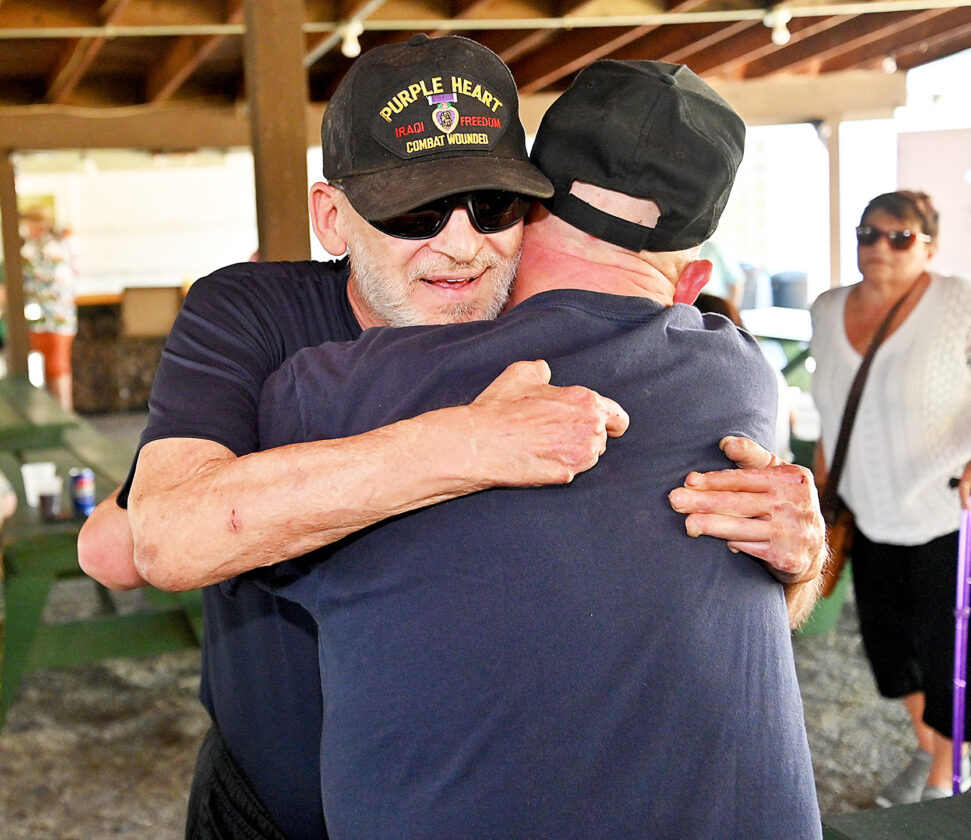
Former Altoona native BUCS Bob Westover (left) of San Antonio, Texas, is greeted by SW1 Dave Behe of Altoona at the NMCB 23 Seabee Battalion reunion at the Unter Uns Musical & Entertainment Society in Altoona on Friday. Mirror photo by Patrick Waksmunski
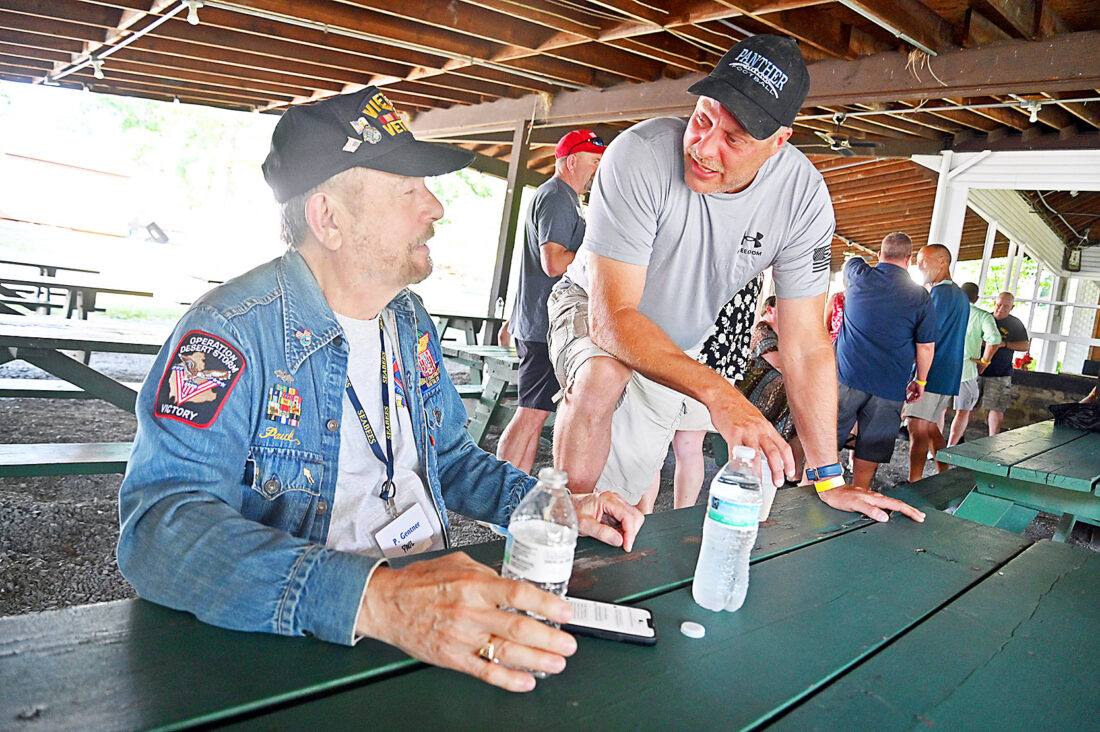
EOCS Paul Gentner (left) of Baltimore and CE1 Harold Britton of Gallitzin trade stories of their eras during the NMCB 23 Seabee Battalion reunion at the Unter Uns Musical & Entertainment Society in Altoona on Friday evening. Mirror photo by Patrick Waksmunski

BU2 Eric Hurley (left) of Lancaster and CM1 Shawn Leydig of Hollidaysburg talk during the NMCB 23 Seabee Battalion reunion at the Unter Uns Musical & Entertainment Society in Altoona on Friday evening. Mirror photo by Patrick Waksmunski
Former Altoona native BUCS Bob Westover (left) of San Antonio, Texas, is greeted by SW1 Dave Behe of Altoona at the NMCB 23 Seabee Battalion reunion at the Unter Uns Musical & Entertainment Society in Altoona on Friday. Mirror photo by Patrick Waksmunski
EOCS Paul Gentner (left) of Baltimore and CE1 Harold Britton of Gallitzin trade stories of their eras during the NMCB 23 Seabee Battalion reunion at the Unter Uns Musical & Entertainment Society in Altoona on Friday evening. Mirror photo by Patrick Waksmunski
BU2 Eric Hurley (left) of Lancaster and CM1 Shawn Leydig of Hollidaysburg talk during the NMCB 23 Seabee Battalion reunion at the Unter Uns Musical & Entertainment Society in Altoona on Friday evening. Mirror photo by Patrick Waksmunski
Trending
Members of the 23rd Naval Mobile Construction Battalion traveled across the country to reconnect during a two-day reunion this weekend in honor of the 20th anniversary of the unit's activation and deployment to Iraq in late 2004.
Veterans from the "Blue and Gray Battalion," gathered at Unter Uns, Altoona, for dinner and drinks on Friday night, before getting together Saturday afternoon for a group picnic at Legion Park in Hollidaysburg.
NMCB 23, affectionately self-described as "Seabees," was tasked with a wide variety of construction and infrastructure repair projects when they were deployed in support of the First Marine Expeditionary Force Engineering Group in Al Anbar Province, Iraq, during Operation Iraqi Freedom.
Their deployment coincided with the Second Battle of Fallujah in late fall 2004, which was among the most intense combat of the period, according to Mark Talasky, a retired senior chief petty officer, who helped organize the reunion.
Altoona was an obvious choice to host the reunion, Talasky said, because it was centrally located relative to the many detachments that made up the 23rd, which were drawn from communities across the eastern seaboard.
According to Talasky, while the 23rd was originally a reserve unit, they stepped up when their country called.
"What impressed me more than anything with most people in this battalion, is that they rucked-up man, they went, a lot of guys volunteered," Talasky said.
During his time in the 23rd, Talasky helped rebuild the airfield at Al Asad, repair damaged roadways across the country and helped set up polling stations for the January 2005 Iraqi National Assembly Elections, he said.
Since the 23rd was composed primarily of former civilian electricians, plumbers and construction workers, Talasky said, the unit held trade skills seminars for the local Iraqi population.
"As a reservist it's tough. ... Basically you left your civilian life and go to war. It was a big change for a lot of guys," Talasky said.
Not all made it home
Jerri Moyer's older brother, Bobby Jenkins, was only 19 when he joined the Naval Reserves, and was deployed to Iraq with NMCB 14 a little over a decade later in March 2004, she said. Jenkins would later die from hostile fire two months after deployment in the Anbar Province.
Jenkins had been with the 23rd until he moved to Florida to live closer to his father in Rockledge, Moyer said.
He was a fun, kind individual who would help anybody he could, Moyer said. "We were best friends -- we were the only two siblings so we hung around together all the time growing up in Juniata."
When Moyer received the news of Jenkins' death, it was devastating.
"It destroyed me," Moyer said. "I had lost my mom only three years before, so I had lost the only two people in my life who grew up with me and took care of me, but luckily, I was married and had two small kids at the time, so I had to keep a level head about it, but it was hard."
According to Moyer, one of the last things Jenkins said to her was that he was excited to be deployed and would be moving back to Pennsylvania after his tour of duty in Iraq.
"And he did move back to Pennsylvania, just not the way he wanted to -- he's actually buried up in Grandview Cemetery next to my mom," she said.
Lifetime bonds
While the 23rd was one of the first units to return from deployment in Iraq without a fatality, Bob Westover was not so lucky.
Westover's life was changed forever when the Humvee ferrying him back to base was struck by an improvised explosive device on Feb. 22, 2005, leaving him deaf and with severe burns across 70% of his body, he said.
"We were hit eight days before I was supposed to come home," Westover said.
After Westover was taken by helicopter to Brooke Army Medical Center in Fort Sam Huston, Texas, doctors told him he had a 10% chance to live.
"'That's about 9% more than I need,' that's exactly what I told them," Westover said.
Westover survived through extensive skin grafting, partial hand amputation and 37 separate surgical procedures to "fix the pieces of my body," he said.
His doctors told him he would never regain the use of his legs, but once he completed his 100th lap around the intensive care unit, he said they changed their tune.
It took Westover two months in the ICU -- plus an additional two and a half years of intensive rehab -- to regain the close-to-full function of his legs, but once back on his feet, he hit the ground running.
Westover would go on to build a dirt-track racing car from the bare frame in collaboration with a local driver he met in Texas. In the team's inaugural season, they won rookie of the year.
He now lives in San Antonio, rescuing and rehabilitating malnourished horses before helping them find a new home.
According to Westover, he flew back to his hometown of Altoona to reconnect with friends he hadn't seen in more than 20 years.
Since he was flown to Texas from Iraq, he didn't go through the normal return process like the rest of the 23rd, so many of the unit didn't know if he had succumbed to his injuries.
"It's just reaffirming a bond you developed many years ago," Westover said, adding that he considers his unit "family." "When we bury somebody, it's the same way, we grieve as a family."
According to Westover, going through war side-by-side with someone forges an indelible connection.
"We can go 10, 20 years not seeing each other, but the bond never leaves, it's like when we saw them yesterday, that's the beauty of it," Westover said.
Mirror Staff Writer Conner Goetz is at 814-964-7535.