
State treasurer tours ag industry
Garrity discusses bird flu, inheritance tax
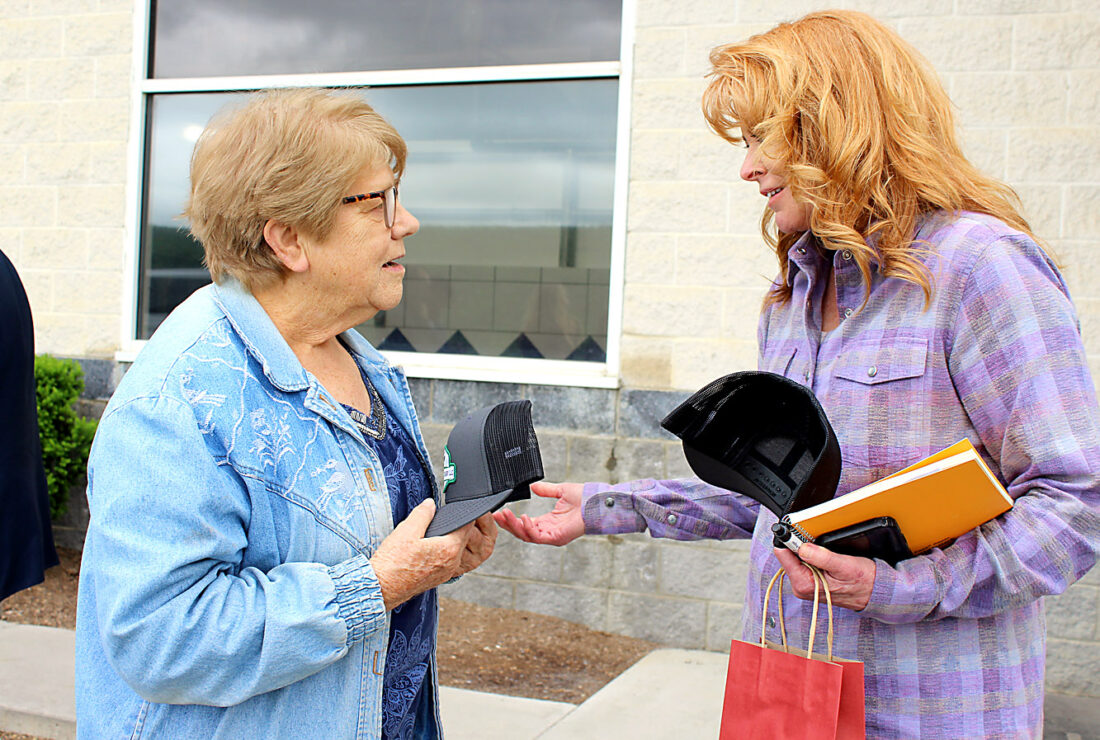
Mary Ann Kulp talks with state Treasurer Stacy Garrity (right) at the Kulp Family Dairy LLC in Martinsburg. The treasurer and ag officials toured the farm Wednesday. Mirror photo by Holly Claycomb
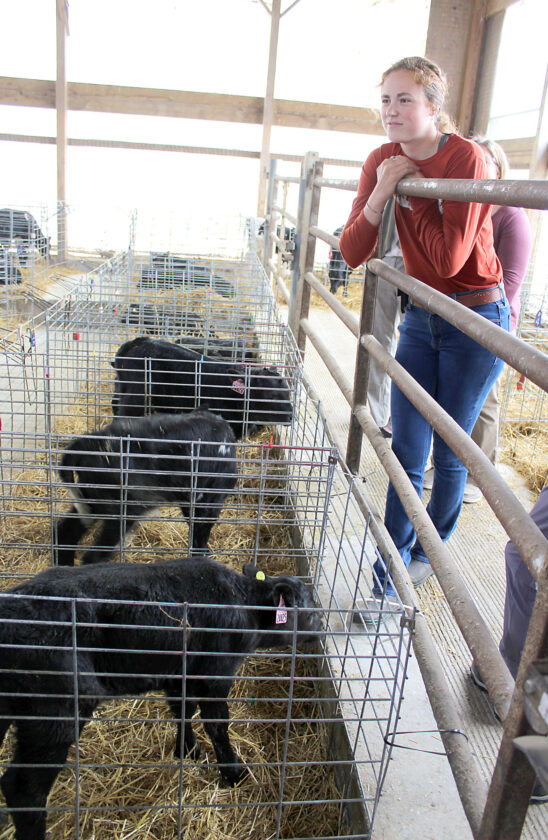
Grace Kulp looks over calf pens while leading a tour of the Kulp Family Dairy LLC on Wednesday. Mirror photo by Holly Claycomb
Mary Ann Kulp talks with state Treasurer Stacy Garrity (right) at the Kulp Family Dairy LLC in Martinsburg. The treasurer and ag officials toured the farm Wednesday. Mirror photo by Holly Claycomb
Grace Kulp looks over calf pens while leading a tour of the Kulp Family Dairy LLC on Wednesday. Mirror photo by Holly Claycomb
Trending
ROARING SPRING -- Leaning on her own life experiences, state Treasurer Stacy Garrity told a group of Central High School FFA members that they can be anything they want to be, if they continue to work hard toward their goals.
In a room full of agribusiness leaders at Renaissance Nutrition Inc., Garrity directed her comments Wednesday to the students, stating that she was the first in her family to go to college.
She joined the Army's ROTC program and ended up serving 30 years in the Army Reserves, retiring as a colonel.
"Serving is and was the honor of my lifetime," she said.
Garrity holds a degree in finance and economics from Bloomsburg University and a certificate from Cornell University Business Management Institute. As the state treasurer, she oversees an office of more than 300 employees and protects more than $150 billion in state assets.
Sharing the story of her journey from Bradford County to university and three deployments -- Operation Desert Storm in 1991, Operation Iraqi Freedom in 2003 and Operation Enduring Freedom in 2008 -- to the treasurer's office, Garrity told the teens, "If I can do it, you guys can do anything."
She also took time to encourage those in attendance to go online and see if they are among the thousands of Pennsylvania residents who have unclaimed property stored in the treasury vault in Harrisburg.
With $4.5 billion in unclaimed property, Garrity said she was sure a few in the room would find themselves on the list, which can be searched at patreasury.gov/unclaimed-property.
In fact, state Sen. Judy Ward, R-Blair, who was in attendance, said she recently found out her husband has unclaimed property, after searching the site at
Garrity's urging.
"We'll be discussing that when I get home," Ward said with a laugh.
On a more serious note, former state Rep. Sam Hayes Jr. said Garrity is the first state treasurer to seek out the agriculture community.
"In all my years, a state treasurer never asked to come out to meet agriculture," the former secretary of agriculture said.
Inheritance tax, bird flu concerns
Garrity said she wanted to meet farmers and others involved in agriculture because she understands that "farmers drive our economy. It's our number one industry."
During her stop at Renaissance Nutrition, Garrity shared her concerns on using agricultural land for solar farms, adding that "agriculture is a matter of national security."
When the topic came up of avian influenza in poultry and its recent crossover to dairy cattle, Chris Herr, vice president of PennAg Industries, said he has been in discussions about the issue.
Avian flu caused the "depopulation of five million head of poultry in recent years," he said.
With money appropriated to support poultry farmers dealing with the avian flu, it's time to look into the dairy industry, to support those who may lose income and production due to the illness, he said.
There also needs to be a communication plan in place related to the avian flu in dairy cattle, those gathered agreed.
"If we get (avian influenza), we need to tell people that it's not harmful to products," Herr said.
Other questions raised included how alternative dairy products, such as almond and soy milk, affect the dairy industry.
Herr replied that consumption of dairy products, such as cheeses and yogurts, is up, but fluid milk is down.
"Kids today have cereal bars," he said, noting the bars can be put in a pocket and eaten on the go. "When I was growing up, there was cereal and milk," he said.
Herr suggested the dairy industry needs to be more engaged with each other.
His focus is mainly on the poultry industry, which is very integrated, as is the hog industry. For instance, he can quickly connect with a wide variety of poultry leaders and businesses just by making a few clicks on his computer.
"The dairy industry is independent," he said, noting dairy doesn't work together the way other agriculture industries do "and that could be a downfall."
Garrity said the state Department of Agriculture is putting more effort into marketing the industry, with Ward adding that current Agriculture Secretary Russell Redding understands the issues.
Another top issue for farmers is the state's inheritance tax, a hurdle for those looking to pass a farm down to family members, those in the group said.
The state has an aging population, so finding a solution to keep family farms operating is an ongoing issue, they said.
A suggestion to get rid of some of the regulatory burdens put on farms, so that young people want to stay, drew agreement from the group.
"Succession is an issue in any business," Hayes said.
Garrity said legislative aid is needed for many of the issues the industry faces.
"I wish I had a good answer," she said.
Family-owned, operated
Following the question-and-answer session, Garrity and a number of others toured the Renaissance Nutrition facility at 339 Frederick Road.
The business, which has been family-owned and operated for four generations, supplies feed and specialty mixes to agribusinesses in more than two dozen states and has more than 100 consultants spread across its coverage area.
In addition to livestock products, it supplies seed, crop stabilizers and forage growth stimulant products.
Travis Ritchey, who led the tour, pointed out the offloading, mixing, bagging and shipping process, noting the company uses a robot to stack the sacks of feed and seed.
In addition, a computerized system ensures the proper balance of ingredients in each of the products offered, he said.
The company also offers nutritional consulting, ration balancing and custom formulation, dairy records and analysis, forage and feed management, sampling and analysis as well as farm management consulting and cattle evaluation.
Another family-owned and operated business, Kulp Family Dairy LLC, in Martinsburg, offered Garrity and others a tour of the main farm, where about 1,650 head of cattle are milked each day.
The dairy encompasses three farms -- one in Sinking Valley and two in the Cove -- said Grace Kulp, a third generation farmer. In total, the farm milks about 3,000 cows a day, she said.
Kulp's love of farming shone through as she guided Garrity and others on a tour of the facility, starting in the milking parlor and passing through the barns and calving areas.
Providing a brief background on the farm, Kulp said her grandparents started the dairy in 1973, and her grandfather and father formed Kulp Family Dairy LLC in 1999.
Since then, the farm has grown and is in the midst of expanding again.
"We're very thankful," she said. "We've been blessed."
In pointing out the two 7,000-gallon tanks used to store the milk, Kulp said a bulk truck comes twice a day, every day to empty the tanks. The tanks are then washed and sanitized before the next milking session.
Of all the dairy products, she said, "milk is the safest" because of the myriad of regulations that must be followed. The milk from Kulp's is shipped to Land O' Lakes for processing, she added.
In addition, the main farm is a kosher farm, in that the milk qualifies as being kosher, she told Garrity.
In the main barns, Kulp showed off the tags each Holstein cow sports, stating the numbered tags are basically the cow's name, adding with a grin that naming that many cows would be "insane" otherwise.
The farm utilizes a computerized system to make sure the cows are healthy, as each is tagged with a microchip that can be scanned by the system, which tracks the cow's temperature among other statistics, she said. This allows for sorting of the cows, when needed, and helps the farm maintain herd health.
The tour also showed off a system that periodically "flushes" the aisles with a torrent of water, thus cutting the labor involved in clearing the floors, and a new sprinkler system that helps to keep the cows cool in the summer heat.
"Summer production would always dip" due to the heat, Kulp said, because cows prefer cooler temperatures. The farm has seen "a huge difference with the sprinklers," she said.
When asked about bedding, Kulp said the farm uses and reuses sand in the barns. As the tour passed by the two manure pits -- capable of holding four million gallons of manure -- Kulp explained the system that flushes the aisles, picking up sand as well as manure.
Using a series of smaller retention areas, the sand settles to the bottom while the water and manure flow into the pits. The sand is then collected, washed and reused, she said, saving the dairy about $250,000 a year.
The farm is in the midst of building a new calf barn and future plans are to convert the main farm, or Farm 1, into the sole milking facility, while Farm 2 and Farm 3 would house the dry cows.
"Having a cow is a little bit of an investment," she said, as a cow can't be bred until it's 13 months old. Then there is a 9-month gestation period. After the calf is born, the cow can then be added to the milking herd.
With 6,400 acres, the farm also grows its own forages, except for speciality mixes, she said.
At the end of the tour, Garrity said the farm was "very impressive," adding the family is using innovation and best practices to remain competitive.
Kulp said she plans to buy into the farm this year, noting that when the LLC was set up, the bylaws spell out how family members can join.
"We have to work here full time for two years," she said, "to make sure we know what we're getting into."
"I really enjoy it," she said, and added that for those interested, she has an Instagram account @dairyfarmerg where she shares photos and videos.
"Follow me to see real life farming," the account states.
The ag tour wrapped up at Ritchey's Dairy in Martinsburg, where Garrity, Hayes and others had the opportunity to see the facility and sample the Cove-created frozen confection.