
Holland’s work combines conservation, creation
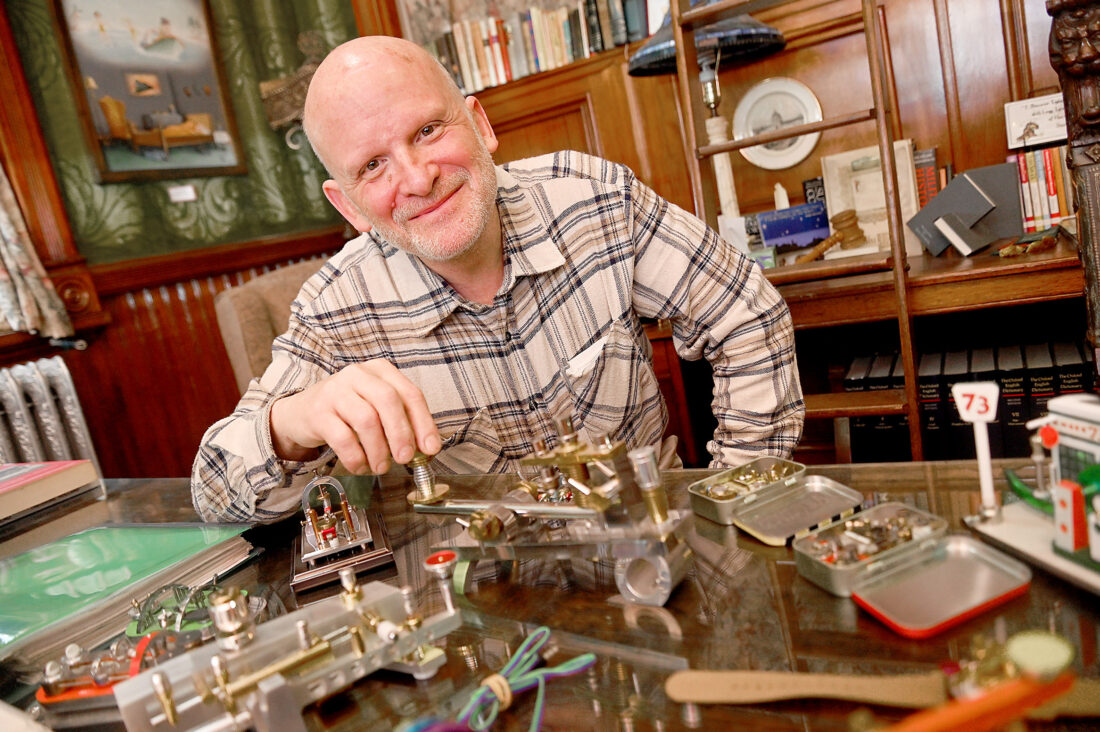
Ted Holland Jr. displays some of his telegraph keys. One of Holland’s most consistent pursuits has been restoring vintage telegraph keys, and even fashioning his own designs from raw brass and steel in his home workshop. Mirror photo by Patrick Waksmunski
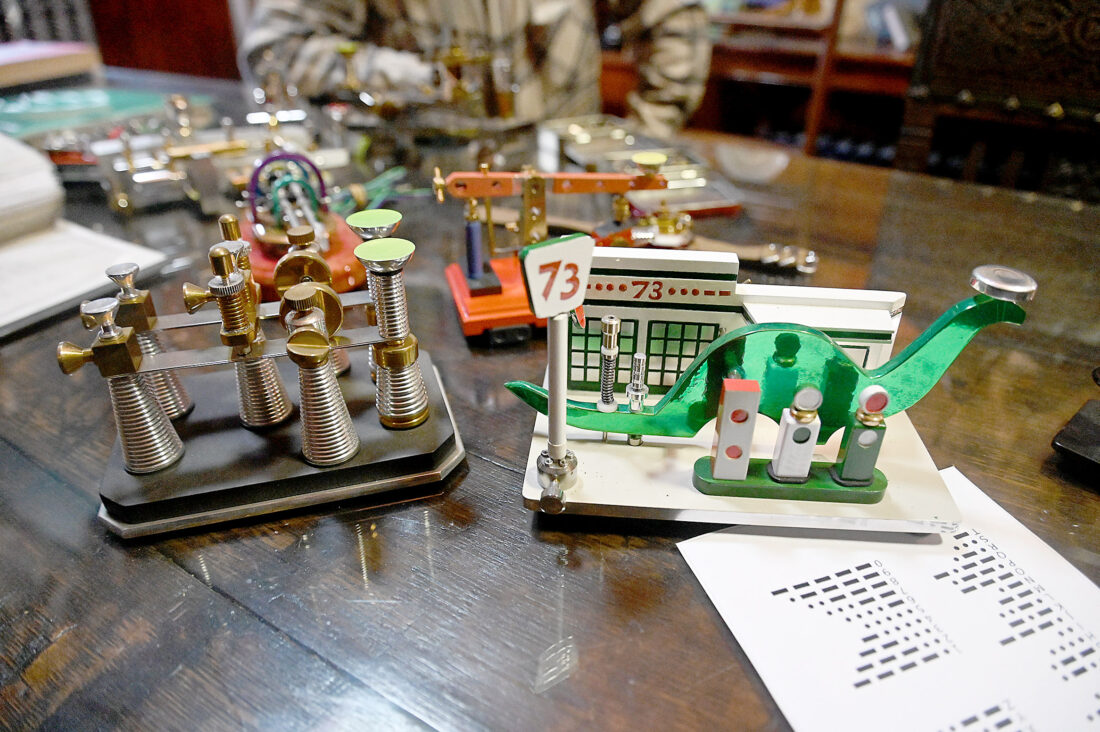
Ted Holland Jr.’s collection of telegraph keys numbers over 100 now, and includes highlights such as keys styled like Santa’s sleigh, a Sinclair gas station and even a gingerbread house-version of the Church in the Middle of the Block. Mirror photo by Patrick Waksmunski
Ted Holland Jr. displays some of his telegraph keys. One of Holland’s most consistent pursuits has been restoring vintage telegraph keys, and even fashioning his own designs from raw brass and steel in his home workshop. Mirror photo by Patrick Waksmunski
Ted Holland Jr.’s collection of telegraph keys numbers over 100 now, and includes highlights such as keys styled like Santa’s sleigh, a Sinclair gas station and even a gingerbread house-version of the Church in the Middle of the Block. Mirror photo by Patrick Waksmunski
Trending
Theodore "Ted" Holland Jr.'s life is a whirlwind of activity -- where he resides in the calm eye of the storm. The teetering stacks of books to be read, intricate machines to be built and a dozen more projects in progress that burst from every nook and cranny of his makeshift home in The Church in the Middle of the Block do not deter Holland.
Instead, the now-retired former executive director of the Altoona Railroaders Memorial Museum has found a comfortable rhythm in the maelstrom, and is eager for more.
From his childhood growing up in Duncansville, Holland, now 67, has always held an innate curiosity for the world around him, he said.
When he was young, Holland said he would split his time between 4-H and scrambling through the woods of Blair County collecting insects -- even winning awards for his displays at shows in Harrisburg.
His parents, Theodore Sr. and Doris, and twin sister, Beth, were always "tolerating" Holland's mercurial interests.
"It was (these) obsessions that the parents put up with for years," he said.
These "obsessions" carried Holland through high school and then college.
After completing his bachelor's degree in anthropology at Penn State University in 1979, Holland went on to earn his master's degree from the University of Oklahoma through an external degree program, then his doctorate from the Union Institute and University in Cincinnati in the late '80s.
Holland was one of the first employees hired by the Railroaders Memorial Museum after it opened in 1980 and helped shape many of its early exhibits.
"None of us really knew how to build a museum ... we were like the blind leading the blind, but we all got along well and it's turned into some big things now," Holland said.
One of Holland's most "significant" undertakings during his tenure at the museum was an oral history program.
"At the time, a lot of the railroaders that I knew were beyond my age, and they were the last generation that actually ran steam locomotives," Holland said.
The awareness of this scarce resource prompted Holland to begin recording interviews with the railroaders for a project that would later become the Folklife Documentation Center.
"A lot of museums have the artifacts, but they don't always have the stories that bring those things alive," Holland said.
Working on the oral history project left a lasting impression on Holland.
"That was a real special part of my life -- to have a chance to do that," Holland said.
Holland officially left the museum in 1991 to work full time as a technical writer at Albert Michaels Conservation Inc., leaving his post as executive director.
"I think by the time I left, I'd held every position they had there," Holland said.
At the time, Albert Michaels was undertaking the initial steps of a sprawling art restoration initiative on the Capitol in Harrisburg, restoring the century-old frescos, paintings and original decoration spread throughout the 600-plus room building.
John Rita and his older brother Albert Michael Rita Jr. opened the business in 1971 as a stand-alone art gallery in their hometown of Altoona, which expanded into historic art conservation in the early 1980s with a series of restoration projects on churches across the state.
In 1987, Rita met Holland as the then-curator of the Railroaders Museum, having been called in to help restore the Loretto II train car originally built for steel magnate Charles Schwab in 1917.
"We became fairly fast friends," Rita, 70, said.
The duo became close working together on the railcar project, and when Holland was looking for a new challenge, Rita offered him a position in his company.
Holland used his anthropology expertise to help document the restoration work under the ever-expanding scope of the Capitol project, even traveling to Chicago to study microscopy at the McCrone Research Institute.
With his newfound skill, Holland transitioned to more hands-on work, conducting microscopic analysis of paint samples taken across the building.
"I did the lab work to determine what the original finishes most likely were, then the artists like (Rita) made sense of that, and that's what they put the rooms back to,"
Holland said.
The restoration project would go on to encompass the state Senate Chamber, the House of Representatives Gallery, the Supreme Court Chambers and the 55-painting collection of past Pa. governors.
When at work in Harrisburg, Holland and Rita, alongside the three Modico brothers, devoted their time to restoring the crumbling Fifth Avenue property that would become the Church in the Middle of the Block, an expansive arts and cultural hub centered around the Sweitzer Theater.
The former Second United Brethren Church, which had been purchased in 1993 from the city of Altoona for $1, took "two or three years of work to get to a semi-usable state" after having sat in a state of complete disrepair for many years, Rita said.
Now, the church has returned to life, full of the rotating cast of community members who use the building as a performance venue and meeting place.
The once-bare walls are now covered in rich tapestries, historic artwork and recovered artifacts amassed through years of dedicated curation.
Holland moved into the church full time from his residence in Duncansville in 2014, cementing the connection to the building where he had spent so much of his life.
His workshop, carved out of a converted space adjacent to the dining room, is Holland's personal sanctuary.
It is a fully organic environment, built out with layers of small modifications and hand-written diagrams reflecting years of Holland's successive projects.
A row of high-tech milling machines and instruments sits below a wall decorated with a collection of antique farm tools Holland inherited from his father.
"All the toys are here, I don't need to go any place else," Holland said.
Since his retirement from Albert Michaels in 2010, Holland has stayed "busy at a slow speed," devoting more of his time to his once-peripheral interests, such as machining, cycling and HAM radio club.
A lifelong electronic tinkering hobbyist, Holland first joined the Horseshoe Amateur Radio Club in high school, back when it met in the basement of the Hollidaysburg Emergency Operations Center next to the courthouse.
"When you're a kid that age and you look down at that equipment, you felt like you were in mission control," Holland said.
He has remained involved with the club since the 1970s, even serving two terms as vice president from 2000-01 and 2001-02.
Holland now has a "radio room" stacked chest-deep with antique Heathkit HAM radio sets and adorned with hundreds of QSL cards -- a sort of postcard sent to commemorate a conversation with a fellow amateur radio operator in a foreign country.
Holland's call sign, WB3AVD, has now traveled to more than 200 countries across the globe.
Tom Cooney, call sign W3SFC, first met Holland through the club in the mid 1980s, and they have remained firm friends since.
"He's one of the nicest guys; he'd give you the shirt off his back," Cooney, 62, said. "He's a real hoot of a person."
One of Holland's most consistent pursuits has been restoring vintage telegraph keys, and even fashioning his own designs from raw brass and steel in his home workshop.
"When I start building a key, it becomes an obsession for a couple weeks or a couple months," Holland said. "It pushes a lot of other things out."
His collection numbers over 100 now, and includes highlights such as keys styled like Santa's sleigh, a Sinclair gas station and even a gingerbread house-version of the church that contains four separate styles of keys, complete with real candy decoration.
"This is probably the only key in the whole world that you need to put on the shelf so mice don't get it," Holland said.
According to Holland, while his usually intense energy has slowed down as he approaches 70, he still has countless new projects in his sights.
"I don't have any trouble with (finding fresh inspiration) because I read a lot," Holland said. "All kinds of books, classics to folktales and mythology, every place I look I find ideas."
He has recently gotten back into cycling, often traveling to local state parks or to visit his mother and sister in Bedford with the help of his hand-modified electric bike.
Although Holland said he hopes to complete 100-mile round trip journeys soon with the increased range of his bike -- to which he has added three additional batteries -- his main goal is publishing a currently unnamed book on his telegraph key creations.
He said he hopes to finish his manuscript within the next two years, so he can show his mother the complete book before she "is no longer with us."
Now, Holland and Rita are in lockstep, planning the future growth of the church and its supporting community even beyond when they pass the keys to a new generation.
"My archives for both my earlier fieldwork and complete collection of telegraphy, those are my legacies," Holland said. "In this building now we've got a theater group and young people that are starting to use it -- we hope that when we're gone they'll continue keeping this stuff together and value it."
Mirror Staff Writer Conner Goetz is at 814-946-7535.