
CPR twice a lifesaver for local man
McIntosh saved by neighbors, wife during two separate cardiac arrests
Trending
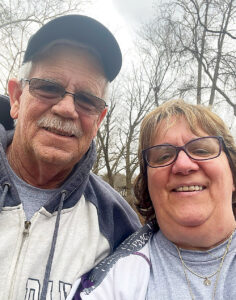
Tom McIntosh is alive today thanks to willing hands who performed CPR when he had a heart attack in March 2023, and then again in February.
During his first attack, a pair of the Duncansville man's neighbors, who happened to be paramedics, started CPR, which ultimately saved his life.
Terrina McIntosh started CPR on her husband after his second arrest.
Tom's continued survival after two arrests at home is miraculous, given that only about 11% of people survive an arrest outside the hospital, according to UPMC Altoona interventional cardiologist Dr. George Jabbour, who placed a stent in a coronary artery after Tom's second arrest. Only about 25% of those who experience cardiac arrest even inside the hospital survive, Jabbour said.
In an effort to encourage others to learn the life-saving method of CPR, Terrina has organized a lesson that is open to the public, free of charge, at the AMED building in Lakemont on Saturday, April 6.
Though it provides no guarantee of survival after an arrest, CPR is a critical component of care for virtually all those who do survive, Jabbour said.
Without CPR, Tom would have been brain dead both times, Jabbour said.
Through hard and fast chest compressions, CPR pushes some blood through the circulatory system, Jabbour said.
While it's not enough to create the blood pressure of a normal heart, it helps keep the heart and brain from dying, he said.
When someone is in cardiac arrest, brain damage occurs within about five minutes,
followed by death in 10 to 15 minutes, Jabbour said.
CPR is conducted when possible in conjunction with an automated external defibrillator, which is designed to shock the heart back into rhythm.
Many public spaces now have AEDs and signs pointing to their locations, but when a heart attack happens at home, CPR alone has proven -- like in Tom's case -- to be life-saving.
Chest compressions are the key component of CPR -- more so than mouth-to-mouth breathing, said Jabbour, adding that anyone can learn to do it.
When administering CPR, you need to push hard and push fast, he said. Use stiff arms, use your body weight and don't worry about injuring the patient, because with a stopped heart, the patient can be considered clinically dead already, he said.
Tom's story
Tom's first arrest came on March 11, 2023, and he was saved by CPR performed by paramedics Rodney and Nicole Estep, neighbors and friends of the McIntoshes. They were assisted by Duncansville firefighter Jim Batzel and an ambulance team from Duncansville, which arrived within three minutes.
Terrina was in Pittsburgh with her mother when Tom called from their home and said he was having chest pains.
Terrina said he should call their daughter Mikayla, who lived 20 minutes away.
Not long afterward, Mikayla called Terrina and told her to get home, that Tom was lying on the floor in cardiac arrest, with CPR being administered.
Terrina started home, and as she drove, she was receiving updates from Mikayla, who said things didn't look good. Terrina was praying that when she got home, "I could at least say goodbye."
When Terrina got to Altoona, Tom was on a cath table in the hospital -- alive and still with a future.
"He wouldn't be here if not for them," Terrina said of the CPR team.
The Esteps had sprinted across the yard in between their houses within 30 seconds of her daughter's call, Terrina said.
As the Esteps were administering CPR, they'd get a heartbeat, but when they stopped it, Tom's heart would stop, and he would stop breathing, Terrina said.
That episode of CPR lasted about 45 minutes.
The Esteps kept it up "because they had hope," Jabbour said.
Tom had to be shocked with an AED 12 times to restart his heart rhythm in the aftermath of the arrest.
While Tom was on the cath table, an associate of Jabbour's performed an angioplasty and placed two stents in the left circumflex artery.
Tom's second attack occurred Feb. 3.
Terrina was upstairs getting ready to go to Sam's Club when her daughter screamed, "Get down here!"
Terrina sprinted down the steps and saw Tom's eyes rolling back in his head.
She herself started screaming and bawling and shaking him.
He wasn't moving or breathing, and didn't have a heartbeat.
She was telling him, "Don't leave me. I love you. Don't leave me," she said.
She turned to her daughter, who was standing there with a shocked expression.
"Go call 911," Terrina said.
When they got through to the 911 center, the dispatcher told them to start chest compressions.
The dispatcher counted with Terrina as she did the compressions.
It helped that six years earlier, when Terrina had a job helping to take care of a person with a mental disability, she had taken a CPR class.
It also helped that Dr. Jabbour had told her after Tom's first arrest that it was OK to do hands-only CPR, which made things simpler than if she had to worry also about mouth-to-mouth resuscitation.
The dispatcher continued counting, and Terrina pushed down hard on her husband's chest, keeping her arms straight, so she could make use of her body weight.
There's a rhythm mnemonic for CPR involving the song "Stayin' Alive," but Terrina couldn't remember it.
She continued to push for about 10 minutes, until the ambulance arrived, although it seemed like forever, Terrina said.
She was crying continuously.
"I was a mess," she said. "(But) I did what I had to do."
When the ambulance came, the crew took over.
Tom had to be shocked twice after that second arrest.
The ambulance crew took Tom to the hospital after about 15 minutes, Terrina said.
By then, he was conscious and talking.
In the cath lab at the hospital, Jabbour performed an angioplasty and placed another stent, in the same artery, but lower down.
Special vest working
Tom is currently wearing a special vest designed to shock his heart back into rhythm if it goes into fibrillation.
He was a candidate for the vest because after the second attack, his heart was functioning at less than 35%.
He'll be wearing it for 90 days, and if by then, his heart function hasn't improved beyond 35%, he'll be fitted with a permanent emergency defibrillator under the skin, Jabbour said.
Before the first arrest, his heart function wasn't compromised, Terrina said.
But before that arrest occurred, he felt pain in his chest and down his arm.
Before the second arrest, there was no warning, Terrina said.
Despite wearing the vest and having two heart attacks, Tom has no activity restrictions.
He goes walking and rides a bike.
Being active is crucial for recovering arrest patients, Jabbour said.
The limitations are "when your body tells you to stop," he said.
Since the second arrest, Tom admits to feeling "a little foggy," and calls being alive now a miracle.
"I owe it all to the first responders, my wife, my neighbors and God," he said. "And Dr. Jabbour and my daughter."
When told he sounded like a player being interviewed after a Superbowl victory, he said, "I feel like I won the Superbowl."
He also feels like he took a helmet to the chest, due to four broken ribs and a broken sternum from the chest compressions, after the second arrest.
Other than that, he feels "100 percent," he said.
The force needed to do CPR, to force the heart to beat and thus forcing blood through the body, often results in broken bones. They'll be left to heal on their own, Tom said, noting that bones were broken during his first arrest, too.
Tom used to earn a living as a maintenance worker for a landlord with multiple properties.
He retired last year after the first arrest and he's been following Jabbour's instructions.
"I don't want to do this a third time," he said.
Mirror Staff Writer William Kibler is at 814-949-7038.
If you go
What: Cardiopulmonary resuscitation class
When: 10 a.m. Saturday, April 6. The class will last from 2 to 4 hours.
Where: AMED building in Lakemont.
Cost: Free; donations accepted for American Heart Association
Sign up: RSVP to Terrina McIntosh at 814-505-7309 or email tgrgrd84@aol.com
Other information: The class will be taught by an AMED paramedic and is being organized by Terrina McIntosh. Her husband, Tom McIntosh, survived two cardiac arrests within the last year thanks to CPR.