
Celestial spectacle: Hundreds gravitate to Fort Roberdeau to view solar eclipse
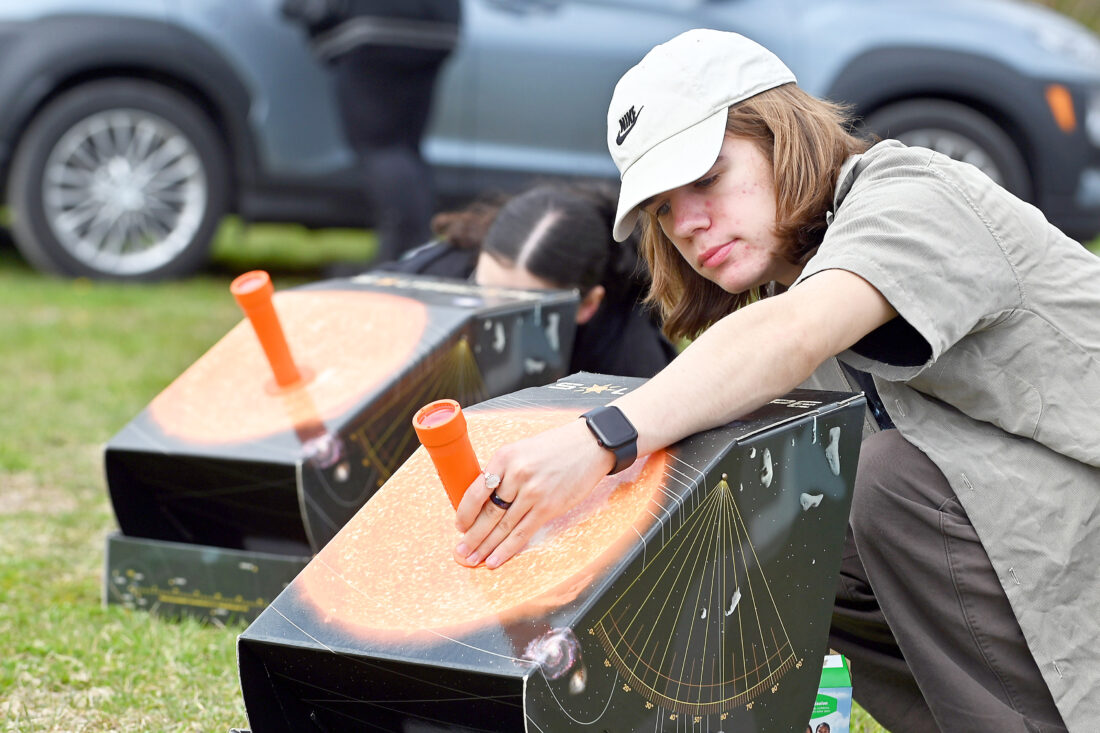
Altoona Area High School astronomy club senior Austin Parker sets up a Solarscope for indirect eclipse viewing at the Mountain Lion Observatory at Fort Roberdeau on Monday. Mirror photo by Patrick Waksmunski
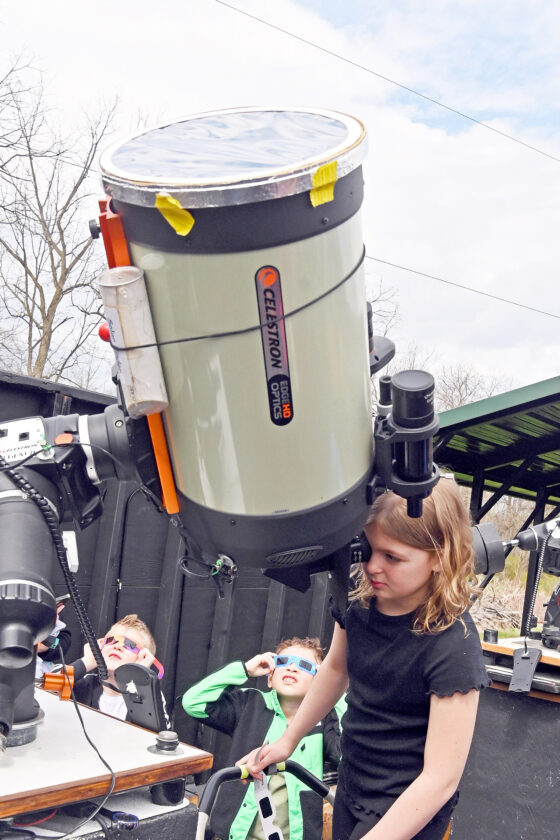
Brylee Hinish, 11, looks at the eclipse through a telescope at the Mountain Lion Observatory at Fort Roberdeau while her brother, Boston Benton (left), 7, and his friend, Cash Crawford, 7, all of Altoona, use eclipse glasses while they wait their turn on Monday. Mirror photo by Patrick Waksmunski
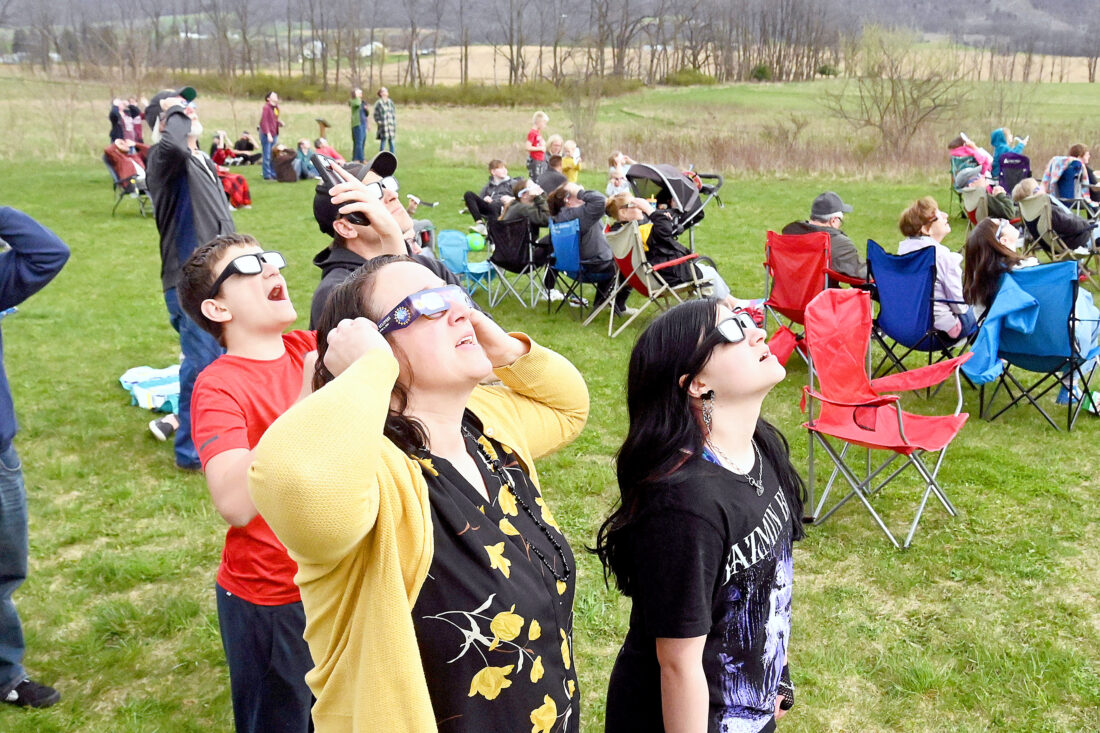
A crowd of people don eclipse shades to view the solar eclipse at the Mountain Lion Observatory at Fort Roberdeau on Monday. Mirror photo by Patrick Waksmunski
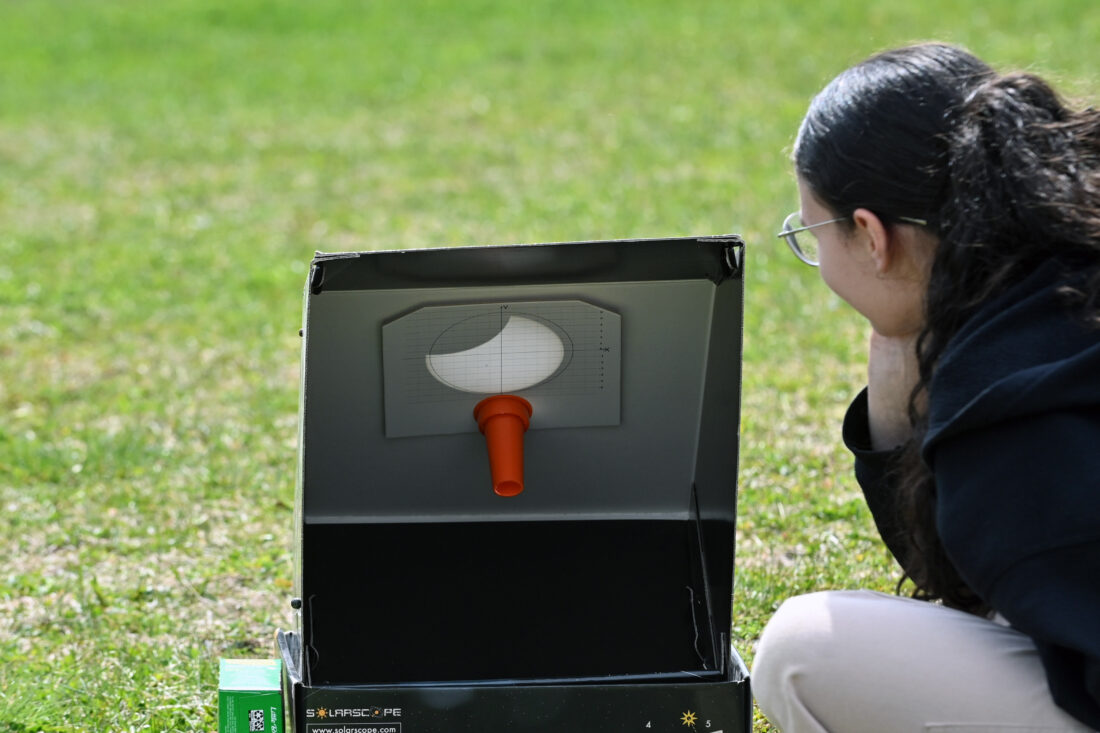
Altoona Area High School astronomy club senior Chloe Uliano watches the early stages of the eclipes with a Solarscope at the Mountain Lion Observatory at Fort Roberdeau on Monday. Mirror photo by Patrick Waksmunski
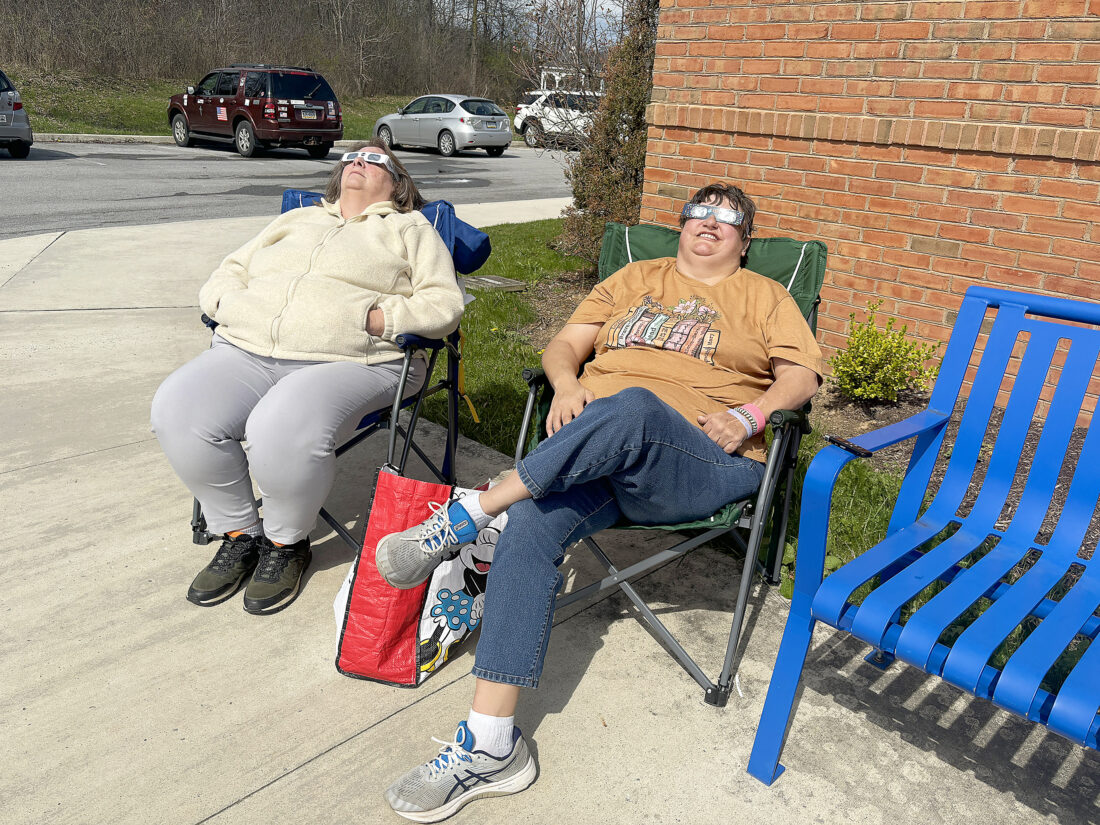
Debra Suder and Tina Lanborn, both of Duncansville, view the solar eclipse at the Hollidaysburg Area Public Library. Mirror photo by Conner Goetz
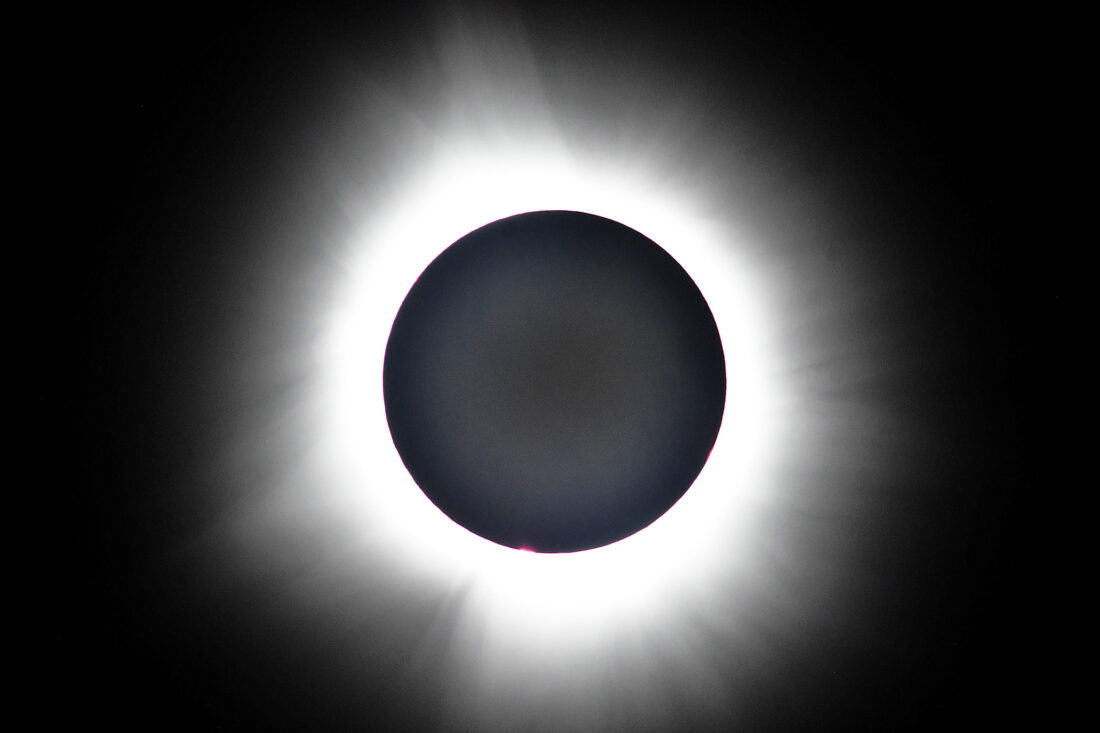
A total solar eclipse is seen from Neil Armstrong Air and Space Museum in Wapakoneta, Ohio, on Monday. The Associated Press
Altoona Area High School astronomy club senior Austin Parker sets up a Solarscope for indirect eclipse viewing at the Mountain Lion Observatory at Fort Roberdeau on Monday. Mirror photo by Patrick Waksmunski
Brylee Hinish, 11, looks at the eclipse through a telescope at the Mountain Lion Observatory at Fort Roberdeau while her brother, Boston Benton (left), 7, and his friend, Cash Crawford, 7, all of Altoona, use eclipse glasses while they wait their turn on Monday. Mirror photo by Patrick Waksmunski
A crowd of people don eclipse shades to view the solar eclipse at the Mountain Lion Observatory at Fort Roberdeau on Monday. Mirror photo by Patrick Waksmunski
Altoona Area High School astronomy club senior Chloe Uliano watches the early stages of the eclipes with a Solarscope at the Mountain Lion Observatory at Fort Roberdeau on Monday. Mirror photo by Patrick Waksmunski
Debra Suder and Tina Lanborn, both of Duncansville, view the solar eclipse at the Hollidaysburg Area Public Library. Mirror photo by Conner Goetz
A total solar eclipse is seen from Neil Armstrong Air and Space Museum in Wapakoneta, Ohio, on Monday. The Associated Press
Trending
To the ancients, eclipses of the sun were a mystery -- omens inspiring awe and fear.
These days, they're occasions for party gatherings, like the one Monday around the Mountain Lion Observatory at Fort Roberdeau, where the vibe was like that of a watch party for Sunday's NCAA women's basketball championship -- whose main mystery was whether Caitlin Clark would go off or South Carolina would finish its season undefeated.
For Jim Krug, director of the Neil Armstrong Planetarium at Altoona Area High School, the seeming ebb of mystery from astronomical events in modern times represents a misunderstanding of the limits of science, because as mysteries unravel, others appear.
"I don't think the mysteries have left us," he said. "The more we discover, the more we discern a higher level of intricacy."
If approached in the right way, some of the ancient awe can return with events like Monday's, as people realize "we're part of something much bigger," he said.
There were roughly 250 attendees at the party, which was held in a field next to the observatory, which includes a small cabin without a roof that, on Monday afternoon, contained several instruments for viewing the sky.
People outside were sitting on folding chairs or blankets or standing around, many wearing the eclipse safety glasses handed out by Krug, who worked behind a table near the observatory.
Most of the time, clouds obscured the view during the eclipse period, which began around 2 p.m., peaked at 3:19 p.m. and ended about 4 p.m.
But the dark round disc of the moon with the crescent sun to the side of it became visible often enough to make the viewing worthwhile.
It elicited cheers from many when the sun came out during the time of maximum coverage.
Colin McFarland of the Starlight Astronomy Club helped attendees with information, with telescopes and with safety viewers that projected an image of the eclipse onto a receiving plate.
A 19-year-old graduate of Bellwood-Antis High School, McFarland wants to go to college so he can teach astronomy at the high school or college level.
Everyone deserves to feel the way he's felt when he first saw heavenly bodies like Saturn, he said.
His efforts Monday would be worth it if they inspired one in 50 or even one in 100 people, he said.
On Sunday, Jenny Behe of Duncansville was in Erie for a retirement party, where the eclipse was going to be total on Monday.
If she had remained, she would have been one of many who were congregating on the "path of totality."
But she had to come back for work, she said.
Still, she got to see the 95% version that was visible in this region, along with Michelle Wilt of Altoona, both of whom were on the job, helping to provide support for Sarah Adams and Leah Leiden.
All four were sitting on a blanket, as if for a picnic.
They were getting paid to have fun, Wilt said.
"Are we excited?" Behe asked Adams and Leiden.
"Yes!" they said, as Adams thrust her arms toward the heavens.
Steve Smith of Duncansville had been planning to go to Erie to experience totality, until he saw a weather report calling for clouds.
He felt the trip wouldn't have been worth it.
But even with clouds, it was worth a drive to Sinking Valley to see something that might not happen this close to home during the remaining years of his life, he said.
The next total solar eclipse visible in the U.S. will happen in 2044.
Debbie Hoy, a radio personality with WTRN, was sitting on the tailgate of a pickup truck near the observatory.
She's been fascinated with stars and the sky since she was a child.
She would have liked to be captain of the Starship Enterprise.
"This is about as close as I can get," Hoy said.
The eclipse helped her see herself as a tiny part in God's "amazing" creation, she said.
Next to her on the tailgate was Glenn "Bebop" Baker of Huntingdon, a retired truck driver.
He, too, has always liked to look at the stars.
The passage of Halley's Comet in 1986 fueled that interest.
He likes to lie back and watch in the night, sometimes at the fort or at Canoe Creek, where the skies are darker.
"The darker the better," he said.
Even though eclipses triggered fears among the ancients, there were astronomers in Greece and China who were able to predict them in those days, using mathematics and "centuries of observations," according to Krug.
Later, during the Middle Ages, predicting eclipses became a high-stakes enterprise for court astronomers, he said.
Some were put to death for inaccuracies -- either predictions that didn't come true or eclipses they'd failed to predict, Krug said.
Those astronomers paid dearly for their lives of luxury, he said.
By contrast, the atmosphere Monday at the fort was uniformly positive, Krug said.
Over in Hollidaysburg, a small group gathered to view the eclipse at the Hollidaysburg Area Public Library.
According to library director Kevin Yoder, a last-minute delivery of eclipse glasses helped keep the event on track after they had run out earlier in the week.
"We did run out, so we were a little nervous about that," Yoder said. "We've been taking calls all day about whether we have them."
The event, which featured eclipse-themed word searches and crafts for children, as well as a range of books on astronomy, was attended by approximately 20 community members.
Since his view of the 2017 solar eclipse was partially obstructed by clouds, Yoder said he was looking forward to another chance to view the uncommon phenomenon.
"We actually got pretty lucky today," Yoder said. "The weather report was saying it was going to be pretty cloudy today, but we're really lucking out."
Despite a foreboding forecast, attendees at the library were treated to a largely unobstructed view for the duration of totality.
Duncansville residents Tina Lanborn and Debra Suder brought lawn chairs to watch the eclipse out front of the library.
According to Lanborn, she saw the 2017 eclipse, so she was "excited" for another chance in 2024. She also considered driving up to Erie for a better view, but ultimately decided to stay closer to home.
Suder said she was a little worried about cloud cover initially, but since it was "fuzzing in-and-out," she was able to find a decent view.
"I'm just happy we can sit outside and enjoy it," Suder said.
Mirror Staff Writer Conner Goetz contributed to this article.