
Tragedy to have minor impact locally
Baltimore bridge collapses after ship rams support column
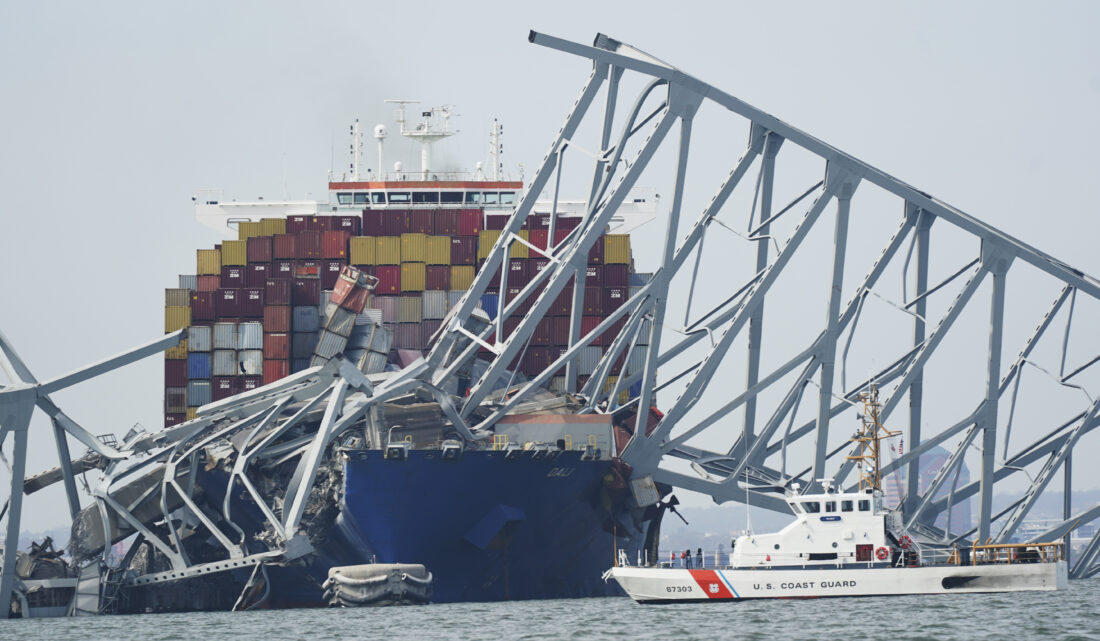
A Coast Guard cutter passes a cargo ship that is stuck under the part of the structure of the Francis Scott Key Bridge after the ship his the bridge on Tuesday in Baltimore. The Associated Press
The collapse Tuesday of the Francis Scott Key Bridge in Baltimore should have minimal impact on the flow of most goods in and out of central Pennsylvania, according to the executive director of Penn State’s Center for Supply Chain Research at the university’s Smeal College of Business.
Although the Port of Baltimore is one of the country’s largest hubs for automotive shipments, because cars can be driven on and off of ships there, and although Baltimore is a critical venue for export of farm commodities, coal and liquid natural gas, it’s not considered a major container distribution center, according to Professor of Practice Steve Tracey.
Moreover, “the mid-Atlantic region’s robust logistics network and the availability of alternative distribution hubs further mitigate potential disruptions, ensuring continuity in the supply chain,” Tracey wrote in an email Tuesday.
A container ship that lost power and thus lost control struck a column supporting one side of the bridge’s central span about
1:30 a.m., causing the bridge to collapse immediately into the Patapsco River.
The ship called a Mayday alarm to emergency dispatch that was relayed to officers on the bridge, who stopped traffic at the entrances, but members of a road crew working on potholes went into the water, according to an Associated Press story. Two people were rescued, one of whom was treated at a hospital, but six crew members are missing and presumed dead, according to the AP story.
Based on what happened to the span, the bridge was “fracture-critical,” such that the failure of one part resulted in the failure of the whole, said Craig Stodart, a structural bridge engineer for P. Joseph Lehman Consulting Engineers in Hollidaysburg.
The ship “took out the foundation,” Stodart said. “(There were) no redundancies to keep it (standing).”
The center span of the Key Bridge was an “arch-shaped through truss,” Stodart said.
It was supported on each end with twin tall concrete columns projecting from the water, as shown by an online picture of the span prior to the accident.
Local bridges with several concrete or steel beams are generally not fracture-critical, but those that have only two beams, for example, are often vulnerable that way, Stodart said.
While the sight on video of the ship striking the bridge was shocking to Stodard, the quick disintegration of the structure was not, said the engineer, based on his having seen videos of deliberate bridge demolitions effected by strategically placed explosives.
Those bridges “all come down at once,” Stodart said.
By contrast, the swiftness of the collapse was shocking to State Rep. Lou Schmitt, R-Altoona, whom the Mirror contacted Tuesday for comment.
“(It was) like it was made of matchsticks,” Schmitt said. “It folded up like a lawn chair.”
It’s possible that the Port of Philadelphia can handle some of the vessel traffic that for the foreseeable future won’t be able to use the Port of Baltimore, Schmitt suggested.
While the Port of Baltimore can continue to handle trucks, vessel traffic is suspended until further notice, according to a statement from the port, provided by the office of U.S. Rep. John Joyce, R-Blair.
Mirror Staff Writer William Kibler is at 814-949-7038.
Local News

Man charged in attempted assassination of Trump

Altoona Area School Board weighs tax increases

Cross hatch
Cross hatch
Altoona Area School Board weighs tax increases
The Altoona Area School Board will consider two proposed budgets — both with a tax increase — in a couple weeks ...
Man charged in attempted assassination of Trump
WASHINGTON — The man who authorities say tried to storm the White House Correspondents’ Association dinner with ...