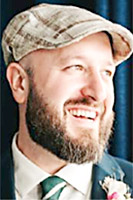
Ready, set, mush! Martinsburg native to compete in Iditarod sled dog race
-

- Jeff and Jeri Reid pose with a team of sled dogs in Alaska. Courtesy photo
-
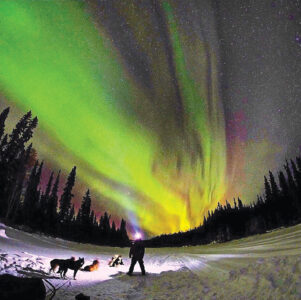
- Jeff Reid, seen silhouetted by the Northern Lights in Alaska, will compete in the 52nd Iditarod beginning March 2. Courtesy photo
-
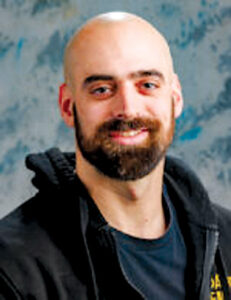
- Reid
-
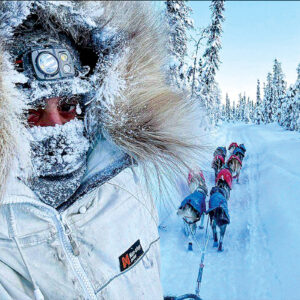
- Jeff Reid is seen with a team of dogs on a trail in Alaska. Reid did two tours of Afghanistan as a Navy SEAL, where he had a fateful meeting with a rescue dog named Frank. His bond with Frank and the influence of Gary Paulsen’s book, “Winterdance: The Fine Madness of Running the Iditarod,” led Reid to embark on his dream of moving to Alaska to become a dog musher. Courtesy photo
-
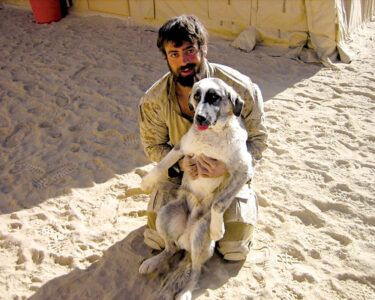
- Jeff Reid holds his dog, Frank, whom he rescued while deployed in Afghanistan. He went to great lengths to get Frank — believed to be an Anatolian shepherd mix — out of Afghanistan and to the United States. “If it weren’t for that first deployment, there would be no Iditarod for me right now,’’ Reid said. Courtesy photo
-
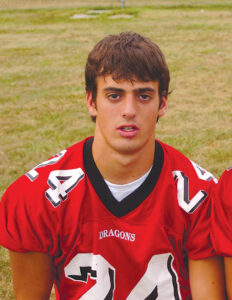
- Jeff Reid was a starter on the Central High School football team as a wide receiver and defensive end his senior year of 2006-07. Courtesy photo

Jeff and Jeri Reid pose with a team of sled dogs in Alaska. Courtesy photo
Jeff Reid developed a sense of adventure at a young age growing up in Martinsburg and listening to his grandfather tell stories about his time in the Korean War.
Reid played various team sports for the Spring Cove School District during his youth and enjoyed hunting and fishing.
That thirst for unusual, exciting and dangerous endeavors led him on a journey that included a career in the Navy SEALs and now places Reid in a spot seemingly unimaginable for a Blair County native.
Reid, 34, will compete in the 52nd Iditarod — a trail sled dog race in sub-zero temperatures that covers roughly 1,000 miles through the rugged snow-covered terrain of Alaska — beginning on March 2.
The race usually lasts eight to 14 days and tests the determination and endurance of a musher and his team of 12-16 dogs.

Jeff Reid, seen silhouetted by the Northern Lights in Alaska, will compete in the 52nd Iditarod beginning March 2. Courtesy photo
“This has been a goal for the last six years,” Reid said by phone from his home in Two Rivers, Alaska. “I may be running toward the back of the pack (during the race), but I’ll get to see a lot more of the state of Alaska and get to do something only a small group of people get to experience.”
Reid doesn’t have any false hopes about his chances of winning the race.
The current field of 42 mushers entered includes many men and women with much more experience and resources than Reid, including five-time Iditarod champion and record-holder Dallas Seavey, along with the last two year’s winners, Brent Sass and Ryan Redington.
Reid said his main focus will be the health of his dogs, so he has developed a “conservative” race plan.
“If I’m at the front of the pack, then the leaders must be in a lot of trouble,” he said. “I’m planning on giving my dogs a lot more rest (than other mushers). They’ve never done a race this long, and they’ve never been on this trail before. With the bond we’ve created, I know I can never ask them to do more than they can do because they trust me, and you can’t break that trust.”
Reid
Cove native
Although Reid now lives 4,000 miles from Martinsburg, he still has strong ties to the area.
His wife of 11 years, Jeri, is also from Martinsburg, and the two dated in high school. Jeff’s parents, Jeff and Patty, and his siblings, April, Nathan and Emily, still live in the area, as well as Jeri’s parents, Anita Baker and Jay Baker.
Jeff played basketball and ran track and was also a starter on the Central High School football team as a wide receiver and defensive end his senior year of 2006-07.
“You could tell how tenacious he was,” former Central football head coach A.J. Hoenstine said. “He was a real scrap iron. His senior year, he was undersized for a defensive end, playing at 5-foot-9, 150 pounds. I remember one time he had to go up against a big tight end that was going to Pitt, but he always laid it on the line and gave all he had.”

Jeff Reid is seen with a team of dogs on a trail in Alaska. Reid did two tours of Afghanistan as a Navy SEAL, where he had a fateful meeting with a rescue dog named Frank. His bond with Frank and the influence of Gary Paulsen’s book, “Winterdance: The Fine Madness of Running the Iditarod,” led Reid to embark on his dream of moving to Alaska to become a dog musher. Courtesy photo
Nearing graduation from high school, Reid faced a dilemma. Although many of his peers were making decisions about college or entering the workforce, Reid didn’t think those options offered a chance for him to fulfill his dreams.
He instead wanted to follow a similar path to his grandfather, James Reid, who had fought in the Korean War and earned a Bronze Star Medal with Valor and a Purple Heart, so he decided to join the military.
“I was terrified to go into the workforce and work a 9-to-5 job,” Jeff said. “That wasn’t for me. I didn’t want to end up in a world where I’d be out selling something.”
Testing his resiliency
Reid didn’t want to just be in the military, he wanted to be part of a special forces unit. At 17, he was not old enough for the U.S. Army “Green Berets,” so when he turned 18, he enlisted with the Navy Sea, Air and Land special operators.
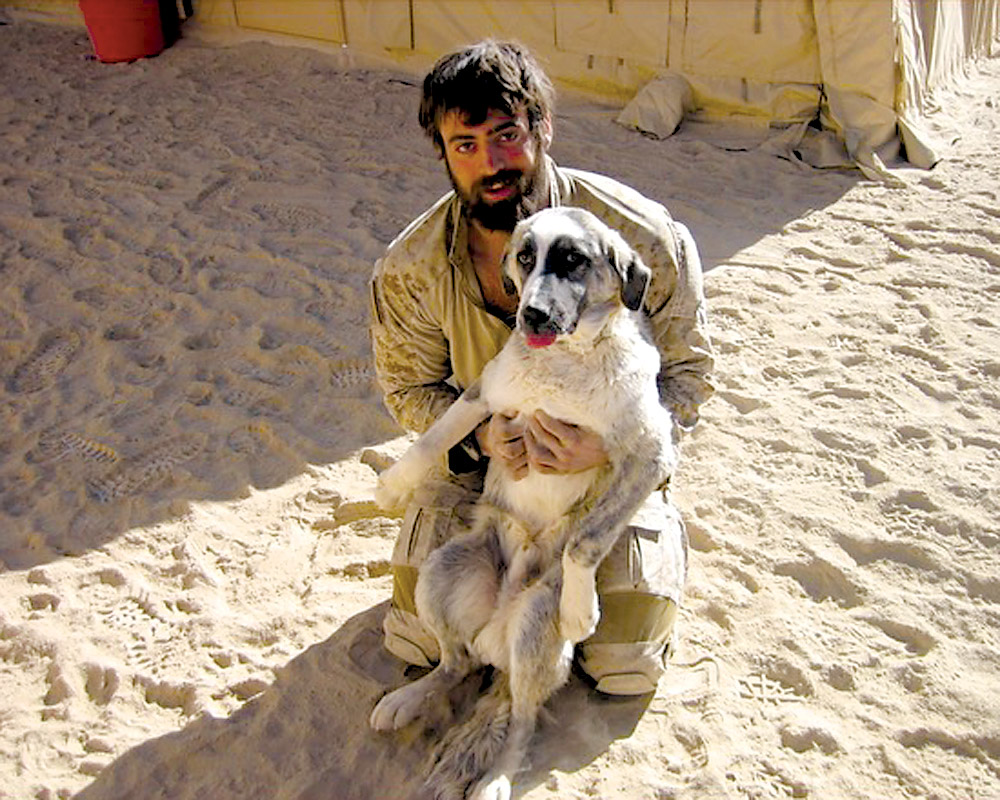
Jeff Reid holds his dog, Frank, whom he rescued while deployed in Afghanistan. He went to great lengths to get Frank — believed to be an Anatolian shepherd mix — out of Afghanistan and to the United States. “If it weren’t for that first deployment, there would be no Iditarod for me right now,’’ Reid said. Courtesy photo
“Everyone knows how difficult it is to become a SEAL,” Hoenstine said. “But I knew he had the mentality for it. He was worried about his swimming (qualifying test), but he worked on that and went out to (Naval Amphibious Base) Coronado (California), and he made it through.”
While in the SEALs, Reid received two combat deployments in Afghanistan. The first one — in the Kandahar Province in 2008 — didn’t involve a lot of gunfire, but he said he had to deal with many improvised explosive devices.
His second deployment involved more active warfare, including having a rocket-propelled grenade narrowly miss a Chinook helicopter in which he was riding. The RPG exploded and shook the helicopter, he said.
Reid worked in Afghanistan as his team’s primary joint terminal attack controller, calling in air strikes. When he finally left the war-torn country, he said the airbase he left from was being shelled by mortars.
“We were under heavy fire,” he said.
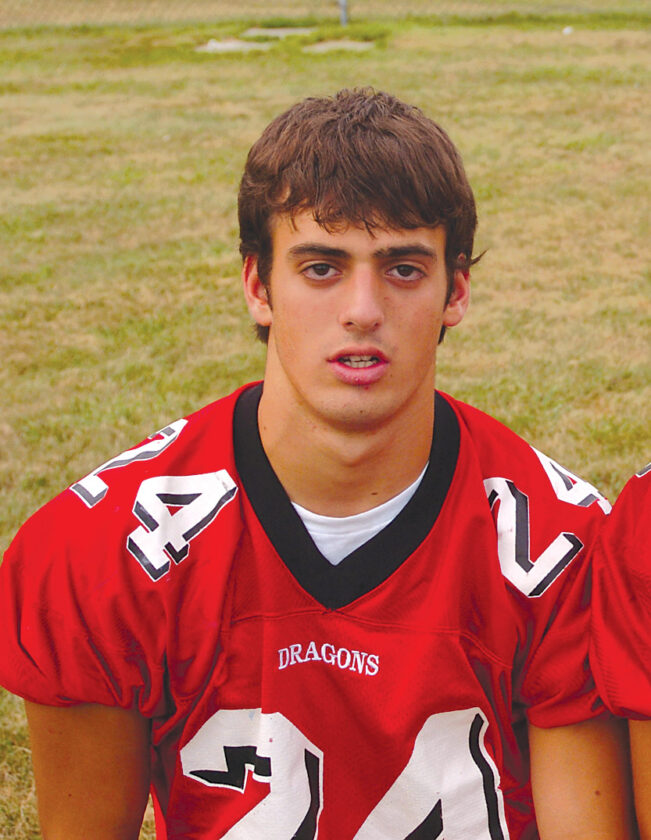
Jeff Reid was a starter on the Central High School football team as a wide receiver and defensive end his senior year of 2006-07. Courtesy photo
Although his first deployment wasn’t as intense as the second, it made a more lasting impression on him because of a very special encounter he had with a dog named Frank.
Reid helped rescue Frank, believed to be an Anatolian shepherd mix, from a war zone and became close with him. He said he went to great lengths to get Frank out of the country and bring him back to the U.S.
“If it weren’t for that first deployment, there would be no Iditarod for me right now,” Reid said.
Frank became Reid’s service dog and followed him wherever he went while he continued his service career working in Virginia Beach for several years.
Heading to ‘The Last Frontier’
A few months before Reid was set to transition from the SEALs to civilian life — in 2017 — tragedy struck. Frank was hit by a car and didn’t survive.
Reid was devastated.
“When he died, because of how tight we were, I figured there would be no point ever having another dog,” Reid said. “I could never have another bond like that.”
But then Reid said he read a book, “Winterdance: The Fine Madness of Running the Iditarod,” written by Gary Paulsen.
The book details Paulsen’s unique bond he developed with his sled dogs and how they overcame many near disasters in completing the Iditarod with Paulsen being a novice musher.
“I thought, unless I do something like that, I could never have that bond again,” Reid said.
Having separated from the SEALs and not wanting to join the civilian labor force, Reid couldn’t stop thinking about Paulsen’s experiences.
“I was lost in the sauce,” he said. “My wife asked me what I wanted to do, pick anything. I said I wanted to move to Alaska and become a dog musher. She said, ‘If you come up with a real plan to make it work, we’ll do it.”’
After sending out emails to various kennel owners in Alaska, Reid connected with Aliy Zirkle, the first woman to win the 1,000-mile Yukon Quest — the second biggest dog sled race — and a three-time Iditarod runner-up, and husband Allen Moore, a three-time Yukon Quest champ and regular Iditarod competitor.
The two operate SP Kennel in Two Rivers, Alaska.
Zirkle and Moore offered Reid a chance to learn from them, so he and Jeri, who had lined up a job as a physician’s assistant, moved to Fairbanks, Alaska, in the summer of 2017.
The first year in Alaska, Reid worked and learned from Zirkle and Moore and eventually began training their main race team, which Moore mushed to a first-place finish in the 2018 Yukon Quest.
“I learned a lot from them,” he said. “I was so lucky to get that rare opportunity.”
In 2018, the Reids purchased property and moved to Two Rivers — a census-designated place roughly 30 miles to the northeast of Fairbanks — and started their own Frozen Trident Kennel. They bought and trained their own dogs — 12 of them at the beginning — and Jeff competed in his first 300-mile race, the Copper Basin 300.
Training
Being able to compete in the Iditarod doesn’t just happen overnight.
The Alaskan husky dogs are not pure breeds but rather a product of various other breeds — such as Siberian Husky, Greyhound and German Shorthair Pointer — that are chosen for different beneficial sled dog traits. This is so the team of dogs is well-rounded and can perform various duties well — much like a team in sports like basketball, football or baseball.
Reid said when the dogs are first born, they are trained in one giant pen with one giant doghouse and eat out of one giant bowl. This helps them become social animals and forms a solid bond among the pack.
When the dogs are a year old, they are introduced to the harness, Reid said, and they begin on some “fun” runs of 20 miles or less. When they are 2, they can begin going on longer runs.
“I have three ‘no chews’ — the (tow)line, harnesses and each other,” Reid said. “They learn pretty quick.”
In 2019, Jeri gave birth to their first son, Atlas, now 4, and their second son, Max, was born in February 2022. Starting a family put Reid’s quest to race in the Iditarod on the backburner for a few years, but the goal didn’t change.
Over the last five years, Reid has done many training runs with his dogs and found himself in several predicaments.
One time he fell through ice in 25-below temperatures, and the shoelaces on his boots froze when he got out of the water. Needing to change his soaked socks before his feet froze and with no one around to help him, he was forced to get back in the water to undo the shoelaces.
Another time, he said he was forced to shoot a moose that charged at his team, and another time, he had to pull his dogs away from a dead caribou after they scared off three wolves that had been feasting on the antlered beast.
He’s also competed in several races like the 200-mile Percy DeWolfe Memorial Mail Race, Two Rivers 100 and Two Rivers 200.
To qualify for the Iditarod, a musher must complete two 300-mile races and one 150-miler while also receiving a good report card from race marshals and veterinarians on his or her overall care for the dogs and cold weather survival skills.
Last February, Reid met the Iditarod qualifying standard by running in the Yukon Quest 300, a shorter version of the 1,000-miler. Reid said his team finished one place ahead of the last finisher, but it was a success.
He wrote on social media after completing the race, “We battled lots of overflow, glare ice, the worst wind storm I’ve ever been in, and cold nights on birch creek; but all 12 of my fuzzy companions ran across the finish line with wagging tales, smiling faces and the desire to keep going.”
The Last Great Race
Having qualified, Reid officially entered his team in the 2024 Iditarod this past September and has been training for it since then.
The race begins in Anchorage two weeks from now and will culminate in Nome, nearly 1,000 miles to the northwest of Anchorage.
The trail runs north through the interior of Alaska until it meets the Yukon River and then heads west along the river and eventually reaches the Bering Sea. From there, the trail wraps up around the western coast of Alaska until it concludes in Nome.
The trail was originally a supply route for Alaskan coastal towns and interior mining camps. In 1925, when Nome experienced a diphtheria epidemic, a portion of the trail was used by mushers and their dogs to deliver serum to the remote city when the use of other modes of transportation was unfeasible.
It was in that spirit that the Iditarod, nicknamed “The Last Great Race on Earth,” began in 1973 and has since been held every year. Since 1996, every winner of the race finished in less than 10 days with Seavey setting the official record in 2017 in 8 days, 3 hours, 40 minutes, 13 seconds.
Mushers start the race with 12-16 dogs and must finish with at least five dogs either on the towline or being hauled. One musher must complete the entire race with no outside help.
Along the route, 19 checkpoints are set up where mushers can have their dogs examined by a veterinarian, fed and/or rested. Dogs that are injured, fatigued or ailing, are left with the veterinarians and then flown to race headquarters in Anchorage, where they await the return of their owners. Distances between checkpoints can vary from approximately 20 to 100 miles.
Reid has already prepared drop bags that will be delivered at various checkpoints. These drop bags contain such items as dog food and human food, booties for the dogs, gloves and straw, on which the dogs can rest.
Race rules mandate that a musher and his dogs must make one mandatory 24-hour stop, an 8-hour stop along the Yukon River and another 8-hour stop on White Mountain.
Reid said he plans on stopping at each checkpoint and also might set up camp between certain checkpoints. He said he will make sure his dogs get plenty of rest.
“Once I get the straw laid out, take off all of the dogs’ booties, prepare their food, that may take about three hours,” Reid said. “If we take a six-hour stop, I might get two hours of sleep.”
Reid, though, said he is used to functioning with little sleep, but not from his time as a Navy SEAL.
“Actually having kids is the best way to deal with sleep deprivation,” he said.
A game plan
The entrance fee for the Iditarod is $4,000. Factoring in travel costs, dog food and gear, entering a team in the race is an expensive venture.
The top finishers in the Iditarod typically earn a reward of $40,000-$50,000 with the last group of finishers earning possibly half of their entrance fee.
Reid said his main sponsor, Team Dog, which sells dog food, has helped make it possible for him to pursue his dream. He also has individual sponsors for each of his dogs, and his mother-in-law, Anita, has held fundraisers at her place of business, Spring Dam Brewing Co. in Roaring Spring.
Anita and Jeff’s parents are planning on traveling to Alaska to help take care of the kids while Jeri works and Jeff competes in the race.
“To do this, it’s just not me,” Reid said. “It takes a whole village.”
Reid said the plan he developed for his race will have him finish in roughly 11 days — if everything goes well.
“The pace I laid out is conservative — I’ll be stopping more than others,” he said. “My main goal is to make sure my team and I get to the finish line. But a million different things could go wrong to prevent that from happening.”
Reid said he has one of the smallest kennels among the race participants. With 19 sled dogs currently in his kennel, it doesn’t leave much room for error.
“I’m going to be leaving only three on the bench,” he said. “I can’t afford to have any get injured during training.”
But Reid said he’ll have the support of his fellow mushers during the race. Although he’ll be basically alone with his dogs in the backcountry of Alaska for most of the race, he said the camaraderie among mushers is unlike most other sports.
“That’s one of the best parts of the race,” he said. “Some of my neighbors do this, and when you see them on the trails you give each other high-fives. It’s nice to be out there with them. When you’re traveling for 1,000 miles, there are going to be several low points, and it’s nice knowing you have the support and encouragement from your fellow mushers.”
Whether Reid is able to finish this year’s race or not, he isn’t ready yet to commit to competing in the Iditarod again, and he isn’t looking too far into the future. He said he’s just taking it year-to-year.
“The main thing right now is accomplishing a goal,” he said. “We’ve been working on this for six-and-a-half, seven years now, and the goal is to see it through to its end. The whole purpose of this started with Frank, to form that solid bond again — being out in the wilderness with the dogs, traveling with them and creating memories.”
Local News

Man shot and killed during Minneapolis immigration crackdown
Region readies for major snowfall from Winter Storm Fern
Outside furnace ignites Kettle Road fire

Child endangerment charges filed against Bedford woman

Police: Tyrone woman stole $7,700 from senior