
Off the beaten path: Altoona man walks entire Appalachian Trail
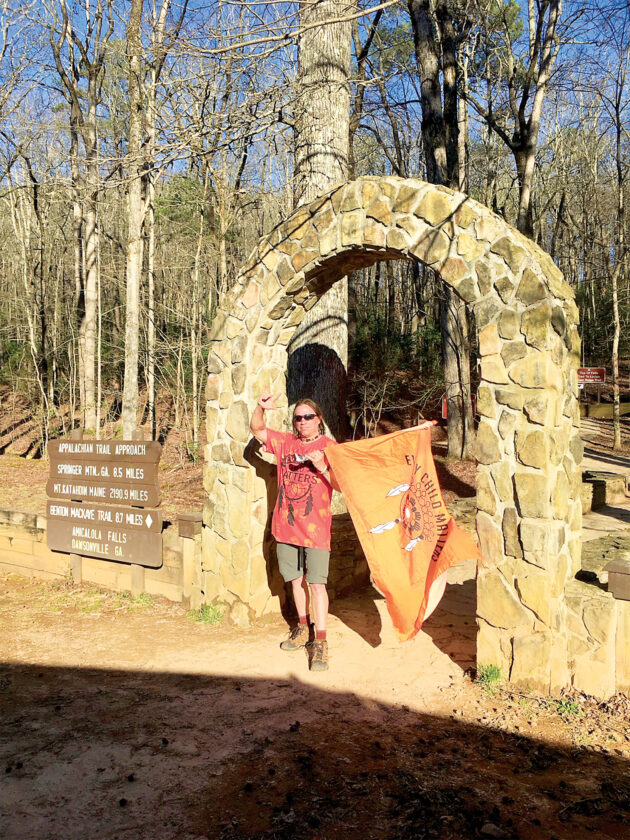
Clark Leddy Ward of Altoona stands at the start of the Appalachian Trail in Georgia. Leddy Ward hiked the entire length of the trail — 2,190 miles to its end in Maine. Courtesy photo
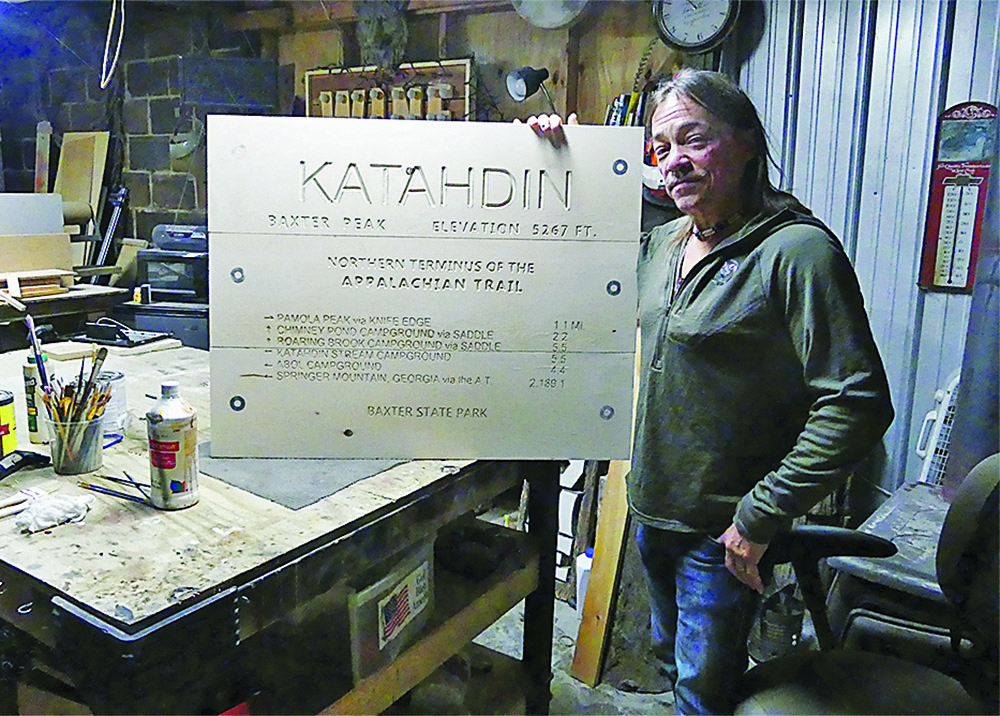
Clark Leddy Ward shows a replica of the sign marking the northern terminus of the Appalachian Trail at Mount Katahdin in Maine that he created in his workshop at his Altoona home. Mirror photo by William Kibler
Clark Leddy Ward of Altoona stands at the start of the Appalachian Trail in Georgia. Leddy Ward hiked the entire length of the trail — 2,190 miles to its end in Maine. Courtesy photo
Clark Leddy Ward shows a replica of the sign marking the northern terminus of the Appalachian Trail at Mount Katahdin in Maine that he created in his workshop at his Altoona home. Mirror photo by William Kibler
Trending
Almost a year ago, Clark Leddy Ward of Altoona was feeling claustrophobic, because his girlfriend was overly busy and their house in Logantown was frequently teeming with kids.
So Leddy Ward went out for some fresh air -- 2,190 miles of it, as he walked from Georgia to Maine, the entire length of the Appalachian Trail.
When he returned, Leddy Ward discovered that he was just as glad to be back in the warmth of the family living room as he'd been eager to leave it seven months earlier.
Half Native American, but raised in the white world, Leddy Ward used his adventure to honor Native American children ripped from their culture and placed in government schools in the 19th and 20th centuries, carrying an orange flag to symbolize a movement that seeks now to keep those kids' memory alive.
Leddy Ward succeeded in a plan to reach the northernmost part of the trail at the top of Mount Katahdin on Sept. 30 -- Orange Shirt Day, the National Day of Remembrance for those children in both Canada and the U.S.
Growing up
Leddy Ward, 61, had a rough upbringing in the area around Syracuse, N.Y.
His biological father was Native American Warren Ward, whom Clark didn't meet until he was 30.
His mother, Sarah Douglas Leddy, and his stepfather, her husband, raised him.
Both his biological father and the man who was to become his stepfather were Golden Gloves boxers, rivals in the same gym.
When his biological father went to prison, his stepfather-to-be moved in and "swept my mom off her feet," Leddy Ward said.
The stepfather never really accepted Leddy Ward, because he was the son of a man he didn't like.
His biological father was a gangster from the Onondaga reservation south of Syracuse.
Leddy Ward said he wasn't "a good kid," and became a thief and drug dealer, at one time making $2,000 a day selling cocaine.
He had a bodyguard who "would have to hurt people who owed me money," he said.
But eventually, he turned away from that life.
"I couldn't stand (it) anymore," he said.
He got rid of his campers, cars and jewelry, although exiting wasn't easy -- resulting in a home invasion by three individuals who beat him and threatened him with a knife, so that he would open his safe.
Although he didn't graduate from high school, Leddy Ward got his GED, then sought to get into college.
He researched schools and ended up at Canandaigua Community.
But he was naive, dressed like he "came from the woods," entered a building on campus, saw students walking back and forth and exclaimed to no one in particular, "I'm ready for college!"
Recognizing someone who needed help, employees of the school hustled him into a counseling office and presented him with "a big stack of papers" that needed to be filled out, after which he would need to return to apply properly, he said.
The encounter launched him into a paroxysm of distress, and he went to a nearby lake and sat on the shore for a long time.
Someone there recognized he was in need, and he ended up in a psychiatric center -- an experience that in turn resulted in a stay in a family care home, with a job in a supermarket, followed by a stint in a motel room and, finally, enrollment at Canandaigua.
"Life seemed to change at that point," he said.
It changed, because he learned to respect people, and because people began to respect him, he said.
With help from scholarships and grants, he earned an associate degree in graphic arts and advertising, although it took him several years.
Partway through, he tried for a time to live with his biological father -- a "powerful guy" of whom everybody was scared, Leddy Ward said.
They'd go to bars, and there would invariably be a fight. In the end, the stint with his father was "a disaster."
Overall, however, his time at Canandaigua was the most fun he ever had.
It helped him develop a talent for art and enabled him to show his intelligence and creativity.
Later, he enrolled at the State University of New York at New Paltz, north of New York City, and at Farmingdale State College on Long Island.
There was a traumatic exit, with a trip back home to Syracuse that brought his college experiences to a close.
After briefly being involved in religion, Leddy Ward started hiking -- around 2005 -- figuring that being alone under the trees would be a source of comfort and an antidote to feeling trapped in Syracuse.
As with college, the beginning efforts exposed his naivete.
Focusing on the need to eat, he equipped himself with 40 pounds of food in a 55-pound backpack that also included items like a hatchet.
He then headed to the Appalachian Trail in Massachusetts.
It didn't take him long to become exhausted, then embarrassed, when he encountered a lightly-equipped thru-hiker who'd started in Georgia.
A conversation with that hiker led to his mailing lots of gear and supplies back home and giving away lots of other stuff.
He ended up hiking 40 or 50 miles.
The experience taught him how to prepare the right way, and how to be a long-distance hiker, he said.
Over the next 18 years or so, Leddy Ward hiked frequently on the Appalachian Trail, traveling on different segments at different times.
His hikes included a jaunt from Tennessee to Roanoke, Va., and another, his longest, from New York to North Carolina.
He logged about 4,000 miles on the Appalachian Trail, but never attempted a thru-hike.
Hitting the trail
Near the end of 2022, though, Leddy Ward said he was getting antsy living in Altoona with his girlfriend Roxanne Vaughn and her children Roman, 11, and Arabella, 8, who consider him their stepfather. He met Vaughn on the trail, and the two have been together 11 years.
Leddy Ward said he loves watching Roman and Arabella, but with other kids around, it sometimes got to be "too much."
He began to crave something that would make him feel alive and he needed to do something for himself -- on his own time and in his own space, he said.
A little before Christmas 2022, he began to plan a thru-hike of the Appalachian Trail, buying a two-person tent with good water repellency, a 0-degree sleeping bag, a ground pad that didn't squeak, neoprene shoes and pants and a pillow.
Using his trail nickname, he said of the goods, "Clark Wild Coyote needs his comfort."
Because he felt a little guilty after leaving to indulge in the hike and he also felt disconnected from his Native American heritage, Leddy Ward said he chose to dedicate his trip to Every Child Matters.
Every Child Matters is a nongovernmental organization in Canada and a nonprofit in the U.S., that since 1972 has advocated for "Indigenous Peoples' rights and ... Indigenous communities' self-determination, cultures and political resistance," according to the Cultural Survival website.
The cause helped Leddy Ward justify his trip and gave him a focus -- including the Sept. 30 endpoint.
At the Springer Mountain starting point in northern Georgia, there was partying and lots of chatter, he said.
Then he was swallowed by the trail.
"It was the most incredible feeling just to walk away, on (my) own journey," he said.
While he didn't walk to raise money, he accepted financial help here and there from people who supported the Every Child Matters cause.
"I can't let none of them down," he told himself, feeling responsible to those supporters to go the distance.
During the trip, when things got difficult, he thought of the kids who'd endured erasure of their culture, who would have wanted to escape the schools where the white man's government had lodged them.
"Every footstep for me was easy compared to (their troubles)," he said.
On the trail, Leddy Ward adapted quickly to a way of life that mirrored the way of life of his paternal ancestors -- up with the sun, to sleep as the sun went down, he said.
He met many hikers along the way -- young athletes on a mission, partiers and older hikers like himself.
The "vibe" would often change, depending on who joined or left, and he didn't keep up with the athletes, who would cover 20 to 30 miles a day and who didn't seem to care much about their surroundings.
He didn't feel comfortable with the partiers, who often indulged in mushrooms, marijuana and LSD -- and who fell a lot, he said.
He was OK with the older hikers, who were more relaxed, careful not to injure themselves and "more aware of everything."
For a while, he hiked with someone who called himself "California Dreamin,'" and as more people latched on, it turned into something other than hiking, he said. So, he and California Dreamin' broke off from the group.
A third hiker later joined them, then that hiker and California Dreamin' quit, and Leddy Ward continued on his own.
Another hiker hooked on with Leddy Ward, then had a heart attack and left the trail, so Leddy Ward continued alone again.
Everybody wanted to be a thru-hiker, it seemed, but few actually made it, he said.
A stranger's shorts
Early in the trip it rained a lot, Leddy Ward said, and one night his tent collapsed under rain and wet snow.
Not long after starting, his pants ripped, and he went to a Walmart, replacing them with a pair of swimming trunks.
The trunks proved "horrible" for hiking, but he soon encountered someone fishing in shorts that looked suitable for the trail, and he asked the man if he was willing to make an exchange. "He just took off his shorts right there in front of everybody and traded with me, and I wore those shorts the whole way," Leddy Ward wrote in a text.
The shoes he started with caused him blisters, so he called Vaughn and asked her to mail him a pair of hiking-style trail runners that were back home in Altoona. At the appointed post office, he opened the box she sent, but there was only one shoe inside. Vaughn was surprised when he called her again and told her about it. On his suggestion, she returned to the post office, where an employee handed her the other shoe -- which had dropped out of the first box -- and which she then sent on to Leddy Ward.
"I was laughing hysterically," Leddy Ward wrote. "I couldn't believe it."
Trying situations during the trip included mosquitoes carpeting his body in Massachusetts, muddy stretches in New Hampshire and dozens of stream crossings in Maine -- into which he witnessed other hikers fall.
He fell on his face a couple times along the trail, he admitted, and in one instance broke a finger.
He got Lyme disease near Mount Greylock in Massachusetts, which rendered him sick for two days with sweats and chills on the trail, after which he spent a few days in a hostel, then eight more days in an apartment paid for by a well-known "trail angel," Miss Janet.
Those were difficult days, but there were times when the trail was flat "and I was just flowing with it," Leddy Ward said.
He tried to minimize his stays in civilized accommodations, sojourning about three dozen times in hostels and two or three times in hotels.
He stopped -- by hitchhiking and shuttle bus -- at grocery stores, laundromats and the post offices to which Vaughn would send supplies.
The best part of the trip occurred near his birthday, Sept. 22, when he reached Shaw's Hiker Hostel in Maine, just before the 100-mile wilderness on the approach to Mount Katahdin.
He got there on the evening of Sept. 21, and the manager learned his birthday was the next day.
The next morning, Leddy Ward woke up to the smell of pancakes, sausage, bacon and pastries. ... "the most amazing smell I've ever smelled," he said.
Everybody was smiling, cheerful and singing "Happy Birthday," he recalled.
"The most beautiful snow, the most beautiful smiles, the most beautiful people," Leddy Ward said, adding the experience was "just freaking awesome."
While they urged him to stay a little longer, he headed out to the next mountain by himself to watch the sunset -- there was still 100 miles to go, but he'd already left 2,000 miles behind.
The sun was in the shape of a heart as it went down that evening.
Days later, he reached the top of Katahdin and, though it was blissful to be done, he "didn't really want it to end," he wrote.
Upon his return to Altoona, there were banners to welcome him home, the house redone with things connected with his Native American heritage and a big dinner.
"They wanted me back," he said. "It made me feel as one (with them)."
Now, he wants to be here for Vaughn and for Roman and Arabella, he said.
But he's glad he took to the trail.
"If I hadn't gone, I don't think I would have ever stopped trying to go," he said. "It was something I really needed."
Mirror Staff Writer William Kibler is at 814-949-7038.