
Lending A Paw: Bedford rescue pets receive ongoing care
Trending
After being rescued from a Bedford home on New Year's Eve by Pennsylvania State Police, more than 90 rescued animals have received ongoing care from a number of veterinary clinics across the region.
And despite coming in with open sores, feces-matted fur and serious leg injuries, the dogs, cats and singular tortoise have shown steady improvement through the week.
Central PA Humane Society assistant manager Logan Hoskinson was one of many volunteers who helped retrieve and transport the pets from the original property.
After talking with the property owners, Hoskinson said that they had apparently begun assembling their pet collection in the 1990s, in an effort to provide them a safe home.
"It's likely the worst (situation) I've ever seen," Hoskinson said, due to the condition of the property and health of the pets. According to Hoskinson, there was a 6-inch layer of animal feces on the floor in various locations throughout the house, and multiple mice living in the property.
"The feces was so caked on, it's like the floor wasn't even visible," he said.
According to a police report, and corroborated by Hoskinson, the 90 dogs were locked in crates stacked "floor to ceiling," sometimes three crates high. The dogs in the crates displayed signs of neglect, including open sores and untreated matted fur. Several carcasses were also discovered
The lone reptile on the property -- a tortoise -- was found in a tank surrounded by moldy vegetables, without a functional heat lamp.
"There were also a few small animals, likely a ferret or rat, just left to rot in their cage," Hoskinson said.
He said the odor was so intense volunteers had to wear gas masks and hazard clothing to protect themselves as they traversed the property.
In total, it took the team of assembled police officers and veterinary volunteers approximately nine hours to remove all the animals from the property.
Among the rescued pets Hoskinson noted are two Bernese mountain dogs, one basset hound, two Australian cattle dogs, two small pomeranian/chihuahua mix, two small poodles, two schnauzers and five domestic short-hair cats.
Veterinarian Edwin Bracken Jr. helped rescue and transport the animals from the property, and temporarily housed six of the dogs at his Bedford clinic overnight.
"I've been in some similar situations -- I've been doing this for 25 years now -- but this was pretty horrific," Bracken said.
"There was just no room (to house them elsewhere) so the Blair County dog officer Paul Gotshall helped transport them," Bracken said. Several of the animals were "caked" in feces and dried urine, leading to sores and decubitus ulcers.
After their overnight stay, the dogs were transported to the Bedford County Humane Society shelter to receive further care. This proved difficult, due to the shelter's original 45-space capacity for large dogs being more than doubled in a single night.
Thankfully, a number of local shelters and veterinary institutions, including Central PA Humane Society, Lakemont Veterinary Clinic and Brackenridge Veterinary, stepped in to assist the overwhelmed BCHS staff, and house some of the pets.
"Everyone was scrambling," Hoskinson said, "90 (dogs) is a burden more than anyone could handle alone." Hoskinson had to temporarily close the CPAHS shelter in order to handle its portion of the rescued animals.
"We were already at capacity before the rescued pups," Hoskinson said.
After a tumultuous few hours trying to locate enough crates to house the new influx of patients, Hoskinsons attention shifted to addressing the dogs' health issues.
"First things we had to address was getting them vaccinated, then spayed and neutered, (micro-tracking) chipped and then we can list them for adoption," Hoskinson said.
He estimates this process could take several weeks due to the high number of patients.
Another concern is the cost of care for each pet.
This amounts to about $165 for a healthy pet, but additional grooming to remove matted fur may raise the cost to $250. Medication for other injuries, such as apoquel to address severe skin conditions, can run up to $100 per dog per medication, Hoskinson said.
Thankfully, due to the support of numerous volunteers (see related article on page A8) and the donations of blankets, leashes, dog crates, cleaning supplies and cash, CPAHS and BCHS have begun to make progress on processing the rescued animals. Hoskinson estimates that his staff are a third of the way through treating the dogs in their care.
BCHS shelter manager Kathy Ramsey said that all of the dogs in her shelter are through intake, and are now receiving their first doses of medication and initial round of vaccinations.
Now, with the majority of dogs successfully through intake, the challenge shifts to finding them new homes.
According to Hoskinson, this may prove difficult, since large breeds like the majority of the rescued 90 typically wait longer to get adopted. And specific breeds such as pitbulls may experience further delays due to unfounded negative public perception.
But recently, Hoskinson has seen success with large-breed adoption.
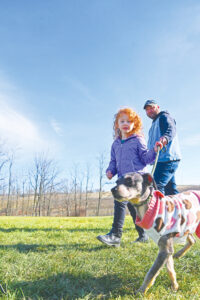
Bartholomew, a recently returned pitbull, saw one of the fastest re-adoption times for his breed at CPAHS, Hoskinson said.
According to Hoskinson, Bartholomew was returned to the shelter after a string of petty thefts -- a bar of soap off the bathroom vanity, a turkey leg off the kitchen table and several other snack-based larcenies.
"He's a really friendly dog with people, but not as much with other animals," Hoskinson said.
But the stigma surrounding pitbulls -- and his own criminal record -- didn't stop Bartholomew, as he found a new home in three weeks.
Shelter officials note that the 90 rescued dogs have much in common with Bartholomew's friendly nature, and hope they can experience similar success in finding new homes.
Mirror Staff Writer Conner Goetz is at 814-946-7535.