
Direct Support: Gates enhances services for Medicaid recipients
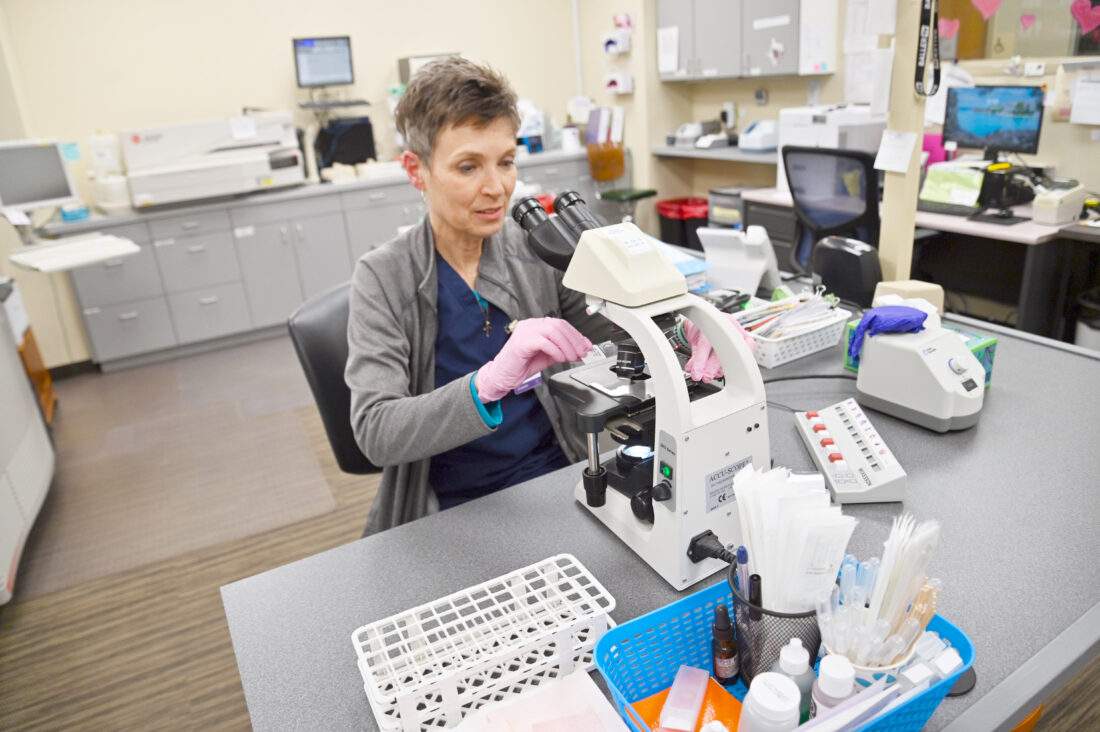
Lab manager Becky Jacobs works in the lab at Gloria Gates CARE in Altoona. Mirror photos by Patrick Waksmunski
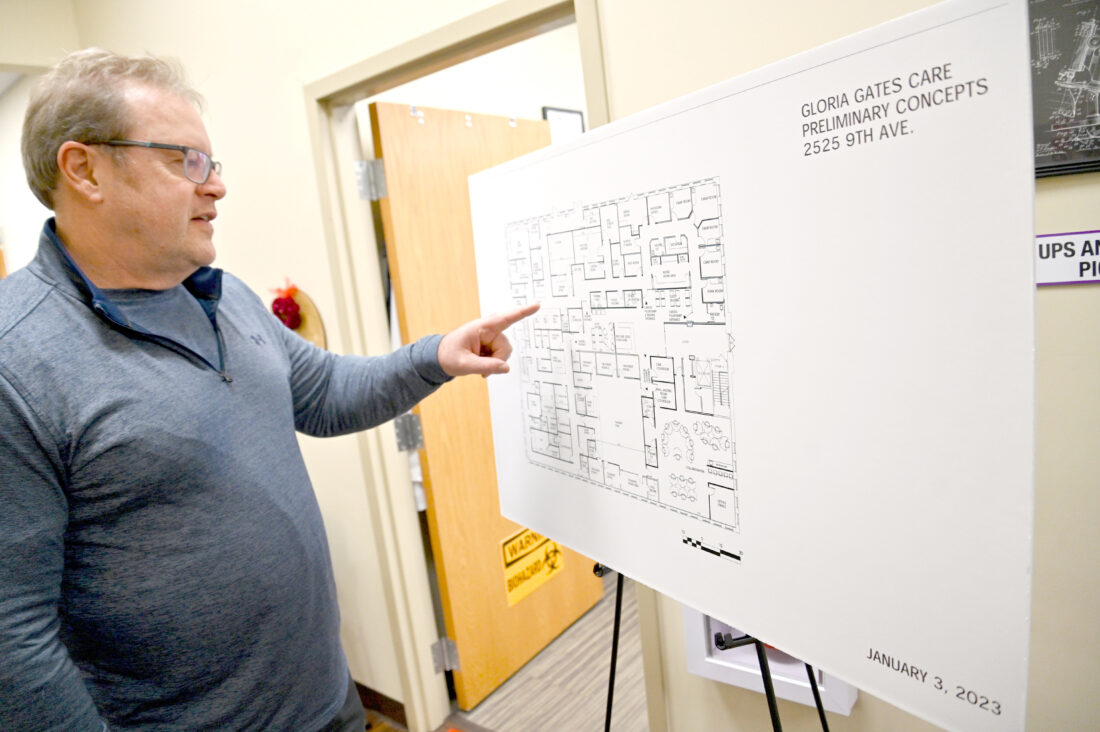
Val Mignogna, senior vice president for clinical operations for Gloria Gates CARE, goes over the plans for the new facility near the Grande Palazzo.

Lab manager Becky Jacobs works in the lab at Gloria Gates CARE in Altoona. Mirror photos by Patrick Waksmunski
Val Mignogna, senior vice president for clinical operations for Gloria Gates CARE, goes over the plans for the new facility near the Grande Palazzo.
Trending
Local physician Zane Gates has launched a new membership-based, direct primary care organization dedicated exclusively to serving Medicaid recipients.
Named after Gates' mother, Gloria Gates CARE will provide Medicaid recipients the same scope of care that patients at Gates' PeopleOne Care provided to holders of direct care memberships that were paid for by employers, according to Val Mignogna, senior vice president for clinical operations for Gloria Gates CARE. The new facility is located at Puritan Park near the Grande Palazzo.
The new organization, and Gates' break from medical involvement with PeopleOne, reflects Gates' passion to serve a population that he was part of growing up in an Altoona housing project, and also reflects his ongoing effort to refine a health care model designed to ameliorate what ails traditional health care while improving the scope and quality of care for the poor, according to Mignogna.
The major ailment is billing and other administrative expenses that generate as much as a quarter of U.S. health care costs, Mignogna said.
Prior to the change, PeopleOne Health provided membership-based direct -- and enhanced -- primary care for both patients whose employers paid the recurring dues and for Medicaid recipients, for whom the government paid.
The enhanced component comprised an in-house pharmacist, in-house social worker and an in-house dietitian, along with screening for drug and alcohol and mental health issues. The employer-paid patients however, also had easy access to lab services, including blood tests; a formulary of basic drugs; virtual visits with specialists; X-ray, MRI and CAT-scan services; along with heart and lung function testing, based on prior contracts between PeopleOne and the providers of those services outside the office, Mignogna said.
Mignogna said it was different for the Medicaid recipients, because they could only obtain those additional services by getting past "barriers" that included prior authorization and bureaucratic interaction between Medicaid and the service providers.
It was not only a hassle for the Medicaid recipients, but it was confusing to staff, he said.
Now, with the creation of Gloria Gates CARE, all those additional services are available without the barriers, Mignogna said.
For some of those services, Medicaid patients will need to go elsewhere, but they will be able to access those services easily, based on contracts between Gloria Gates CARE and the service providers, he said.
Eventually, perhaps by the end of the year, many of those services will be available within the Gloria Gates CARE facility itself, Mignogna said.
Previously, PeopleOne occupied one half of the second floor of that facility at Puritan Park. Now Gloria CARE comprises not only that leased space, but the entire first floor, Mignogna said.
PeopleOne will continue to serve patients covered by employer-paid memberships, but only at its former second location at InTown Square, Mignogna said.
The financial basis for Gloria Gates CARE rests on Gates' application of game theory to a capitation model for health care, in an arrangement under which the parties involved divide up the available funding in a way that makes the most sense for everyone, according to Mignogna.
Under capitation, a fixed amount of money is paid to a provider to give a certain scope of care to a patient for a given length of time.
In the case of Gloria Gates CARE, Medicaid makes those payments, which cover most common medical issues -- although not special matters like surgery.
By covering the costs of common problems with recurring, predictable payments, many permutations of the billing process are stripped away, Mignogna said.
In traditional health care, that billing process can include scheduling of appointments, pre-registration of patients, registration of patients; billing itself; entry of applicable charges; coding, billing edits; billing evaluations to assess validity of claims; and follow up and reception of payments, according to a chart provided by Mignogna.
A California study from a couple decades ago showed that total administrative costs for doctor groups amounted to 27 percent, with billing and insurance related costs amounting to about 14 percent, according to the Center for American Progress. Total administrative costs for hospitals were 21 percent and billing and insurance costs were about 9 percent, according to the study.
The nature of health insurance itself is a problem, because it tends to violate some of the principles on which most insurance is based -- like car insurance: It covers predictable, rather than random, occurrences; it invites overuse by policyholders whose costs are already covered; it can be abused by people who postpone buying it until an illness threatens; and it can sometimes discourage people from getting necessary care, based on what policies don't cover, according to Fundamentals of Insurance: Implications for Health Coverage, in a brief from the American Academy of Actuaries, as supplied by Mignogna.
The social service aspect of the care that Medicaid recipients receive will be enhanced at Gloria Gates CARE by its employment of a health care advocate, according to Mignogna. The advocate will work with patients to ensure they have access to nutritious food, adequate shelter, transportation to get to medical appointments and knowledge about medications and a healthy lifestyle.
Medicaid recipients aren't generally treated well by the medical system, because reimbursement to providers is low -- which means those providers are not "financially incentivized," according to Mignogna.
"People are not lining up to take care of this population," Mignogna said. "We want to embrace them, serve them better than they were ever served."
Medicaid recipients often struggle to obtain appointments and to get the care they need, and they often, therefore, end up getting sicker than they would have gotten with top-notch care, he said. After getting unnecessarily sick, they often end up getting care in emergency departments, which are an inefficient venue for such problems, according to Mignogna.
In addition to steering patients away from emergency departments, the new model should also help reduce hospital readmissions, because post-discharge procedures will get proper attention, Mignogna said.
By giving Medicaid recipients good care on time and by providing adequate preventive care, and by helping patients solve familial, financial and social issues that interfere with good health and with appropriate medical treatment, Gloria Gates CARE can bypass some inefficiencies -- while helping ease the suffering of Medicaid patients, according to Mignogna.
Gates is a "national-level health care innovator," said Mignogna, who has been in health care for 37 years -- the last seven with Gates.
Gates and Mignogna continue to have an ownership interest in PeopleOne.
Gates, along with local entrepreneur Donny Beaver and Blair County native and fellow entrepreneur John Lee, are investors in GloriaGates CARE.
Plans are underway to open a second center this summer as well as create additional locations in underserved communities across the state, according to a news release on the company.
Mirror Staff Writer William KIbler is at 814-949-7038.