
Proud of record, Doyle concludes 2 decades on bench
Trending
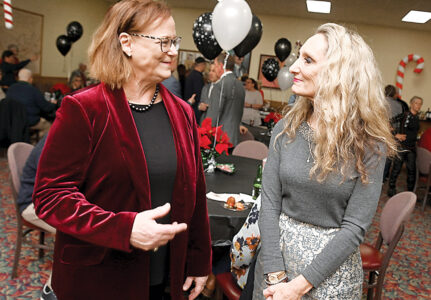
HOLLIDAYSBURG -- Blair County President Judge Elizabeth Doyle, 66, is wrapping up 20 years as a common pleas judge. "Each one of these jobs has been a little bit different and I've been happy to give everything I had to every one of these jobs," she said during a recent interview.
Mirror: What do you take away from your work?
Doyle: I'm very proud of my record. I've worked with so many incredible people over the years who have improved me as a person and as a judge.
Mirror: Do you have a favorite or a memorable case?
Doyle: There have been so many cases over the years but the very first capital homicide case is one that sticks with me. That was Andre Staton's case, especially because the facts were so egregiously horrible and involved domestic violence and children. Those are things you never forget. (Note: Staton was convicted in the stabbing death of his estranged girlfriend, Beverly Yon, 26, in 2004 in Logan Township, where she was in the process of sending her children to school.)
Mirror: Do you recall your feelings associated with the Staton case?
Doyle: I took the bench in 2004 and I was terrified that I would not be prepared to handle a capital homicide case. So I flew out to Seattle, Wash., and I took a course on handling capital cases offered by the National Judicial College. I wanted to be prepared and they had excellent materials that I did use in that case. And I used their materials in the Paul Ross case, the Drue Burd case and the Isiah Payne case. During my time on the bench, I handled four capital homicide cases.
Mirror: So did you feel prepared when you pronounced Staton's death sentence on June 1, 2006?
Doyle: It is a weighty thing to look somebody in the eye and announce that the jury has decided that their penalty should be death. When you say that and when you say the traditional, "May God have mercy on your soul," it is solemn and a weighty occasion.
Mirror: Any other case that you would describe as memorable?
Doyle: One of the most memorable cases was the Tammy Grimes case in 2006. She stole a 19-year-old German Shepherd from its owners and the dog died in her care. Because she portrayed herself on social media as a savior of the dog, I was flooded with emails and written correspondence about the injustice of following Pennsylvania law about theft and property. At her jury trial, she was convicted of theft in 30 minutes. This was a great example of how malicious disinformation on Facebook and other social media outlets can distort the facts and the record.
Mirror: What
other type of cases filled your schedule?
Doyle: I handled a lot of major child sexual abuse cases and I've always taken those cases extremely seriously. Severe sexual abuse of a child kills a little bit of a child as well as the person that the child could have become, if that terrible thing had not happened. So the people convicted of those crimes always received sentences from me that were intended to be punitive and to ensure the safety of the community.
Mirror: Of all the other cases and tasks that have come before you, along with administrative matters, do any other efforts stand out?
Doyle: Yes. When the county was planning reassessment and there was a prediction that we were going to have 6,000 tax appeals to address, I worked with Janice Meadows, court administrator at that time, and we set up a system of mediation, with retired Judge Charlie Brown, attorney Dave Andrews, Dave Halpern ... and others. Reassessment had a huge potential to clog the court for years. But because of the efficiency of the mediation system and the satisfaction of the people who engaged in it, we didn't have any backlog or clog from reassessment. Now, I'm not saying everybody was 100% in love with the result they got ... but I think a majority were satisfied because there were very few who took it beyond mediation to the court of common pleas.
Mirror: Any others?
Doyle: I'm also very proud of helping Sheriff Larry Field set up security at the entrance to the county courthouse. This effort was started long before it happened ... then President Judge Jolene Kopriva let me take the lead on the effort with Sheriff Field. In the first year of operation, the security system intercepted hundreds of knives, some guns and other materials that would have been dangerous in the hallways and courtrooms. I believe this was a real contribution to the safety and security of the courthouse visitors and employees.
Mirror: Can you address your involvement in specialty courts?
Doyle: I ran a juvenile drug court for a while, and with the team involved in managing that court, I think we helped those juveniles and their parents. Fortunately, we have not continued to have the level of addiction that we did, but any judge interested in setting up that specialty court could do so, as long as there's enough staffing in the juvenile probation department.
I've also enjoyed my time with the DUI Court and the team that manages it. The local drug and alcohol service providers are as good as any in the state ... And we've had a lot of success stories in that court.
Mirror: Disappointments?
Doyle: I'm disappointed that the commissioners haven't seen the value of their employees and raised the salaries to a rate where we can attract and retain employees. I'm not criticizing any particular commissioner or combination of commissioners, but it's just disappointing to me that they have not seen the importance of the court service to the citizens and sufficiently raised employee salaries. I understand that they have obligations to be fiscally responsible -- and I know they've always been trying to do what's best for the people -- but we have obligations to provide the best service possible to the citizens and litigants as well.
Mirror: As the COVID-19 cases began increasing locally in 2020, did you feel that you had sufficient support and guidance from the governor's office, the state department of health and the Administrative Office of Pennsylvania Courts to modify court operations?
Doyle: Early in the pandemic, the Pennsylvania Supreme Court shut down court operations statewide, so president judges had no choice but to comply. However, the courts were kept partially open for "essential functions," some defined by the Supreme Court, but the president judges of each district could choose some other functions to be essential. So for example, in Blair County, I deemed protection from abuse orders to be essential functions.
Similarly, I designated court personnel as essential personnel and they were not laid off during the pandemic. This helped us keep our court system running during the pandemic and helped us recover fully after it was over. Every decision I made during the pandemic was based on advice from local experts, local emergency management personnel and people in the court system.
Mirror: What's your assessment of that operational time?
Doyle: Because of the way we conducted court during COVID, Blair County canceled many fewer jury trials and rebounded faster than other Pennsylvania counties after the pandemic was over. We had risen from carrying a load of 1,300 criminal cases to 1,800 cases; within a year, we had brought it back down to 1,300 cases. At the swearing-in ceremony in 2022, I thanked everybody in the court system for their diligence during the pandemic and their good work in keeping our doors open as much as possible to help the citizens of Blair County.
Mirror: Any insight on community changes during 20 years in office and how that has affected crime and criminal cases?
Doyle: Blair County is a wonderful place to live, a wonderful place to raise children. I think the community has been very vigilant over the years to preserve its quality of life. The nature of the cases really hasn't changed. One year will have more child sex abuse and then the next year we'll have more drug cases. The volume of
cases ... it's been about 2,500 a year and it's been that way for a long time. Many years ago, child sex abuse and domestic violence used to be hidden and kept secret because they thought of it as a family matter. But that has changed and we now recognize that it impacts and affects the whole community. And the drugs are deadlier now so we're seeing more unfortunate tragedies in our drug cases.
Mirror: Do you have recommendations on addressing drug-related crimes?
Doyle: I know there's been recent criticism of community groups that help stem the tide of Blair County's drug problem. I disagree with that criticism. An organized community group is for education of children to keep them from using drugs, for supporting rehabilitative efforts of people who have been on drugs and for helping landlords whose tenants may be involved in drug use. So I get frustrated when people accuse community groups who have a broad and good purpose of acting in bad faith with a very small narrow part of their mission. So I would challenge people to build up instead of tear down.
Mirror: So how are you wrapping up your cases and caseload?
Doyle: I am tying up loose ends with all my cases that are being directed to other judges or to Judge (Wade) Kagarise for his caseload or to assign to someone else when he becomes president judge effective Jan. 1. I've always tried to live by Judge (Thomas) People's words about returning the trust of the people in an untarnished state. I believe I have done that and I'm very proud of that.
Mirror: As for your future?
Doyle: I'm going to be retired, but that's not to say I'm going to do nothing in retirement. I'm going to look around and weigh my options. I'm a person who has always kept busy ... I might gravitate toward some kind of public service because public service is in my blood or maybe in the form of volunteering ... But I have time to look around and I'm in no hurry.
Mirror Staff Writer Kay Stephens is at 814-946-7456.