
Work starts on Antis trail coal removal
Trending
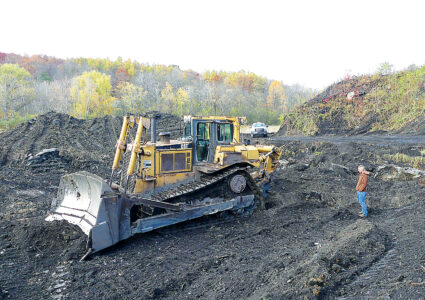
Workers have begun removing a ridge of refuse coal south of Bellwood, between the mainline railroad and a gravel track parallel to Kerbaugh Road -- a two-year project comprising most of what is needed for Phase 2 of Antis Township's proposed First Frontier Valley Trail.
Robindale Energy of Latrobe will be excavating and hauling most of the about 360,000 tons of material to a co-generation plant, where it will be mixed with other fuel and burned to create power.
Funded by a $1.3 million Abandoned Mine Lands grant and administered by the state Department of Environmental Protection, the job will create a raised flat area where the township can construct athletic fields or other facilities that will complement the trail, which will run along the existing gravel track.
Several months ago, a timber company cut the woods that had covered the ridge, grinding up the trees and brush and depositing that material on site for later mixing with soil, after the coal removal is complete.
Robindale employees have cut roads with a bulldozer into the ridge to allow for an excavator to begin digging into the black mix for loading onto tri-axle dump trucks.
Subcontractor Glenn O. Hawbaker will transport the material and will have more trucks available after paving plants close for winter, according to Township Manager Doug Brown.
At its peak, Hawbaker will be taking 70 to 80 loads per day, depending on weather and the availability of trucks, Brown said.
The amount of refuse coal to be removed will depend on what the workers find, he said.
They'll separate the usable material from dirt and rock using screens.
The remaining dirt and rock will be covered eventually with silt from the Lakemont pond.
Antis will receive some reimbursement for the energy value of the refuse coal, according to Brown.
Township officials have been erecting barriers to discourage riders on four-wheelers from accessing the worksite.
Phase 2 will run from Becker Road to Lower Riggles Gap Road.
The trail plan
Phase 1 of the trail will run from under the Route 865 overpass in the middle of Bellwood, along an alley, over the mainline tracks on the existing pedestrian bridge, over Bells Gap Run on a proposed new bridge, then parallel to the stream to Becker Road, Brown said.
PennDOT is handling Phase 1 and providing a $1.5 million grant that will pay for nearly all of the work.
The township hopes that PennDOT advertises for bids this year.
If that happens, much of the work could be done next year, although there are potential complications.
Constructing the bridge over Bells Gap Run will be a challenge, as no activity is permitted in that trout stream between October and April, he said.
The alley section will be paved, and other areas will be surfaced with crushed stone.
Phase 3 would take the trail from Lower Riggles Gap Road to a trailhead just inside Logan Township, near Ponderosa Drive and North Fourth Avenue, at the extreme northeastern tip of the city.
There are no set plans on how to do Phase 3 or how to pay for it, although it's possible that township employees could do much of the work, because the trail would run on an old rail bed that provides a stable foundation, according to Brown.
The township undertook the project several years ago in expectation that other municipalities and agencies would create trails that would help connect the Antis trail to others that already exist, Brown said.
Coal refuse
The refuse coal on the Phase 2 site came from industrial operations that began in 1905, when the H.S. Kerbaugh Co. of Philadelphia hired a contractor to build a railroad construction facility comprised of a foundry, a machine shop, a railcar construction shop and a supply house, according to the article, "Kerbaugh, Pa., Blair County's Unfinished Town," by local historian Michael Farrow.
The site's operations ceased by 1917, but reopened under the Poland Construction Co. of Philadelphia in 1920, according to Farrow.
Poland sold the site to the National Steel Construction Co. three years later, which re-equipped the facility to produce structural and other kinds of steel for buildings and holding tanks.
National Steel sold the property to the Pennsylvania Railroad at the end of 1925.
Most of the buildings were gone by 1930, at which point it was in possession of the Dixon Motor Co. of Altoona, which had intended to build a truck manufacturing facility there, according to Farrow.
The site may have been used at some point as a coal transfer, storage and processing operation, according to an expert the township summoned to examine the property several years ago.
The PRR also used the site to unload ash and spent coal from locomotives, according to Brown.
Mirror Staff Writer William Kibler is at 814-949-7038.