
Tools of the trade — Local butcher joining international contest
Trending
Growing up near Princeton, N.J., Mark Madden played baseball and hoped through the years that one day he could make it big, but he peaked in high school.
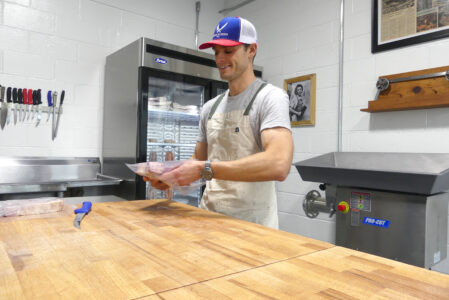
Now 34, Madden lives in Hollidaysburg with his area-native wife and their three young children, operating a custom butcher shop in Bellmeade.
It's a trade that in skill and physicality resembles an athletic endeavor like baseball, except that unlike baseball, he's broken through, qualifying recently to compete on the U.S. team at the World Butchers' Challenge in Paris, equivalent in that industry to the Olympics or the Major Leagues.
"The dream is not dead," Madden said, only semi-facetiously, in his shop on East Pleasant Valley Boulevard.
Madden began his butchering career while working for the Hillstone Restaurant Group in Denver, Chicago, Los Angeles, Long Island and Bethesda, Md.
It began in 2015 and 2016 as a "side passion" -- working with whole steers or hogs "for fun, for learning, for family and friends who wanted a quarter of freezer beef," he said.
He took inspiration from chefs in restaurants where he worked who made delicious meals out of animal parts that other chefs threw in the trash.
Those trashed parts included the heads of whitefish, whose filets the chefs would turn into sushi.
Experienced, creative chefs, some from Japan, Vietnam or even Italy, would take those heads, parboil them, cover them in greens and herbs, then pour in hot peanut oil, creating tender, delicious meals, some of the best he's ever eaten, Madden said.
He doesn't blame people who are unaware of what can be done with the less choice and less well-known parts of animals, but it's simply lazy when they know and still don't care or bother to take the trouble, Madden said.
"It sits uneasy with you once you see what you could have done," he said.
Chefs who refuse to waste any usable parts of animals operate under an ethic familiar to people raised during the Great Depression, Madden agreed.
With beef, the traditional choice parts include filet mignon, rib-eye and sirloin, but there are ways to butcher and cook other parts that make meals just as good or even better, Madden said.
Generally, the choice parts come from muscles that are basically unused by the steer, such as the one that lies alongside the spine, he said.
That lack of use makes them tender, he said.
Other parts that require expert butchering and special cooking to bring to gastronomical life are found in places like the shoulder that work hard as the animal goes about its life, he said.
Traditionally, shoulder meat is simply ground into hamburger, although it also yields some popular roasts, Madden said.
He bucks tradition by finding "tender, flavorful steaks" in the shoulder.
He does it by separating the muscles and dealing with them individually, identifying some that are more tender, some that are tougher.
Shoulder cuts have good fat marbling, better than some traditional choice cuts, which ultimately contributes to superior flavor -- although the tougher cuts need to be cooked longer and slower, with proper seasoning, he said.
"Fat equals flavor," he said.
He tries to educate his customers on the virtues of the non-traditional cuts and how best to cook them.
"Send (customers) away with a game plan," he said.
If he convinces one to buy a Denver steak, and the customer comes back the following week, having abided by Madden's cooking suggestions and wants another Denver steak, "that's a success," Madden said.
But if the customer comes back "and truly wants a rib-eye, that's OK too," he said.
Under the use-it-all ethic, Madden renders fat into beef tallow or pork lard to remove the moisture, after which it can be sold for cooking or even soaps and cosmetics.
He also saves the bones, which can be made into stock.
"Very energetic and self-driven," said Madden's father-in-law Gary Watters, executive director of AMED. "Working hard to make a success of himself."
Selecting his meats
He buys his animals from Pennsylvania farms.
They're shipped to a slaughter facility in Howard, Centre County.
Most of the beef he buys are steers divided into two forequarters and two hindquarters.
The total weight that he picks up from the slaughterhouse in his refrigerated truck is usually between 800 and 900 pounds - from what was originally an animal that weighed between 1,300 and 1,500 pounds, he said.
All those steers and occasional heifers are under 30 months old, as required by the U.S. Department of Agriculte, for reasons of disease prevention.
Working with those quarters is taxing. "It's a physical thing, which I like," he said.
It's not easy, but it's rewarding. It's satisfying to see 200 pounds of meat on a table and, an hour later, to have 50 steaks, ready to sell, he said.
Vying for team
Madden tried out for the U.S. team in Sacramento in September, competing with 10 individuals for one of six spots.
He first learned about the world competition in 2017 and was intrigued right away.
He began following the organization through social media and its website.
The initial application process was by video. Essentially, it was "show us what you got," he said.
There was also an Instagram Live connection and a phone interview.
In Sacramento, each contestant had 40 minutes to butcher a sirloin, a pork loin and a leg of lamb.
It was done outside, under a tent, in a pedestrian mall, before an audience.
The runup to the Paris competition will require monthly three-day team practices in Sacramento.
During those practice sessions, the team will come up with and refine a game plan.
In Paris, the competing teams will be judged on utilization, yield, creativity, professionalism and cleanliness.
The ethic against wasting usable components of the animals will be operative, Madden said.
As of now, 13 nations have committed to sending teams.
He and a team member from New York City are the only American participants from the eastern U.S.
Each of the U.S. team members is responsible for raising a certain amount of money -- with everyone's obligation the same.
Madden declined to say how much.
He plans to raise the money by offering something in return -- lessons, classes or demonstrations, along with sponsorships, he said.
"I'm not asking for something for nothing," he said.
If someone cares to donate, they can call Madden at 609-819-1429 or 814-419-6463.
Donations also can be made on his behalf at the butchersofamerica.org.
Madden long ago aged out of his baseball ambition, but now has a chance to compete in what is known as "The Olympics of Meat," he said.
Not many people get a chance to represent their country like that, Madden said.
It's an opportunity that's "really, really unique," he said.
Mirror Staff Writer William Kibler is at 814-949-7038.