
Local officials react to speaker ouster
Bipartisanship fading from national politics
Trending
When Stanley Brand was general counsel for the U.S. House of Representatives under Speaker Tip O'Neill in the early 1980s, and a commission study showed Social Security to be in financial trouble, O'Neill and President Ronald Reagan took a walk in the Rose Garden and crafted a compromise that ensured the program's solvency for the next 20 years.
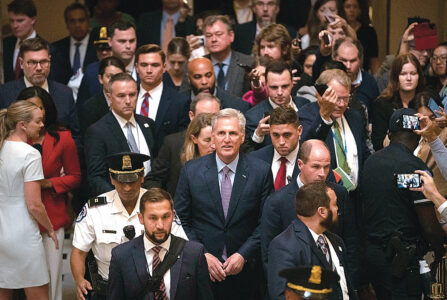
That kind of bipartisanship has increasingly disappeared from national politics since the Clinton administration, the latest manifestation being the ouster of House Speaker Kevin
McCarthy in a move executed by a group of far-right members, with support from all the Democratic representatives, said Brand, distinguished fellow in law and government at Penn State Dickinson Law School, in a phone interview.
McCarthy's removal illustrates what happens when members have the attitude expressed by a new Florida representative in the mid-1990s, who said, "'I didn't come to Congress to compromise,'" Brand said.
It's an attitude that doesn't comport with the Constitution, according to Brand.
"You came to the wrong place," Brand said rhetorically, answering the Florida congressman's assertion. "The Constitution is one gigantic compromise."
The proximate reason for McCarthy's loss of the speakership was his recent compromise with Democrats to pass a temporary budget extension that averted a government shutdown.
The far-right members didn't want him working with Democrats.
But without compromise, things don't get done, especially in situations like that in which the Republicans are operating, according to Brand.
They have only a slender House majority, and they're in the minority in the Senate and don't hold the presidency.
Having principles is "fine," but when those conflict with the reality of political numbers, they need "to yield in some acceptable way," Brand said.
"Flexibility" is key, according to Brand.
The far-right Freedom Caucus in the House isn't flexible.
One representative has labeled that group "pyromaniacs," Brand said.
Those members had the power with just eight votes to evict McCarthy, because they had extracted a concession in exchange for helping to install him as speaker in the first place that allows just one representative to initiate a recall vote, Brand said.
Florida Rep. Matt Gaetz exercised that option, leading to the ouster.
House action stalled
For now, the House is paralyzed, because the speaker's chair is empty.
There's a temporary speaker who's not likely to "seize power" to conduct business, given his tenuous position, according to Brand.
It's not clear who'll be able to get the 218 votes necessary to become McCarthy's permanent replacement, although two candidates have emerged: Reps. Steve Scalise and Jim Jordan.
Former President Donald Trump also has suggested he could take over the speakership temporarily before reportedly endorsing Jordan on Friday to fill the position.
There are discussions set for next week, but there's no certainty that someone will be in place when the continuing budget resolution expires in November, Brand said.
"It's not the fault of the Constitution that this has broken down," he said. "It's the fault of the politics of the people (involved)."
In recent times, there have been fewer "professional politicians" who win election to Congress, Brand said.
Thus, there are fewer in Congress who work to be there long-term, he said.
A group of Tea Party members elected about a dozen years ago quit after several years, when they couldn't achieve their ideological goals, he said.
Widespread gerrymandering has helped nourish the ideological tendencies, rendering compromise unnecessary, at least to get elected.
With gerrymandering to create districts that are safe from the opposition party, the only threat comes from one's own party, in the primary, where contests often devolve into which candidate can appeal most convincingly to the base, according to Brand.
It's not only a right-wing phenomenon, but equally true for the left, he said.
The role of the speaker is "to get things done," said Blair County Republican Committee Chairman Jim Foreman.
But in a "split government" like the current one, the speaker doesn't have the luxury of ruling "with an iron fist," like the Freedom Caucus members expected of McCarthy, according to Foreman.
McCarthy took the pragmatic approach; those who ousted him the dogmatic one, according to Foreman and Brand.
Gaetz and the other seven Republicans who voted to remove McCarthy did so because they felt it was necessary to stand fast against further increase in the national debt, because they believe spending is out of control and because they think it's time for government to "take (it's) medicine," Foreman said.
Gaetz also seems to have had a personal animosity against McCarthy, according to Foreman.
In spite of the power exercised by the Freedom Caucus, there are many moderate Republicans fed up with the "hostage-taking," Brand
Vote hypocritical
Gaetz's unseating of McCarthy was ultimately hypocritical, given that he did so in retaliation for McCarthy working with Democrats on the continuing budget resolution, then essentially worked with Democrats on the ouster, according to Blair County Democratic Committee Chairwoman Gillian Kratzer.
McCarthy's behavior seemed actually to be selfless, being punished for working with Democrats for the good of his party and the nation, while then declining to work with the opposition party to save his prestigious post, Foreman said.
Some observers have criticized the Democrats for not supporting McCarthy.
Not Kratzer.
"Kevin McCarthy made his bed, and now he's lying in it," Kratzer said.
McCarthy can't complain about lack of Democratic support after previously "bragging" about not working with the Democrats, she said.
"You can't have it both ways," she said. "Why is it our party's responsibility to (rescue) him?"
Could the Democrats have traded support that would have kept McCarthy in his post in exchange for concessions?
Democratic Minority Leader Hakeem Jeffries broached that possibility with McCarthy, but McCarthy refused to make concessions, Foreman said, citing "a good source."
Maybe the Democrats should have offered support regardless, according to Brand.
"In the long term, I think they are going to regret that they didn't find a way to trade something for something," Brand said. "They're likely to get a lot worse than they got under McCarthy."
The whole situation is "a shame," said former Blair County Commissioner Donna Gority, a Democrat.
"A witch's brew," Brand said.
"Washington, D.C., is useless," said state Rep. Lou Schmitt R-Altoona. "They're not dysfunctional; they're non-functional."
It would be nice if someone could unite the Republican Party who's willing to "work on a reasonably trusting basis with Democrats," Gority said.
That needs to be done at the community, state and national levels, according to Foreman.
"Even with differences of opinion and approach and perspective, (it's important) to be able to respect and acknowledge the greater good (possible) from working together, when you don't get your way 100 percent of the time," Foreman said. "It's like a marriage: it can't be your way all the time, and if it is, there's a problem."
Mirror Staff Writer William Kibler is at 814-949-7038.
Joyce reacts to ouster
U.S. Rep. John Joyce, R-13th District, voted no to the recent resolution calling for the speaker's chair in the House to be vacated. He was traveling through his district during the last half of this week, and so was not able to talk by phone, according to an office spokesman, who emailed a statement: "My constituents sent me to Washington to fight inflation, secure our border and decrease our national debt -- not vote with AOC, Ilhan Omar, Jamal Bowman, and 216 House Democrats to oust a conservative Republican Speaker of the House. I was proud to stand united with my Republican colleagues, including every Republican congressman from Pennsylvania."