
Blair NAACP celebrates 100 years
Chapter is steeped in history of nation’s civil rights struggle
Trending
For 100 years, the Blair County NAACP has been influential, not only at the state level, but nationwide, as its members have worked tirelessly toward its goals of achieving equity, political rights and social inclusion for all people of color.
"All of the hard work and all of the effort has made progress, but the fight isn't finished," President Andrae Holsey said. "It won't be until we get to where we need to be as an inclusive community."
The branch's centennial will be celebrated at its third annual Freedom Fighter Gala on Wednesday, Oct. 18, at The Casino at Lakemont Park, where they will also be honoring civil rights advocates Alice Lawrence and the Rev. Gwen Pattillo.
The theme for this year's gala will be "The Fight Ain't Finished," to show how the branch works to advocate not just for Blair County, but all of central Pennsylvania.
"Not a lot of branches get to be so old, and some are still relatively new," Holsey said. "To have such a foundation is incredible. It's about the mission of this association and what it means to the people and how they actively work every day to make Blair, Bedford and Huntingdon a better place."
The Freedom Fighter Gala stems from the Freedom Fund Dinners implemented by past-president Donald E. Witherspoon in 1994, Holsey said. Upon Witherspoon's passing in 2020, Holsey said that he wanted to give the tradition new energy because "the freedom fight had transformed."
"We realized that with the intensity of the Black Lives Matter and the feelings around it, we had to better communicate our goals as a branch so it only seemed appropriate to make a decision like this," Holsey said.
Proceeds from the event help finance the branch's yearlong programs in the areas of education, housing, economic development, health and youth.
Established 1923
In 1922, the KKK began taking out advertisements in local newspapers promoting the superiority and purity of whiteness.
"So, according to the archives, the klavern in 1922 Altoona was so influential that it was able to tell the national organization what they were going to do on their own, independent from other klaverns," Holsey said. "The NAACP faced major opposition here."
As a result, in November 1923, a group of residents came together in Hollidaysburg to form the state's first branch of the NAACP. Most of its members at that time were already members of other civic organizations such as women's clubs or peoples rights leagues, Holsey said, many of them the descendants of slaves.
The branch spent its first year with an interim president trying to get on stable ground, Holsey said, and on Nov. 6, 1924, Dean B. Stives, a woman of Hollidaysburg, was elected as the branch's first official president.
Archives show that Katherine M. Graves was elected vice president; C. Randolph Brown as secretary and G. M. Graves as treasurer. Their first action was to plan a fashion show and dance with the Community Aid Club on Dec. 1 to aid the poor in the community.
Holsey said that these types of events were typical of the branch's early years as it tried to gain a foothold in the community. Its members held charitable events while educating the community on how to uplift each other.
They made sure to focus on community aid and not civil rights, he said.
In his own research, Holsey found that the branch's first committees included those for legal redress in the local judiciary, a labor and industry committee and an education committee to address segregation in local schools.
In 1934, at the Juniata Street home of George and Agnes Walker in Hollidaysburg, nine people held a meeting that would ultimately form the NAACP Pennsylvania State Conference. According to the State Conference's website, those present at the meeting included Pittsburgh resident Daisy Lampkin, who was the NAACP field director, member of the NAACP National Board and vice president of the Pittsburgh Courier newspaper; Sophie B. Nelson, a school teacher and civil rights worker from Pittsburgh; Charles R. Brown, postal worker from Hollidaysburg; John C. Jones of Pittsburgh; and James A. Gillespie and John B. Campbell, both of New Castle.
The early objectives of the State Conference included "providing support to the National Office in its efforts to end injustices and bigotry throughout the nation, as well as securing voting rights for all citizens and putting an end to mob violence and lynching," while on the state level, it put emphasis on "organizing new local branches, and securing fair housing and fair employment."
Fight for civil rights
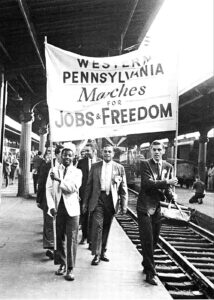
Between 1945 and 1958, most of the Blair County NAACP's focus was on functionality, communication and setting up regional vice presidents, Holsey said. In the late 1950s and early 1960s, the founding members of the branch had moved on to State Conference positions.
In October 1955, Agnes Walker was re-elected as third vice president of the Pennsylvania State NAACP, while George Walker was elected as a director of the state branch in December of that same year. In 1958, tennis legend and Wimbledon winner Althea Gibson attended the 24th annual NAACP State Conference, which was held at the Penn Alto Hotel in Altoona, making the Blair County branch nationally famous and influential, Holsey said.
Members of the Blair County NAACP can even be seen in the front row of the March on Washington in 1963, watching the Rev. Martin Luther King Jr. give his "I Have a Dream" speech.
"It's pretty cool, it's a big part of history," Holsey said. "This branch has been very influential in the history of the NAACP and decisions made nationwide."
Archives show that in 1965 the Blair County NAACP, alongside the Blair County Human Relations Council, planned to hold a march on March 18 "to express sympathy for persons in Alabama."
According to the National Archives, in March 1965, three marches took place in Alabama from Selma to Montgomery to protest the blocking of Black Americans' voting rights by the systemic racist structure of the Jim Crow South. The Selma Marches would become a watershed moment that led to the passing of the Voting Rights Act of 1965.
Holsey pointed out that the Blair County NAACP was instrumental in changing the state's harassment laws because, until the 1990s, it was still legal to burn a cross in someone's yard. He said that Don Witherspoon, state Senate President Pro Tempore Robert Jubelirer and Gov. Tom Ridge assisted in passing a law by helping to draft an anti-cross burning bill, an amendment on what constitutes harassment.
"We are one of the few that can take credit for being named on legislation thanks to Mr. Bob Jubelirer," Holsey said. "With the anti-cross burning bill of 1997, our branches had direct interactions with Althea Gibson, Coretta Scott King, Thurgood Marshall."
To the next 100 years
Holsey said that the Blair County branch is one of the only branches that has co-authored a bill, but has not taken anyone to court for intimidation or corruption and has never gone to the state conference to solve the county's issues.
"Now that we move into our 100th year, the Blair County NAACP intends to take legal actions, asserting its points through litigation and legislation over the course of the next year or two in Congress and court," Holsey said. "The Blair County NAACP of today plans on partnering with authoritative bodies of government to hold other bodies of government accountable."
Holsey said that so far, he has performed an inspection of the local prison with clearances from the prison society, worked with several organizations regarding their concerns with public officials and discrimination cases.
"We have also returned to town in the Gables Building, which in the early 1900s was one of the only places where African Americans could be employed as equals alongside white people, with full-fledged civil rights," Holsey said.
He also said that their membership numbers were quite strong, but that the more hands they had in the fight, the easier it would be to engage the community.
"It's not all lawsuits and memorandums," Holsey said. "We want to keep the community a better place. We want to have a say in broadband, in the comprehensive plan, and the more people we have to spread out the work, the better off we'll be."
Looking toward the future, Holsey said that his hope is to advance regional president communication because "this area has struggled for a long time."
"Our issues are everyone's issues," Holsey said. "To defeat hate, we must make the community our responsibility."
Mirror Staff Writer Rachel Foor is at 814-946-7458.