
Toad-ally awesome — Frog Week project aims to monitor, increase wild populations of amphibians
Trending
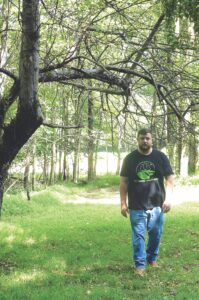
EBENSBURG -- A passion for helping animals evolved into Frog Week, a citizen science project created by AAron Capouellez to increase interest in conservation efforts.
"I wanted to create something to get people interested," Capouellez said. "It was the idea of getting people to care. But the deeper I got into it, I saw there was a need for somebody to care for the commons."
Now owned by PA Woods and Forests, the Frog Week project aims to monitor, increase and document wild populations of American toads, wood frogs, gray tree frogs and pickerel frogs. Capouellez and his crew of volunteers also film their efforts to create educational videos for a YouTube and fieldwork conservation project with its partner, Woods and Forests Media.
"The state doesn't fund these animals," Capouellez said. "The state doesn't necessarily have the resources to take care of them. So, we can put ourselves in a good position. Let's say 50 years from now, the American toad would be in decline somewhere. Well, if we know how to create the habitat or know how to do things to help them, then we're put in a place to possibly stop a declining species."
Other key features of the project include performing road rescues to move frogs; rescuing wounded or sick frogs and taking them to wildlife rehabilitation centers; hosting nature hikes to teach the community about the frogs and toads in their backyards; showcasing ambassador animals with Critter Talks; creating backyard habitats and monitoring them for suburban frogs and toads; and relocating tadpoles from drying pools.
"If I can build the nonprofit big enough with the other board members or if I can build up the media brand and I can get funded from that, I mean, that's kind of the goal," Capouellez said.
Beginning in undergrad
Capouellez is a graduate student specializing in herpetology, the study of reptiles and amphibians, in biology at Indiana University of Pennsylvania. He began this project five years ago, as an undergraduate studying communications at the University of Pittsburgh at Johnstown.
"I don't even necessarily think that it was a change," Capouellez said of going from communications to biology. "I'm somebody who knows how to talk to the public and wanted to go and get as technical as possible to get that knowledge and education in biology, then bring it all back together at the end."
That way, he can create something special that would get people involved while being able to talk to them in a way that they would understand.
"The way I approach it is I'm trying to meet people, trying to actually work with the public," Capouellez said.
Capouellez is working on a research paper to create a distribution map of frogs and toads for Somerset, Cambria and Indiana counties.
Capouellez said, "I'm able to go out and look for these animals and the school has funded a little bit of that with federal work study."
He also works as an intern at the Somerset Conservation District and works with geographic information systems for IUP's geography department.
Backyard conservation
Capouellez said that the plan for Frog Week 2024 is to emphasize backyard conservation and that he'd love to go to schools and show how to create little habitats for frogs.
"I have a couple of high schools and elementary schools that I go to," Capouellez said. "It'd be awesome to rescue (tadpoles) and put them in classrooms, let the kids watch them grow and then bring them back here."
If the project can get the necessary funding, Capouellez said they would get trail cameras to monitor each of the habitats that it has created. Some of those habitats are located on 36 acres of land outside Ebensburg owned by Susan and Paul Rosenbaum.
"It's only going to help these animals as people are building ponds back here," Capouellez said. "It's all private property and the people here don't seem to mind the frogs."
Capouellez met Susan Rosenbaum at an event, where they ended up discussing tadpoles and frogs. He said that Rosenbaum thought she heard gray tree frogs on her property.
"He actually got a couple audio clips faintly in the woods," Rosenbaum said. "And I was like, 'all right, like it is definitely out there. I'm gonna go look now.' It was so late in the season though. That was like in July, and I was surprised to hear them."
Capouellez said that the Rosenbaums' property was a nice representation of all the different habitats available for frogs in Cambria County.
"There's a stream that runs about a half mile through the property, so we have water close by," Rosenbaum said. "We have plenty of trees and tall grass."
Preserving the land
Growing up in Hawaii and California, Rosenbaum said she had never lived in a rural area until coming to the East Coast.
"We wanted to preserve the land the way it was," Rosenbaum said. "We really value nature and leaving things kind of in the way they were meant to be."
The Rosenbaums bought their property from a logging company, which had left "a heck of a mess."
"They fell a lot of trees, big wood, all of those logs out there," Rosenbaum said. "And then they never picked them up. Bob said, 'you know what, we'll clean them up' and I said 'really?' If you let them rot down, it's better for certain species of critters."
Rosenbaum said they were first approached about conservation and monitoring certain animals by researchers studying the golden winged warbler.
They had also been approached by a shale company that said they had the largest deposit of shale in Cambria County on their property.
"They were offering big bonuses to put in shale mines," Rosenbaum said. "You know, those ugly mines."
She and Paul walked around their property to understand what they could lose if they allowed the mines on their land.
"We had a big discussion over it," Rosenbaum said. "Do we want to be financially comfortable? Or do we want to do what's best for the environment, which is why we bought this property and love it."
Indicator species
Capouellez described frogs and toads as "good indicator species."
"They're important for water quality," Capouellez said. "Like if you're looking for a frog and you want to know how good the water quality is, it'd be the pickerel frog. They're also good if you want to control pests, like stink bugs, ticks and lantern flies."
Capouellez explained that frogs have a hard time between deforestation and water pollution and that "seems to be where they don't show up."
"Gray tree frogs are an indicator of if the forest is intact," Capouellez said. "They breed in the open fields and then they live in the forest."
Strip mines and deforestation are especially detrimental to frog and toad populations because they completely destroy their habitats. Frogs lay tens of thousands of eggs in the hopes that one survives, Capouellez said.
"If they're lucky, maybe one out of 20,000 survives," Capouellez said. "When you see a big one, it's probably been alive for five or 10 years."
Some of the work that Capouellez does involves rescuing these animals and taking them around to different schools to teach the students the protocols they would need to follow to do something similar.
To properly rescue a frog, it first has to be quarantined in case it has a disease, then understand its habits, its dependencies, perform wellness tests, test water quality and then try to create a large enclosure for it, Capouellez said.
Capouellez's work with PA Woods and Forests spans eight counties, with possibilities of expanding into a ninth. He said there are even efforts for them to work with zoos.
"What I want to do is try to get the zoos to work with us to possibly take in wounded animals and do frog walks with them," Capouellez said, referring to nature hikes. "So they advertise it and then we can all accomplish a lot."
Mirror Staff Writer Rachel Foor is at 814-946-7458.