AAHS dedicates new courtyard sensory garden
Two teachers came up with the idea
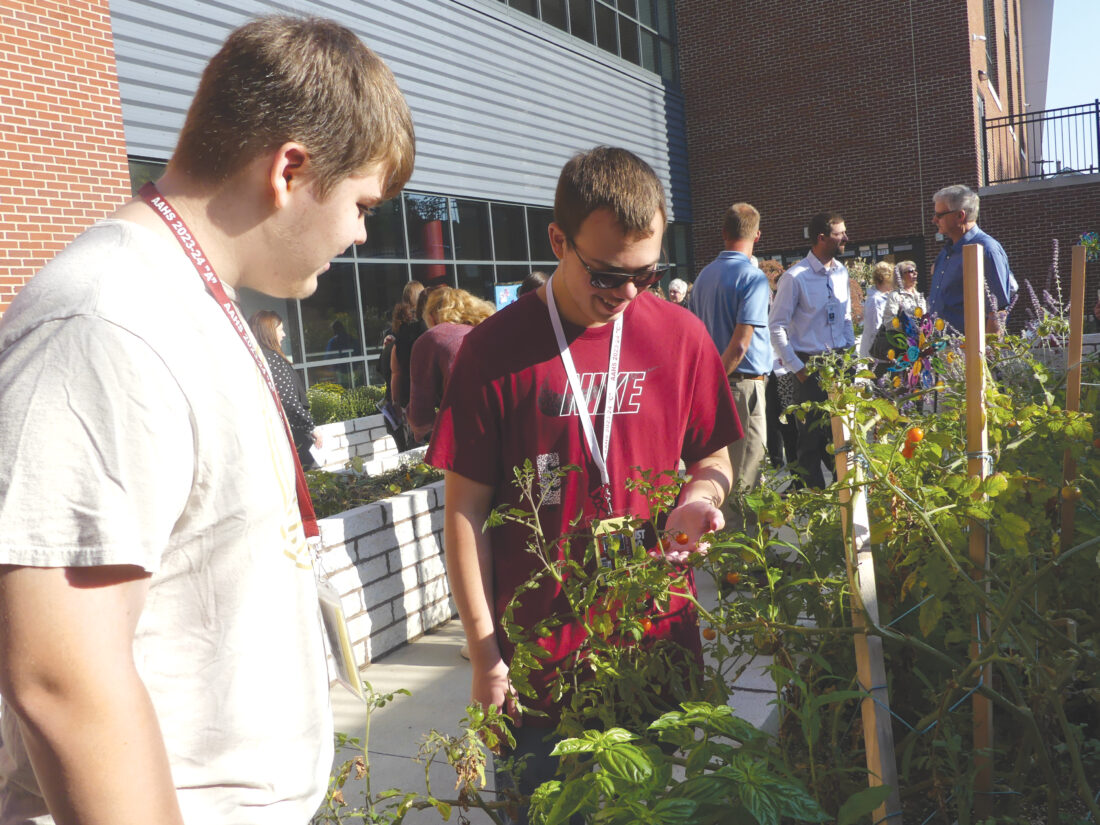
Photo by Cati Keith / Korbyn Clifford, a 10th grader, and Braydon Hetrick, an 11th grader, from the design and engineering class look at tomatoes growing out of one of the planters they helped create in the AAHS sensory garden.
A garden at Altoona Area High School is producing more than just vegetables.
It’s growing social skills, nurturing literacy and offering a calming place for students.
The sensory garden built in a courtyard within the Altoona Area High School was dedicated this week and featured refreshments made from the produce grown there.
“In the short amount of time that we have had this, it has impacted so many groups of students. It’s amazing,” AAHS Principal Andrew Neely said.
Special education teachers Paige Matteson and Maria Tyger presented the idea.
They wanted to involve as many departments from the high school and Greater Altoona Career and Technology Center as possible.
Matteson and Tyger wanted to create an environment for students that would stimulate the senses of sight, smell, touch, taste and sound.
Brendan Moran, AASD Foundation president, said the idea was presented to their board in early 2022.
The board was interested in the idea and agreed to provide the funding for the project.
“It is a perfect example of our mission to support educational experiences for AASD students,” he said.
The sensory garden was designed by students from Todd Bennett’s engineering and design class, installed by Bill Doutt’s GACTC masonry students and planted by AAHS Life Skills and volunteer students.
Bennett said when he was first approached about having his classes take part, the majority of students had never heard of a sensory garden.
“We took steps in researching and creating mock ups of what we wanted to do here,” Bennett said.
Once his students decided upon a look and measurements, they used computer programs to create digital schematics that were then given to Doutt’s masonry students to follow.
“Everyone did a good job designing and building,” said Braydon Hetrick, an 11th grader in the engineering and design class.
Planters in the garden showcase vegetables, fruits, herbs, state native bushes, flowers and a water feature.
Matteson said the garden enhances the students’ social skills through collaboration and communication and nurtures literacy through research, plant identification and documentation of their gardening experiences.
Students are learning how to grow produce and cook it in their life skills classroom every day, Matteson said.
“Let this garden represent our unwavering dedication to nurturing the potential in every student,” she said.
It not only provides an area that is both educational and stimulating but also an area where students can calm themselves.
Last week, a student with emotional needs sat at the fountain to calm down.
The garden also serves as a symbol of inclusion reminding them that every member of the community deserves opportunities to grow, learn and thrive.
“It is a testament to our community because I have witnessed how many people have come together to build this space, and I’ve witnessed our students here use the space already,” Matteson said.
Special education students maintain the garden throughout the year and harvest the fruits and vegetables.
No clue where to start
Matteson said when they first came up with the sensory garden, she had no clue where to start.
“I’m not a gardener, I’m just a teacher. I love to take care of the kids, and that is what I do,” she said.
Matteson said she really relied on people in the community to help get the project off the ground.
Through this experience, she learned that working with chocolate mortar is difficult.
“It was challenging, but the students did a beautiful job,” she said.
Since the creation of the garden, Matteson said it has really done a lot for the school.
“It is more than just a pretty place, it is a space with a purpose,” she said.
Matteson said the sensory garden was designed for social and emotional needs, and supports a deep understanding of biology and ecology in students.
The garden also instills valuable business lessons as they learn about sustainability and entrepreneurial opportunities.
The garden also serves as a symbol of inclusion reminding them that every member of the community deserves opportunities to grow, learn, and thrive.
“It is a testament to our community because I have witnessed how many people have come together to build this space, and I’ve witnessed our students here use the space already,” Matteson said.
A safe place
Korbyn Clifford, a 10th grade student in the same class, said it felt good to see the project finished.
“I hope it will be a safe place for anyone who needs one,” he said.
Doutt said this was his last big project before retirement, and working with the students was a joy.
“When Paige told me we were going to use chocolate mortar with white blocks, that raised some eyebrows,” he said.
Doutt said it is a challenge even for an experienced mason let alone students who are learning.
“They understood the challenge, and I cannot say enough about the effort they put forth,” he said.
Every student had a part in the project whether it was material into the courtyard, mixing mortar, laying the blocks.
“They were enthusiastic even when the weather was not great. They have learned so many things that they will take with them for the rest of their lives,” Doutt said.
Mirror Staff Writer Cati Keith is at 814-946-7535.
Local News
State targets AI misinformation
The Pennsylvania Department of State has established an artificial intelligence safety task force and launched an ...
New land for prison to cost Blair County $600K
States struggle to implement SNAP junk food ban
The head of the Department of Human Services says there are logistical problems with proposals to ban the use of ...
Cambria County plans America250 events in Ebensburg
The Cambria County America250PA Committee has announced plans to mark America’s 250th anniversary on July 4 with ...
Book club