
Kneel-in protests racism
‘White coats’ fight injustice

Health care workers and members of the Blair County Branch of the NAACP held the third annual White Coats Against Racism and Injustice kneel-in outside of UPMC Altoona on Thursday afternoon. Mirror photo by Patrick Waksmunski
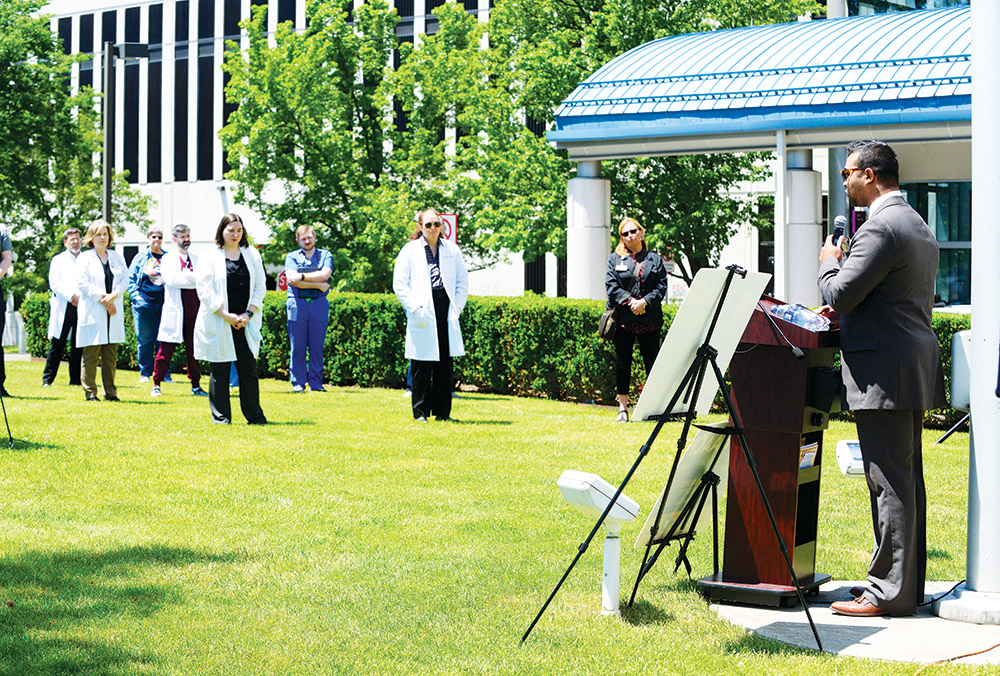
Blair County NAACP President Andrae Holsey (right) addresses those gathered for the third annual White Coats Against Racism and Injustice kneel-in outside of UPMC Altoona on Thursday afternoon.. Mirror photo by Patrick Waksmunski
Health care workers and members of the Blair County Branch of the NAACP held the third annual White Coats Against Racism and Injustice kneel-in outside of UPMC Altoona on Thursday afternoon. Mirror photo by Patrick Waksmunski
Blair County NAACP President Andrae Holsey (right) addresses those gathered for the third annual White Coats Against Racism and Injustice kneel-in outside of UPMC Altoona on Thursday afternoon.. Mirror photo by Patrick Waksmunski
Trending
Dozens of medical workers, NAACP members and area residents attended the third annual White Coats Against Racism and Injustice kneel-down in front of UPMC Altoona on Thursday to shine a light on racial injustice and discrimination in both health care and society.
The event was born out of the protests that followed the death of George Floyd on May 25, 2020, UPMC Altoona Family Physicians Program Director Donald Beckstead said.
"It was a horrible event," Beckstead said. "Sometimes good things, I find, can come out of bad circumstances, and I think this might be one of those times. Since that time, a new light has shone on behaviors that are just not acceptable."
UPMC Altoona was one of 13 UPMC hospitals that participated in the kneel-down, with the actual kneeling lasting for nine minutes and 29 seconds -- the amount of time that prosecutors said former-officer Derek Chauvin knelt on Floyd's neck during his murder trial last year.
UPMC Altoona Family Physicians Dr. Anudeep Alberts said that the loss of Floyd's life highlighted "a long series of racial inequalities and injustices."
"Our gathering today symbolizes how we, as medical professionals and members of this society, denounce racism and acts of injustice," Alberts said. "We promise to treat everyone fairly and equally. We promise to use our position as respected members of the health care community to oppose all acts of injustice."
Blair County NAACP President Andrae Holsey also spoke, saying that "time for action was then and the time for continued action is now" and that "we are fighting racism in institutions such as (UPMC Altoona)."
He said that those that work inside the hospital have a responsibility to "preserve the health of our community" and that "as far as the institutions are concerned, there are great strides to be made just in the realm of awareness."
Holsey also referenced the incident at the Aviation Inn last week in which an employee had printed a racial slur on a customer's receipt as evidence of things that still need to be overcome.
"Pardon my French, but to think that in 2023, employees in everyday places in this community can still laugh about referring to food and individuals as (n-words) is astounding," Holsey said.
He also said that there is "hope in the willingness of individuals to speak out and pursue change to its implementation to show those in the wrong the path to the right and that's why we're here today."
"In this hospital, this can be done by treating every patient with the same regard in spite of race, gender, age or class," Holsey said. "UPMC is making these strides as an organization, but there is always the impact of individual prejudices on people's service. For everyone else, just showing up is half of the battle. Going to local government meetings, attending demonstrations like this and going to the polls when the polls are open."
Dr. Jesse Blank, with UPMC Altoona Family Physicians, said that one way the health care community can combat racial discrimination in medicine is by recognizing that other cultures respond differently to certain situations.
"One of the things that varies greatly is the way we expect certain people to behave," Blank said.
By increasing diversity among health care workers, those workers will be better able to advocate for their patients' backgrounds, Blank said, adding that patients who have a doctor the same race as them typically have better blood pressure and better-managed diabetes.
However, many communities are still overcoming a fear of health care due to "historical baggage" such as the Tuskegee syphilis study and experimental surgery on unwilling patients for gynecological research, Blank said.
He also said that studies have shown that levels of health care differs by race and socioeconomic status, which leads to higher rates of suicide and fetal and maternal mortality.
"We are failing those people by not giving them the same opportunities," Blank said. "That's what has me here."
Mirror Staff Writer Rachel Foor is at 814-946-7458.