
IU8 adapts to maintain support for area schools
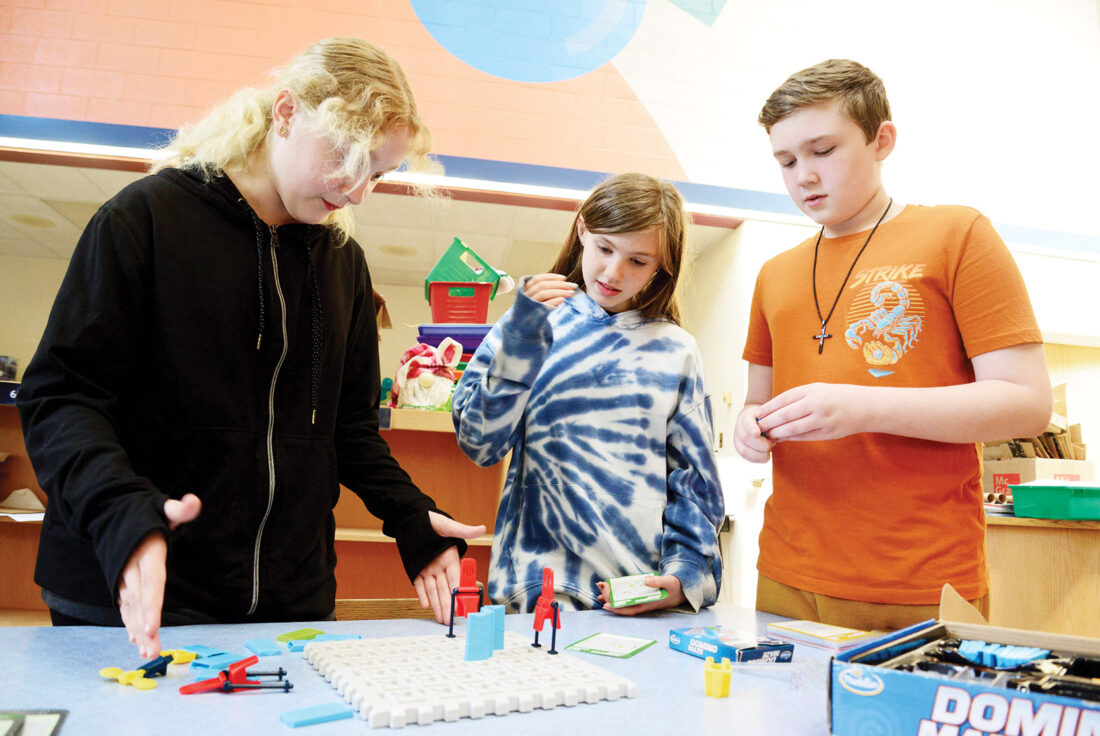
Claysburg-Kimmel Elementary School fifth graders (from left) Marley Durr, Mia Roma and Colby Draeger, all 11, work on a Domino Maze project in the school’s STEM center. Mirror photo by Patrick Waksmunski

Claysburg-Kimmel Elementary School first grader Tristan Wicker, 7, uses a Sphero indi robot educational tool that teaches kids the basics of coding in the school’s STEM center. Mirror photo by Patrick Waksmunski
Claysburg-Kimmel Elementary School fifth graders (from left) Marley Durr, Mia Roma and Colby Draeger, all 11, work on a Domino Maze project in the school’s STEM center. Mirror photo by Patrick Waksmunski
Claysburg-Kimmel Elementary School first grader Tristan Wicker, 7, uses a Sphero indi robot educational tool that teaches kids the basics of coding in the school’s STEM center. Mirror photo by Patrick Waksmunski
Trending
While the role of intermediate units has changed since they were created in 1970, the goal remains the same -- "to help school districts provide the best learning opportunities for their kids," said Thomas A. Butler, executive director of Appalachia Intermediate Unit 8, which covers Blair, Bedford, Cambria and Somerset counties.
IU8 is one of 29 such units in Pennsylvania tasked with offering programs and services to enhance education in the school districts they serve. IU8, with 35 public school districts, is the second largest geographic intermediate unit and has the second largest number of schools, he said.
Despite the work they do, intermediate units don't get a direct subsidy and cannot tax.
Participating school districts do pay an annual fee based on a formula, he said, but that number hasn't been increased since 1982. Currently, IU8 receives a total of $173,000 a year or about $4,900 per district.
That total is a drop in the bucket for IU8, which has a $54 million budget and 267 employees, more than 60% of them teachers.
"We live and die on contracts for the programs and services we offer," Butler said.
Butler, who has been in his present position for 10 years, said IU8 is operated by a 13-member board, which represents the 13 different regions of the four-county area. There are two exceptions: when IU8 was created, Johnstown and Altoona were given permanent membership on the board, Butler said. Some of the districts share a member, which alternates every three years.
For about 20 years -- 1972-92 -- intermediate units were the sole provider of special education services to school districts. That changed in 1992 when school districts hired their own special education staff and operated their own special education services.
Today, intermediate units continue to be contracted to provide some special education services, but that is no longer their main role.
"The majority of services we provide are special service contracts," Butler said.
Services include curriculum, occupational and physical therapy, speech, vision and hearing, and more -- basically, whatever a school district may need to provide solid learning opportunities for students.
As an example, Butler said that when the COVID-19 pandemic hit "we increased our offering in the online learning area."
Since the pandemic, IU8 has added a STEM Outreach Center and received two $500,000 grants to expand it to underserved areas of the coverage region, he said.
"We have a lot of equipment that schools can use in their classrooms," he said, adding that libraries can use the equipment, too.
The STEM Lending Center has been a valuable resource to the Claysburg-Kimmel School District, said Suzanne Wicker, elementary STEM teacher.
This year, the school implemented STEM teaching at the elementary level, she said, so having access to equipment really helped.
"Students have been able to apply their knowledge through the use of multiple robotic devices," she said.
Claysburg-Kimmel utilizes the IU8's resources for in-building trainings, data tracking progress and professional development for teachers, as well as the STEM Lending Center. These resources allow educators to enhance their knowledge and help students to develop critical thinking skills.
"We have seen measurable growth in students' literacy skills," Wicker said.
The Tyrone Area School District also uses the STEM resource center.
"The center is a dream come true for teachers who are able to participate in the program," said first grade teacher Sarah Ciampoli.
Not only does the center provide equipment to enhance lessons and focus, the items available to borrow motivate and challenge students," she said.
"At the beginning of the school year, I look at the standards, our scope and sequence, and lesson objectives that I need to cover," Ciampoli said. "When I borrow the items, I look at how I can best use it in our classroom to enhance my students' critical thinking and problem solving skills."
For the Williamsburg Community School District, IU8 provides services for students with special needs, such as autism support or assistance for students with multiple disabilities.
"Without the IU's services, we would struggle to provide programs that meet the needs of these students," said Superintendent Lisa Murgas.
Like Claysburg-Kimmel, Williamsburg uses the IU8 services for staff professional development, such as training on instructional practices and training mandates required by the state, Murgas said.
Williamsburg also contracts with the IU8 through extended campus for its cyber school program.
"This allows our students who choose to participate in a cyber program to do so as a Williamsburg student," she said. "We work collaboratively with the IU and our cyber students to help them be successful."
Butler said IU8 has 2,500 students participating in online learning. "That is significant," he said.
IU8 also offers an early intervention program that is available before a student starts kindergarten if a student is identified as needing extra help.
"We have 3,500 students between special education and early intervention," he said.
Intermediate units are "in the background providing support," Butler said. "Our people go out and work in the schools. We also go into homes with toddlers who may have been identified as needing some assistance."
Employees with IU8 are stretched out over four counties, he said, adding that covering the service area can be logistically challenging.
"We have dedicated people, they love what they do," he said.
Mirror Staff Writer Walt Frank is at 814-946-7467.