
ABCD to organize builders’ fair for lot development
As part of blight battle, city hopes to encourage projects on vacant properties
Trending
The city has enlisted Altoona Blair County Development Corp. to help organize a builders' fair to encourage development of housing on lots that are not attracting interest.
City Councilman Dave Ellis recently suggested holding such an event to pique the interest of capable developers in constructing homes on the many and often narrow lots created over the decades by the city's blight demolition program, helping to reverse the tax-base loss incurred by that demolition.
Development of those lots could also provide a needed infusion of mid-market housing for new professionals coming to the area, said ABCD Corp. CEO Steve McKnight, who thinks the builder-recruitment fair is a great idea.
A key requirement for success will be providing incentive or subsidy to bridge the gap that is preventing those lots from being developed now, McKnight and City Manager Omar Strohm said.
One component of that subsidy could be conveyance of those lots by the city at low cost to a developer willing to undertake a project, McKnight said.
Another is the presence of utility lines next to most of those properties. Yet another could be low-interest "patient capital" -- loans that wouldn't require payback until developers began earning income from the properties through sale or rent, McKnight said.
ABCD is currently lobbying lawmakers and the Shapiro administration to make a housing version of the Business In Our Sites program that has provided such financing for commercial projects, McKnight said.
There may be private options for that kind of financing also, McKnight said, that would provide "a little more cushion to take some of these projects on."
Developer equity may still be required, though, he added.
The city will be compiling a list of potential building sites, with a preference for larger tracts and multiple contiguous parcels, Strohm said at a recent meeting.
It's a challenge when there is just one isolated narrow lot, McKnight said, adding that four or five together, or a half-block or a full block is better, because the developer can benefit from economies of scale.
The houses may be narrow, but there are housing designs for narrow lots that mimic the design of existing homes in the city built a century ago, but with modern amenities, McKnight said.
Townhomes are also a possibility, he added.
The city will be compiling a list of developers to invite, both local and regional, Strohm said, and officials will need to identify a site for the fair.
The ABCD boardroom is a possibility, along with the Curry Innovation Center -- as suggested by McKnight, he said.
The city's new training facility on Margaret Avenue is also a possibility, said Councilman Dave Butterbaugh.
The city Redevelopment Authority will need to be involved in the effort, Strohm said.
"I think by fall there will be something in place," Strohm said. "Stay tuned.
"We're excited to be a partner," McKnight said.
Deterioration a concern
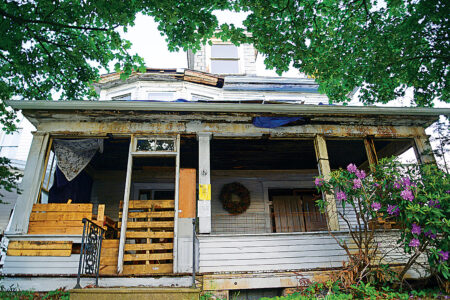
In addition to encouraging construction of homes on vacant lots created by demolition of blight, the city needs to figure out how to intervene to stop deterioration of homes before they reach the stage when demolition is necessary, said Councilman Ron Beatty, reiterating an idea he had expressed at an earlier meeting.
He used a house on the 1300 block of 21st Avenue as an example.
That house has been subject to 54 code inspections, which have revealed numerous violations, and it has fallen into complete disrepair over the past four years, Beatty said.
The city or the Redevelopment Authority should form a committee to deal with the issue -- to find "a way to catch (that kind of situation) before it's too far gone," Beatty said.
Perhaps the recently started effort to create a new city comprehensive plan can suggest a way, he said.
In the case of the house on 21st Avenue, "codes was all over (it)," said Ellis.
There were misdemeanor charges filed in county court, but the owners didn't show, Ellis said.
"But I agree," Ellis said. "We need some mechanism."
In addition to losing such homes to demolition, and thus, losing the tax income they once provided, the city has also been paying wages and legal costs as part of the codes effort prior to demolition, officials said.
Fortunately, the state has recently provided additional tools for municipalities to combat blight, Butterbaugh said.
Conservatorship might be one such tool, Mayor Matt Pacifico said.
Conservatorship was discussed in connection with the McCrory's building, now being renovated, but it's not a simple, straightforward process, solicitor Tom Finn said.
"At some point we have to look at the problem and just try something," Beatty said.
One possibility would be to hire a contractor to gut and install a new roof on such structures, then "put (them) out for rehab," he suggested.
The home on 21st Avenue was beautiful at one point, he said.
Mirror Staff Writer William Kibler is at 814-949-7038.