
A helping hand: State program to offer $1.6M for area farmers’ efforts to protect water
Trending
A total of $1.6 million will be available to assist Blair County farmers protect water quality while maintaining production, according to local officials.
Similar funding is targeted for other counties.
The Agriculture Conservation Assistance Program was created through the Clean Streams Fund established by the FY2022-23 state budget. ACAP provides financial and technical assistance to implement best management practices.
These are measures that producers can take to reduce the amount of fertilizers, pesticides, animal waste and other pollutants entering waterways.
For many years, Pennsylvania has consistently been taken to task by the Environmental Protection Agency and other Chesapeake Bay watershed states for not having dedicated state funding for agricultural conservation practices. ACAP uses short-term federal funding as a down payment on a long-term program that benefits local water quality in every county, said Grant Gulibon, regulatory affairs specialist in the Pennsylvania Farm Bureau's Government Affairs and Communications Division.
ACAP is administered by the State Conservation Commission.
Each county conservation district receives a three-year allocation based on several criteria. All program money is to be allocated by the end of 2024 and spent by the end of 2026.
The SCC's apportionment criteria must consider: agriculturally impaired stream miles, number of cropland acres, number of farms, number of livestock and poultry and other criteria established by the SCC.
"The primary factor is to reduce nutrient and sediment going to the Chesapeake Bay, this will help them meet their goals," said Donna Fisher, manager of the Blair County Conservation District, which will receive $1,679,457 over three years.
Each county conservation district will create its own application and ranking system for the projects.
"We gave priority points to farms in our farmland preservation program," Fisher said.
"The best thing about the program is that it is administered locally at the county conservation district level. Everything from the application to the review, ranking, approval and payment of a project is completed locally at the county conservation district," said John Dryzal, manager of the Cambria County Conservation District, which will receive $1,397,610 over three years.
Numerous projects are eligible.
"Basically, any project installing best management practices that reduce soil erosion, control nutrients, improve and/or protect water quality and/or improve soil health are eligible," Dryzal said. "Practices that control nitrogen, phosphorus and sediment will have the highest priority as they will have the greatest impact on improving and/or protecting water quality."
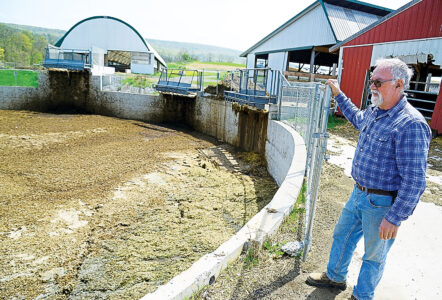
A range of practices are eligible, from large projects like manure storage to smaller projects like streambank fencing.
"We're hoping to fund some rotational grazing systems," said Celina Seftas, manager of the Huntingdon County Conservation District, which will receive $2,023,341 over three years. "Projects will be ranked based on reduction of nutrient and sediment runoff, proximity to waterways, watershed, severity of resource concern, and matching funds available."
Farmers can apply for a ACAP Program grant through their county conservation district.
Those interested in applying should contact their local conservation district to see if it has any prescribed application periods or if applications may be submitted to the conservation district at any time, Gulibon said.
Fisher said Blair County received its first installment of the money -- $279,000 -- in mid-April.
"We have known this was coming for six months. We have been getting the word out. We are not yet open to receive applications, but we are developing our policies and ranking sheet. We hope there are folks out there who are interested," Fisher said.
Fisher said the conservation district's board of directors will review any applications and decide which projects will receive funding.
Officials are excited about the program.
Blair County has set a 90% cost share, that means the landowner pays 10% or maybe a little more for larger projects. This creates opportunities for landowners who have been hesitant to get involved, said Chairman Jim Biddle of the Blair County Conservation District board.
"I think it is a great opportunity to get money to local landowners. We have been asking for block grant funding so we can address these projects, so we are pleased," Fisher said.