
Pouring it on
Bellwood dam project crews place 1,280 tons of concrete
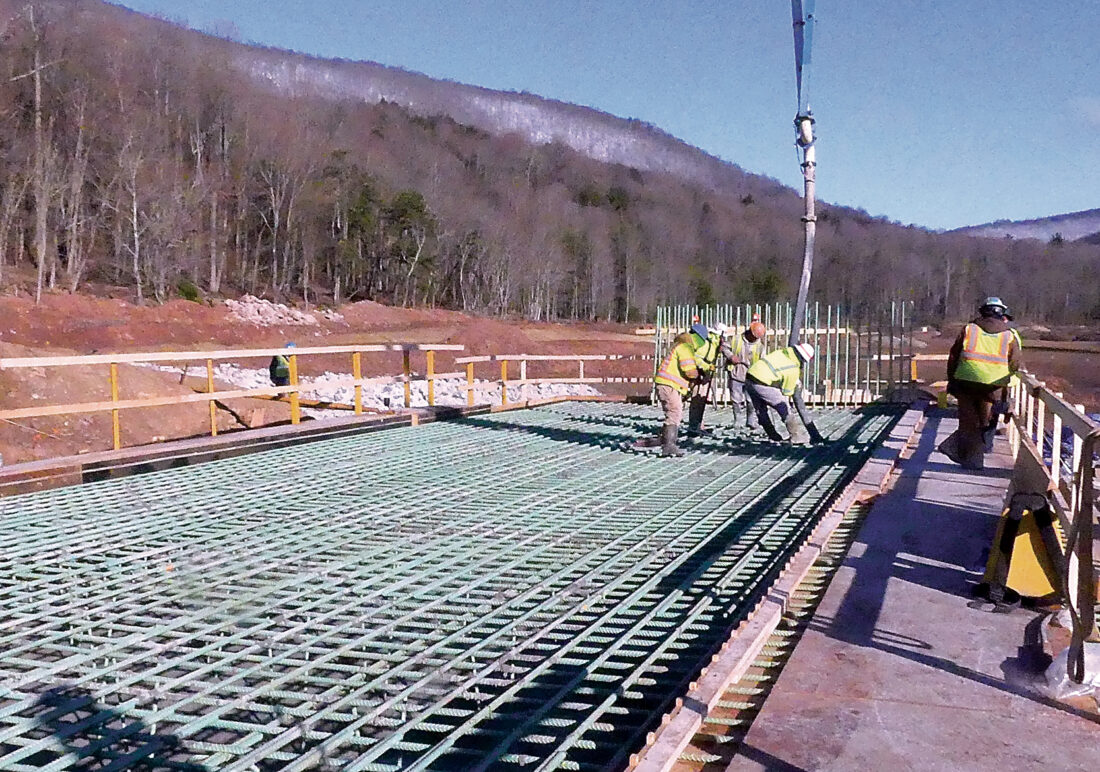
Workers from Allison Park Contractors of Gibsonia pour concrete Thursday for the first of eight side-by-side foundation blocks for the labyrinth spillway at the Altoona Water Authority’s Bellwood Dam, which is being renovated. The concrete was poured into a network of corrosion-proofed rebar. Mirror photo by William Kibler
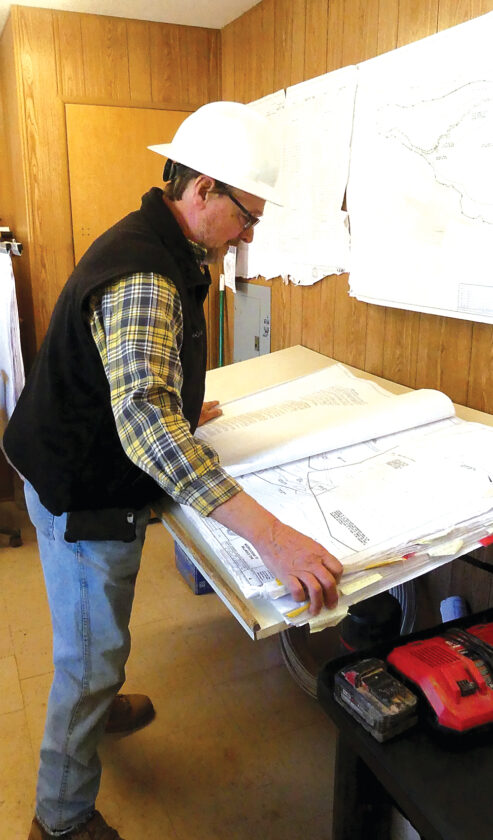
Bellwood dam renovation superintendent Jim Gregor of Allison Park Contractors looks over sheaf of prints of on the project. Mirror photo by William Kibler
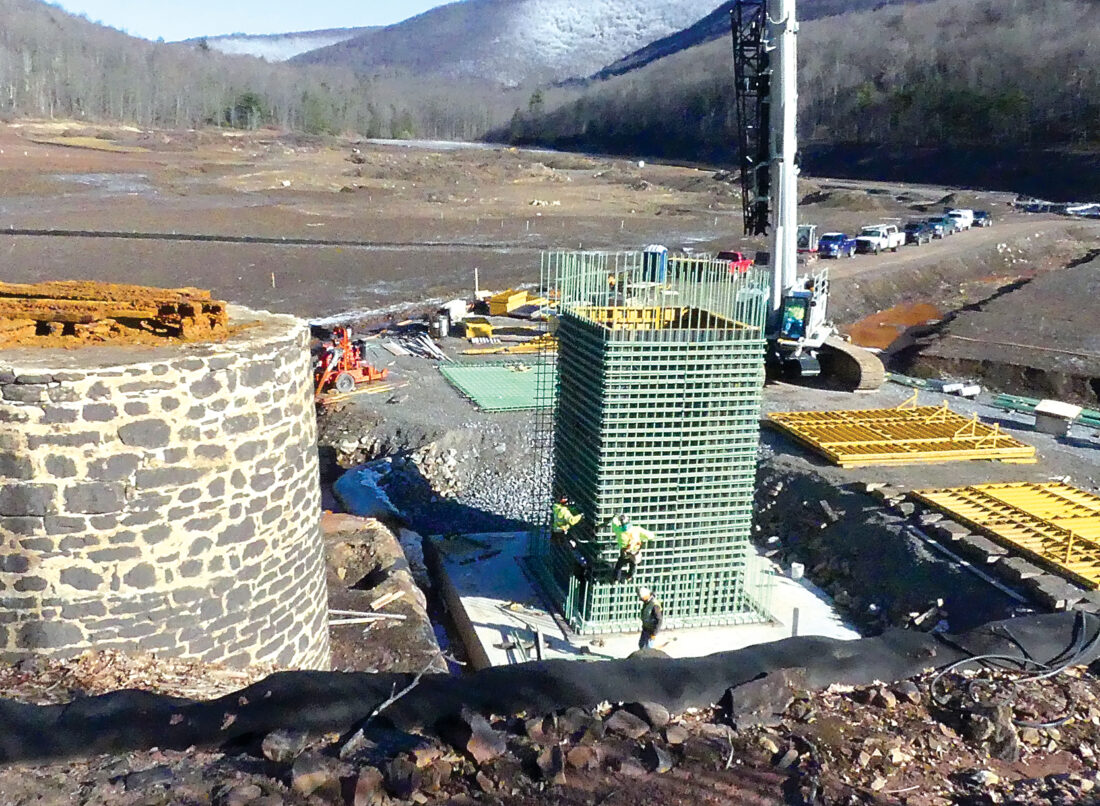
Workers from Allison Park Contractors of Gibsonia place rebar for the bridge pier for an intake tower at the Bellwood dam project. Mirror photo by William Kibler
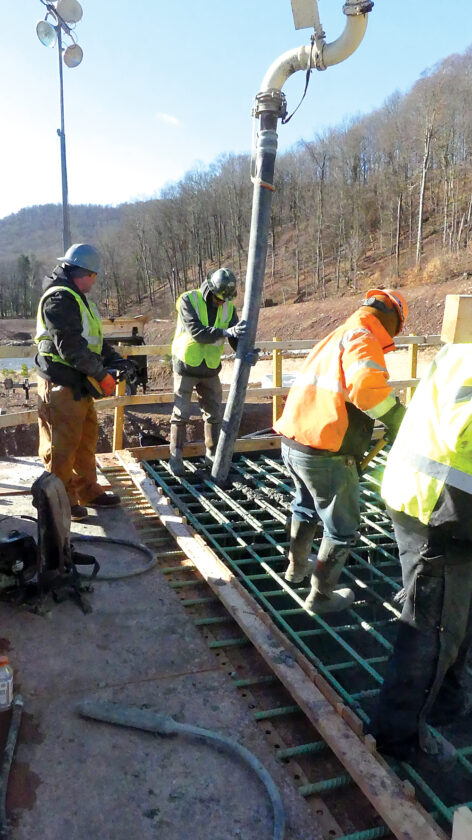
Workers from Allison Park Contractors of Gibsonia pour concrete Thursday for the first of eight side-by-side foundation blocks for the labyrinth spillway at the Altoona Water Authority’s Bellwood Dam, which is being renovated. Mirror photo by William Kibler
Workers from Allison Park Contractors of Gibsonia pour concrete Thursday for the first of eight side-by-side foundation blocks for the labyrinth spillway at the Altoona Water Authority’s Bellwood Dam, which is being renovated. The concrete was poured into a network of corrosion-proofed rebar. Mirror photo by William Kibler
Bellwood dam renovation superintendent Jim Gregor of Allison Park Contractors looks over sheaf of prints of on the project. Mirror photo by William Kibler
Workers from Allison Park Contractors of Gibsonia place rebar for the bridge pier for an intake tower at the Bellwood dam project. Mirror photo by William Kibler
Workers from Allison Park Contractors of Gibsonia pour concrete Thursday for the first of eight side-by-side foundation blocks for the labyrinth spillway at the Altoona Water Authority’s Bellwood Dam, which is being renovated. Mirror photo by William Kibler
Trending
Jim Gregor tends not to sleep well the night before critical events like one that took place Thursday at the Bellwood dam, where he supervised an hourslong concrete pour for a new spillway.
Beginning at 4 a.m., workers from several companies and the Altoona Water Authority poured 634 cubic yards of concrete into a network of epoxy coated rebar to form the first of eight arch-shaped pads on which workers will eventually construct the zig-zag top of a labyrinth spillway.
Gregor, 60, is Allison Park Contractors' superintendent of construction for the $20.6 million dam renovation.
"It's a big-deal day," said Gregor by phone, around 4:30 p.m., after his workers had completed the pad and were eating pizza he'd ordered, in keeping with his company's tradition on large pours.
If a carpenter miscuts a two-by-four, he can get another and cut it correctly, but if something goes awry with a massive amount of concrete like the 1,280 tons placed on the breast of the dam Thursday, there would be grievous consequences.
Extensive preparation and scientific knowhow make failure unlikely, Gregor said.
The workers used manufactured steel forms, an Allison Park engineer went over the stresses and loads and the authority's consulting engineer Gwin Dobson & Foreman reviewed and approved those calculations, Gregor said.
Allison Park also developed mix plans for the concrete with supplier New Enterprise Stone & Lime Co. Inc., and with testing firm Hillis-Carnes Engineering Associates, to ensure the resulting pad would set to the appropriate strength, Gregor said.
"It's a monthlong process," he said.
Thursday's effort went off "without a hitch," although the crush testing of cylindrical tubes filled and set aside -- seven days and 28 days hence -- is necessary to confirm success.
If the seven-day test shows the concrete is close to the full-strength standard for 28 days, "we'll pretty much know," Gregor said.
That 28-day standard for withstanding breakage is 4,500 pounds per square inch, according to Leo Drass, Gwin project engineer.
Early start
Workers for Allison Park began showing up at the job site off Route 865 about 2:30 a.m. to get the lighting apparatus and other machinery going, Gregor said.
About 20 of his workers were involved with the pour, along with the NES&L drivers who brought about 63 truckloads from the firm's Roaring Spring and Tyrone plants, plus workers from Howard Concrete Pumping Co. of Canonsburg,
Hillis-Carnes, Gwin and the authority itself.
Hillis-Carnes checked the amount of air in the concrete being delivered, its temperature and the "slump" -- how far down a pile of wet concrete sags when a newly filled cylinder is turned over and removed, according to Gregor.
Truck arrivals timed
The NES&L trucks, coming in timed succession, disgorged their loads, which were fairly stiff, close to what is used for highway construction, into the hoppers of the pumping trucks, which were parked on the dam breast, next to the forms.
The derrick-equipped pumping trucks delivered the concrete so workers standing on the rebar network could send the material to the bottom of the forms, which created an archlike structure perpendicular to the dam breast, 12 feet deep in front and back, 6 feet deep in the middle.
Other workers dropped flexible vibrating poles into the wet concrete to ensure against voids.
The floor of the middle section is 27 feet below the top of the dam breast.
The rebar extends beyond the form into the adjacent space where the next pad will be poured, so the second pad locks into the first.
In addition, the form for the first pad was constructed to create a key slot in the concrete, so the concrete of the second pad will further lock in, according to Gregor.
There is also a water barrier between pads, according to authority General Manager Mark Perry.
It will be a relief when all the concrete work is finished and confirmed to be satisfactory, Gregor said.
The first pad is 34 feet wide and 125 feet long.
Others will be bigger -- consuming as much as 1,000 cubic yards of concrete.
Allison Park assigned Gregor to the renovation project in January 2022, and he began work by studying the plans and specification book.
The plans number 183 pages of large prints, while the book is about 4 inches thick.
"Money-wise," the Bellwood dam renovation is his largest job.
It's challenging and fun, although he doesn't enjoy all the regulations, especially some he considers "overkill," handed down by the Environmental Protection Agency and the Occupational Safety and Health Administration.
The project is expected to be done by April 2024.
Mirror Staff Writer William Kibler is at 814-949-7038.