
Lawsuit: Pipeline destroyed property
Homeowner plagued by contaminated water, sewer backups
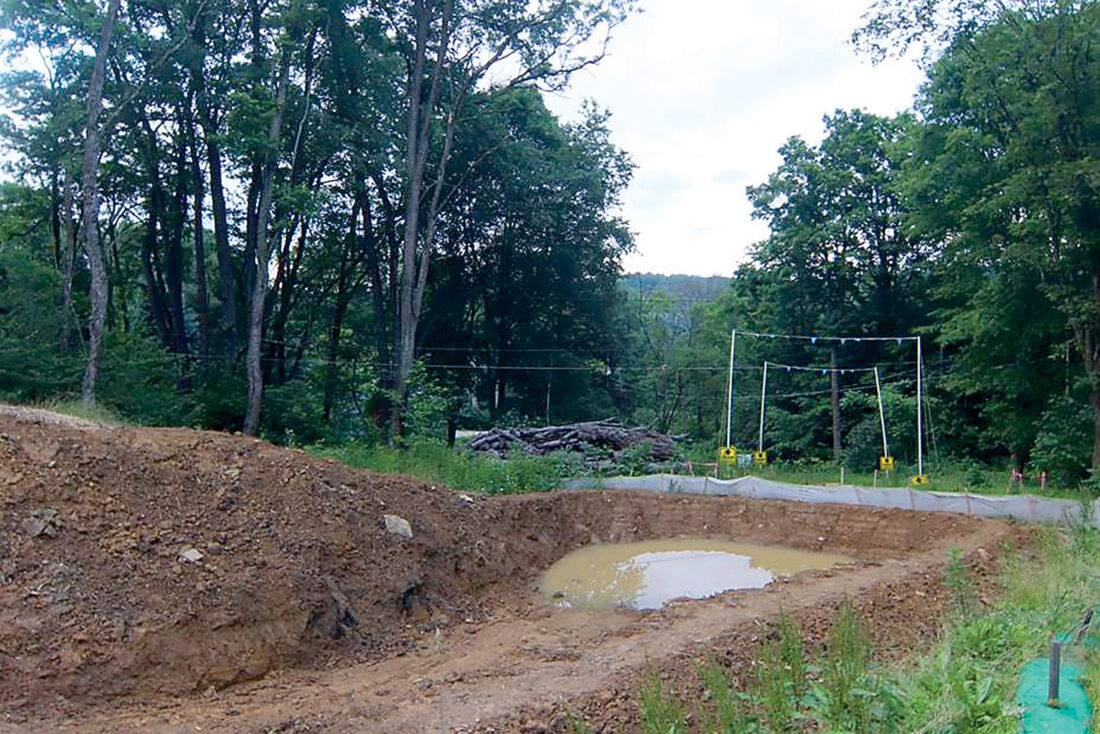
Ronald J. Shawley and his wife, Jane, have sued Sunoco over its construction of the Mariner East 2 pipeline through their property in Jackson Township, Cambria County. Shawley’s property is now susceptible to frequent flooding and sewage backups into his home. Above, Sunoco dug a holding pond over the Shawley’s leach field. Courtesy photo
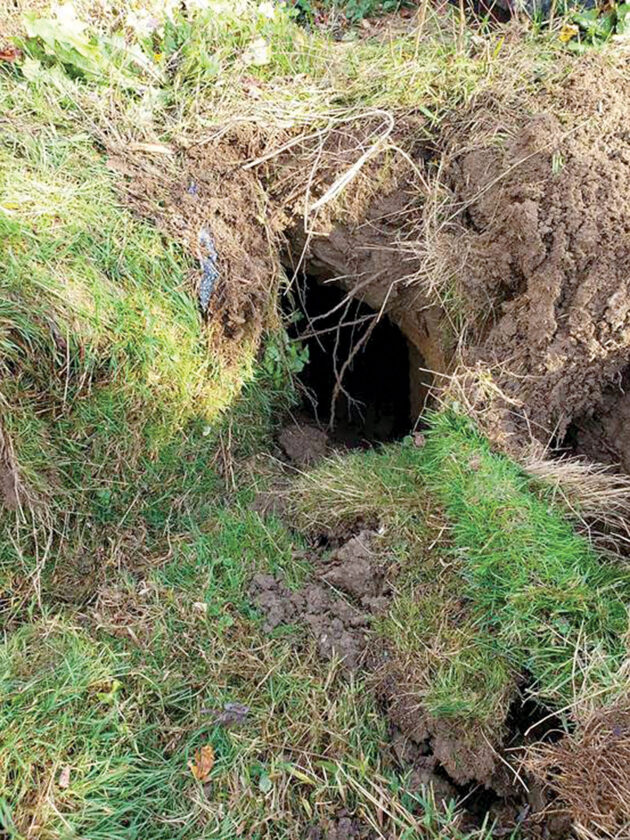
A sink hole can be seen on the property of Ronald and Jane Shawley after construction of the Mariner East 2 pipeline. Courtesy photo

Ronald J. Shawley says Sunoco’s construction of the Mariner East 2 pipeline through his property resulted in contaminated water unfit for consumption from his well, which is now empty. Courtesy photo
Ronald J. Shawley and his wife, Jane, have sued Sunoco over its construction of the Mariner East 2 pipeline through their property in Jackson Township, Cambria County. Shawley’s property is now susceptible to frequent flooding and sewage backups into his home. Above, Sunoco dug a holding pond over the Shawley’s leach field. Courtesy photo
A sink hole can be seen on the property of Ronald and Jane Shawley after construction of the Mariner East 2 pipeline. Courtesy photo
Ronald J. Shawley says Sunoco’s construction of the Mariner East 2 pipeline through his property resulted in contaminated water unfit for consumption from his well, which is now empty. Courtesy photo
Trending
Ronald J. Shawley, a disabled Navy veteran, and his wife, Jane, opted to live in a wooded area of Jackson Township, Cambria County, but their quiet, idyllic life has been severely tested since 2017 when Sunoco began the construction of the Mariner East 2 pipeline through the property.
As part of the construction project, Sunoco Pipeline LP removed more than 60 large trees, including trees in the construction area, Shawley claimed.
Because the large trees were removed, he said windy conditions leveled many other smaller trees.
Several of those trees, Shawley said, fell into and destroyed Koi and goldfish ponds that he had constructed and that served as a quiet place for many veterans suffering from post-traumatic stress disorder.
A bore hole drilled by Sunoco destroyed Shawley's water well, and the large machinery that traversed his property crushed much of his on-lot septic system, he said.
Shawley's property is now susceptible to frequent flooding and sewage backups into his home.
He said that raw sewage comes up through his kitchen sink and "spills throughout the kitchen."
To make matters worse, Sunoco pumped contaminated groundwater throughout the house, causing damage to the refrigerator, water heater and washing machine.
He said in a recent interview, "My quality of life, living here, has been ruined: no water, no sewage. They gave me a water buffalo."
In response to what occurred on his property, Shawley, through two attorneys, John E. Kotsatos of Easton and Scott Edwards of Westchester County, N.Y., in December filed a lawsuit against Sunoco in U.S. District Court in Johnstown, seeking monetary damages, charging the company civilly with creating a "private nuisance" and citing the company for "negligence."
Shawley, however, is now frustrated once again in his efforts to restore his property.
He said the government protects the natural gas company and he has been forced to move his lawsuit from the federal court to the Cambria County Court of Common Pleas.
Edwards explained why this occurred.
He said the lawsuit filed in the federal court was permissible under the concept of "diversity," which means the federal court can serve as a forum for a dispute between citizens of different states -- Shawley being a resident of Pennsylvania and Sunoco being a subsidiary of Energy Transfer LP of Dallas, Texas.
However, Shawley's attorneys determined that Sunoco was a limited partnership, with many Pennsylvania partners, thus "diversity" no longer applied and the federal court was no longer available.
The move took place in late January, and Edwards said Sunoco is expected to file an answer to the Shawley lawsuit within a few weeks.
Edwards said he has been an environmental lawyer for more than 30 years and what happened to the Shawley property is a "disgrace."
He pointed out the Shawley situation has been reviewed by many experts including representatives of Sunoco, the Pennsylvania Department of Environmental Protection and even the township's sewage enforcement officer.
"There's no dispute here. Experts who visit the site can see the water system has been destroyed. They can't fix what's broken there," Edwards explained.
But, as for Sunoco, "They want to play hardball," he said.
"In 30 years, I've rarely seen a case so strong," he said of the Shawley lawsuit.
When addressing the inability to file the lawsuit in the federal court, Edwards said that's a problem Congress has got to fix.
Shawley case
one of many
The Shawley case is just one example of the disruption caused throughout the southern tier of Pennsylvania in 2017 and 2018, during the construction of the Mariner East 2 pipeline.
State officials described the project as a massive construction effort that crossed 17 counties along southern Pennsylvania -- including Blair, Cambria and Huntingdon -- and another 42-mile pipeline that included Butler, Beaver and Allegheny counties.
During the construction, there were many infractions and that eventually led Josh Shapiro, who was then the Pennsylvania attorney general, to utilize a statewide grand jury to investigate.
The grand jury looked into multiple incidents in which the liquid used in the boring of the pipeline spilled.
The grand jury recommended indictments of the company that included violations of Pennsylvania's Clean Streams Law.
The company last August entered guilty pleas to 48 charges and ordered Energy Transfer to pay for evaluations of potential water quality impacts on homeowners as well as pay $10 million to improve water resources contaminated during the construction process.
Shapiro said after the guilty plea last August, "We have a constitutional right in Pennsylvania to clean air and pure water."
Testifying before the grand jury was Joanne Snyder of Hollidaysburg, who described the water from her well as "pristine" prior to the construction of the pipeline adjacent to the Everett Railroad.
Her well was contaminated and she was eventually given a water buffalo.
Snyder told the grand jury that an agent of the company told her to settle with the company and "go build another house."
"He told me if I didn't settle, they would just come and take my house," she reported to the grand jury.
Another person who testified was Patrick Robinson of New Florence.
Robinson, who is a friend of Shawley, lives on 9.5 acres that includes commercial and residential land. It spans the line between Cambria and Indiana counties.
Robinson had a well that was 450 feet from the pipeline project, but on the day Sunoco started drilling at a nearby creek, he said the water level in his well dropped 120 feet.
Sunoco offered him a water buffalo if he signed a lease absolving it of any responsibility.
He refused to sign the document.
The company, he said, replied that because there was no pretesting of the water prior to construction, it was not accepting responsibility for damage to his water system and property.
Robinson recently told the Mirror that his home was constructed in 1971, and he had lived on the land for 18 years prior to construction.
His well was always full, he said, until the day construction began.
His water is now contaminated with bacteria and isn't fit for consumption, but he has used it for washing.
He believes the contaminated water was at least a contributing factor to an infection he incurred that cost him his left foot and right leg.
He also is a veteran of the Navy and now must use a wheelchair.
Robinson said he had many jobs after his military career was completed, including those in the oil and gas industry.
One of his jobs was with Halliburton, an energy construction firm.
He said he is a supporter of pipelines, but he described the work that Sunoco did on the Mariner 2 pipeline as "shoddy."
The grand jury investigated repeated instances where problems, such as spills, occurred during construction, but Sunoco did not report the incidents to DEP as was required.
Robison, 57, said he can't afford a lawyer to seek restoration of his water system. The lawyer he consulted wanted a retainer of $10,000 and $100-per-hour in fees. He said he couldn't afford that.
He quipped, "I'm driving a 1995 car."
He said he also worries what happens if the natural gas carried in the pipe leaks. He wonders whether Sunoco has a program to prevent leaks and to prevent possible explosions.
He said it's tough to find anybody to listen to his story.
"People don't care if it doesn't affect them," he said.