
Rich history
Trending
When Harriett Gaston learned about Charles F. Brown being the first Black high school graduate in Pennsylvania, it started an educational journey.
"I wanted to see what else happened," the coordinator of minority programs at Penn State Altoona and historian for the Blair County NAACP Chapter said. "I was digging, and I said this is something I would like us to know and be proud of. In this day and age, you have people who are scared of what all of our history will look like."
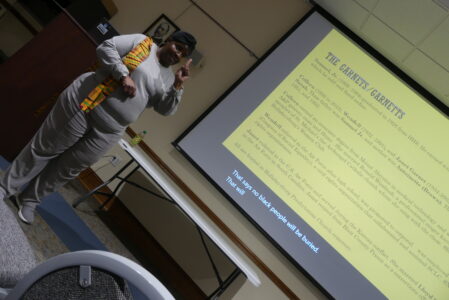
Last week, Gaston presented "The Educational History of Hollidaysburg's Black Residents: Overcoming and Thriving" at the Hollidaysburg Public Library, highlighting key periods of Black history in Hollidaysburg.
Before Blair County was established in 1846, Black people arrived in Hollidaysburg for work because "the Pennsylvania Railroad needed bodies," Gaston said.
"So people moved here, with at least some people moving here with at least one or two slaves from the East," Gaston said.
Showing a map from the Blair County Genealogical Society, Gaston pointed out an area called "Shanty Town" -- where a large number of Black residents lived -- and another, separate area called "Hollidaysburg borough."
"So, they're not part of the town in 1851," Gaston said.
Census records noted that Black residents lived on Garber, Hickory, Pine, North Juniata, Walton, North Montgomery and Allegheny streets, Gaston said.
Education through the news
Abolitionist, physician, journalist, Civil War veteran, Harvard graduate and free Black man Dr. Martin Delaney started writing a newspaper called The Mystery after having some issues with Harvard "about how they don't want to deal with him," Gaston said.
Delaney selected Daniel Williams and William Nesbit to distribute and collect the money for his newspaper, Gaston said. Delaney then joined Frederick Douglass at his newspaper called the North Star, "again, talking about those issues that are going on in this country," Gaston said. "Usually, it's about abolishing slavery and putting in stories about what happens when the slave catcher catches up with someone."
When the 15th Amendment -- which gave Black men the right to vote -- was ratified in 1870, Nesbitt sent a message around the country to "friendly white-owned newspapers and Black-owned newspapers" to celebrate April 26 in observance.
"Now they can vote and that means they can be on juries," Gaston said, noting that Moses Brown was even elected as a fee assessor for Hollidaysburg's 3rd Ward.
Going into the 20th century, the Pittsburgh Courier and Christian Recorder "wants to share news about what's happening to its readers," Gaston said.
"So there are folks in Altoona, Tyrone, Bedford, Johnstown, Hollidaysburg writing about what's happening in the Black community," Gaston said. "Not only this one, but others where they're exposed to Black writers and poetry and artists, and so forth, because it's not happening in the majority community."
School desegregation
In 1834, Pennsylvania passed the Common Schools Law, creating free, secular public schools.
"You had to have both [Black and white] children attend the school if you did not have a separate school," Gaston said, adding that Hollidaysburg did have a separate school.
When a separate school for Black students began is unclear as "there was never any notices in the standard newspapers about what was going on," Gaston said.
"It was a school that wasn't looked after very well," Gaston said. "In the case of the 1877 fire, it was one of its students who tried to burn it down."
In 1881, a Black man in Erie sued Pennsylvania, saying having separate schools violated the 14th Amendment, which granted citizenship to all people born or naturalized in the United States, including formerly enslaved people, and gave all citizens "equal protections under the law."
A judge found that the Pennsylvania segregation legislation of 1854 "was in violation of the United States constitution."
"The commonwealth gave in and agreed, but that doesn't mean it happened all at once," Gaston said. "Some places were slower to desegregate than others, with people making 'I don't want them in my neighborhood, my backyard' statements."
Success stories
Following desegregation, Moses Brown wanted his son, Charles F. Brown, to go to high school. After passing the entrance exam, he was admitted and graduated in 1881, Gaston said.
"In 1883, there's a newspaper article out of Philadelphia talking about a young Black woman from Coatesville, Philadelphia, being the first Black high school graduate in the commonwealth of Pennsylvania," Gaston said. "The Tribune and others say 'whoa, it's Charles F. Brown of Hollidaysburg.' I'm assuming that's true. I haven't found anything to discount it."
Following Brown's graduation, he became a businessman and joined his father in the restaurant and catering industry while also selling lumber.
Samuel Garnett, the janitor for all of Hollidaysburg's schools, had a son, George, who graduated as salutatorian.
"He will go on to Howard University and become a doctor," Gaston said, adding that he ran a baby clinic for Black families in New Castle and is now buried in Union Cemetery.
Gaston also named Katherine Graves, who became a foot doctor.
Then there is Dr. Daniel Hale Williams III, born in 1858, who is considered to be the first person to successfully perform an open heart surgery.
"Hollidaysburg was his hometown," Gaston said. "He became an apprentice as a barber, then he got connected with a doctor."
Williams went on to found the National Medical Association -- not the American Medical Association, which wouldn't take Black doctors at the time -- and founded Providence Freeman Hospital in Chicago, where the open heart surgery took place.
"We have a rich history and my job at this point is to get it out there and hopefully it's not forgotten," Gaston said.
Mirror Staff Writer Rachel Foor is at 814-946-7458.