
Water group’s future murky
ISC dealing with uncertainty as charter set to expire this year
Trending
Like the water it is trying to improve, Intergovernmental Stormwater Committee is seeking clarity on long-term issues including imposing stormwater fees and paying maintenance of completed projects.
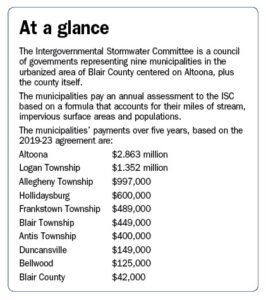
The ISC, a council of governments comprising nine Blair County municipalities, was formed several years ago to comply with increasingly strict regulations on stormwater pollution.
Now after assessing $7,466,000 from the nine municipalities and the county for projects to reduce sediment in stormwater runoff, the group is pondering its future when its charter expires at the end of the year.
Issues facing the ISC include how to deal with post-construction maintenance on projects, how much elected municipal officials can bind their successors to contracts they make now, how to deal with limited guidance from the state and whether the municipalities should impose stormwater fees on their residents.
The issues came up recently during discussion of a proposal for floodplain restoration on a stretch of the Beaverdam Branch of the Juniata River -- a project that would be the biggest the committee has attempted in its effort to comply with a state requirement to reduce sediment that runs into area streams by 1.4 million pounds per year by the end of 2025.
To figure out how to handle post-construction maintenance on its projects, the board instructed its consulting engineers to study the matter and make policy recommendations.
That study effort will include a survey of municipalities to determine their interest and capacity in doing maintenance work.
It's an open question whether the organization as a whole or the municipalities where particular projects are located should have maintenance responsibility, said committee member Tom Levine, who is an engineer.
It will be important to know how much maintenance work on various projects will cost, said committee member Doug Brown, the Antis Township manager.
A suitable formula for sharing the burden might reflect how much of the maintenance work primarily benefits the municipality where a project is located, he said.
There will eventually be maintenance issues with all projects the committee will have to undertake, according to Levine.
There definitely needs to be an understanding of where maintenance responsibility lies if the committee dissolves, Levine said.
It would be ideal to "have agreements ironed out" before then, Doug Brown said.
Binding successors
In case the organization decides it makes sense to renew its charter for longer than the current five-year term, the committee asked solicitor Patrick Fanelli to look into legalities that govern municipal leaders' ability to bind their successors to contracts they sign.
It might be better to craft a longer council-of-governments arrangement because of the continuing escalation of runoff-control requirements from the Department of Environmental Protection -- an escalation that tends to lead to projects of bigger scope and longevity.
Because the annual assessments for municipalities have become burdensome, it might make sense to consider a dedicated fee to cover stormwater control costs, according to Doug Brown, who has raised the issue before.
That could be especially important if there are significantly fewer committee members beginning in 2024, he said.
As a council of governments, the ISC lacks the power to impose direct stormwater fees or assessments on property owners, Fanelli said previously. But an authority could do it.
There's no way all the municipalities are going to agree to a stormwater fee, said Chairman Tim Brown, the Logan Township manager, emphasizing that the decision on a fee rests with the individual municipalities.
Still, there would be no obstacle preventing municipalities willing to entertain the idea from getting together to "brainstorm," Tim Brown said.
It might make sense for the committee to undertake a funding study, said stormwater coordinator Chelsey Weyant.
Future requirements
Another part of the uncertainty plaguing committee members is the unknown shape of stormwater control requirements after 2025.
"We're getting zero guidance (from the state)," Doug Brown said.
State guidance has been "haphazard at best" in the past two decades "and usually (it comes) at the 11th hour," Levine said.
Still, municipalities that keep up with requirements as they materialize tend to benefit, Levine said.
At one point, there were hopes that the stormwater cleanup requirements would go away, Levine said.
"(They're) here to stay, unfortunately," Levine said. And likely to continue to "amplify."
That means not only requirements for bigger reductions in sediment but additional contaminants to contend with, Levine said.
"The program is dug in now, and we're going to have to deal with it," he said.
Post 2023
It behooves the committee to determine what will happen with its municipal membership after the current agreement expires, Levine said.
"I'm all for figuring out what this group will look like (long-term)," he stated.
"We need to know sooner rather than later," Doug Brown said.
"This comes up in every meeting," Tim Brown said. "Are we going to do something about it?"
Doing what's required by DEP for stormwater control will likely be cheaper for municipalities that remain within the organization, than for those that go their own way, Tim Brown said.
Still, municipalities will need to know what it will cost, he said.
"What's the next step?" Levine asked at one point.
"I don't have an answer," Doug Brown said.
Mirror Staff Writer William Kibler is at 814-949-7038.