
US honors retired firefighter for efforts during COVID
Mitchell recognized for work directing pandemic response in multiple locations
Trending
Retired Altoona firefighter Kirk Mitchell is a fan of history, especially World War II in the Pacific, where a compelling element was the struggle to find order amid chaos -- the kind a naval commander confronts when his ship is under attack.
Mitchell dealt with that kind of struggle as a captain in the Altoona Fire Department and as an operations officer and section chief periodically deployed by the U.S. Department of Health & Human Services during disasters.
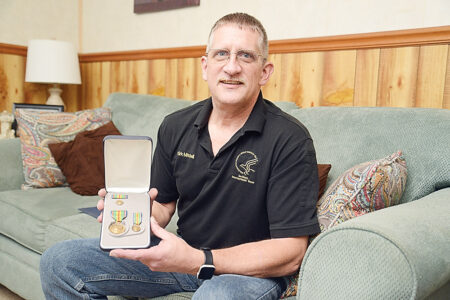
He dealt with it well enough for HHS during the pandemic that he recently received the COVID-19 Pandemic Civilian Service Medal "for exemplary service as part of the federal medical response to the pandemic," as stated in an HHS news release.
Mitchell is one of 1,400 HHS employees receiving the medal, authorized by the Surgeon General for those serving at least 30 consecutive or 60 cumulative days on pandemic duty by the HHS's Administration for Strategic Preparedness & Response.
His most memorable struggle to bring order from disorder occurred prior to the pandemic, when he was deployed to Dallas to manage medical teams being sent to Houston and other areas of South Texas inundated by Hurricane Harvey.
He got there at 10:30 p.m. and called a meeting in preparation for the arrival of 260 individuals the next morning whom he would be responsible for assisting.
There were questions about lodging, transportation and testing for masks.
Unit leaders "were asking this and that, so that I was to the point where I was feeling extremely overwhelmed," Mitchell said.
Requests were coming "from every direction" -- including Washington, D.C., where leadership wanted to know how things were going.
"I was being bombarded," Mitchell said. "I felt like I was the target of artillery."
So he closed his eyes and stepped out of the meeting room, said a short prayer, gathered himself and walked back in, he said.
"(Then) I was able to start delegating," he said.
He knew that if he made the wrong decisions on the "50 things that need(ed) done," he might get yelled at, even sent home, he said.
But that was OK, because he needed to act.
His COVID work began in February 2020 when the ASPR sent him to a succession of places as the operations chief for teams of doctors, nurses and other medical personnel who were caring for people quarantined upon returning to the U.S. after potential exposure to the virus overseas.
The first such site was Omaha, for Americans returning from Wuhan, China, where the pandemic began.
Then Mitchell went to Travis Air Force Base in California, then to the Marine Corps Air Station at Miramar, also in California.
Quarantined people were housed in empty barracks, and the teams served them like hotel staff, Mitchell said.
After that, ASPR dispatched him to San Antonio, where he was responsible for overseeing medical teams at three separate hospitals that were overwhelmed with COVID patients.
His next stop was New York City to work at the Javits Center, which New York state was setting up as an overflow field hospital.
In New York, he was also responsible for teams of mortuary specialists helping medical examiners at an alternative morgue set up on the docks in Brooklyn.
The city's process for handling bodies had become overwhelmed, not only because of the large number of deaths, but also because of the restrictions on how coroners and funeral directors could handle those bodies, according to Mitchell.
In fall 2020, Mitchell's service with ASPR became virtual.
Back in Altoona, through computer and phone, he oversaw medical teams working in as many as seven hospitals at a time -- in Florida, Louisiana, Tennessee, Kentucky, Minnesota, California and Arizona and in tribal nations in Arizona and New Mexico.
He continued to work for the Fire Department. While on shift, he generally assigned his ASPR duties to a deputy.
He didn't mind the long hours, as he'd gotten used to 12-hour, even 16-hour days when deployed.
Among problems he needed to handle were call-offs from people who had contracted COVID.
He credits his training as a firefighter for helping him handle the calls, even in the middle of the night.
"Firefighters fix problems," he said. "They don't form committees and talk about (them)."
He also credits his nature, and the maturity that comes from experience.
"God gave certain people the ability to step away from the immediate chaos," he said.
Mitchell's service in the Fire Department, which constitutes the Blair County Hazardous Materials Team, led to his joining ASPR.
As a member of the hazmat team, he served in the South Central Mountains Region Task Force, which provided incident management teams.
He discovered that he liked incident management work.
That work put him in contact with HHS officials, one of whom suggested he apply.
Mitchell's HHS deployments were like those of reservists.
His union's contract with the Altoona Fire Department called for deployed workers to receive pay for 15 days a year, plus 15 training days annually, with administrative leave covering additional time.
Mitchell received a wage from HHS during his deployments.
Mitchell now works as the command emergency management officer at the Naval Support Activity in Bethesda, Md.
"I'm the equivalent here of Mark Taylor in Blair County," Mitchell said, referring to the local county's emergency management director.
As an intermittent employee of HHS, "I was a small part of a big effort," Mitchell said. "(I worked with) a lot of talented and dedicated people."
Mirror Staff Writer William Kibler is at 814-949-7038.
The Mitchell file
Name: Kirk Mitchell
Age: 56
Raised: Mill Run
Education: Attended Edison Elementary School, Riggles Gap Christian Academy, Calvary Baptist Christian Academy and Altoona Area High School, graduating in 1984
Military service: Served in the U.S. Marines for four years, was an air traffic controller at Cherry Point, N.C., and in Okinawa, Japan
Current job: Emergency management officer for Naval Support Activity, Bethesda, Md.
Family: Wife, the former Pam Thomas; three children; three grandchildren