
Out of this world
Students tour interactive exhibit
Trending
LORETTO -- Students from St. Michael School were among the first to experience the new Earth to Moon interactive exhibit built by Saint Francis University faculty, staff and students, but soon kids in Blair and surrounding communities will get the chance to explore the portable museum for themselves.
The Space Sciences and Engineering Mobile Interactive Exhibit for Rural Areas: Earth to Moon is a three-part display built for children and their families in rural communities of the Appalachian Mountains in central Pennsylvania, according to the program's outline.
It's NASA funded, said Lanika Ruzhitskaya, a professor of physics and director of the Palumbo Planetarium at the university.
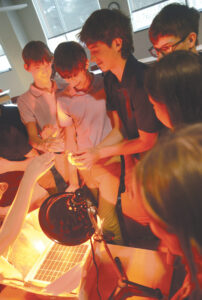
It's just plain "cool," said students Wednesday as they explored the exhibit that includes a 16-foot inflatable and portable planetarium, pieces of moon rock and re-creations of moon dust, earth rocks and photographs of the Apollo 16 moon landing, 3D images from the Apollo 17 mission and the surface of the moon that can be viewed using 3D glasses.
While the exhibit is currently housed at Saint Francis University's Science Outreach Center, it will travel to Claysburg, Patton, Hollidaysburg and Portage public libraries and others that want to host it.
Rocks, experiments and more
Ruzhitskaya, leader of the project, wrote the grant request to NASA.
"When I wrote the grant, I had people telling me we will not get it and NASA will not be interested," she said. "I said 'why not, the worst that could happen is not getting it.'"
In the end, NASA appeared interested, and Ruzhitskaya was granted $25,000 to create the exhibit.
Ruzhitskaya's aim was to excite today's children, commonly called the Artemis generation.
Their future, Ruzhitskaya said, is to explore the moon.
"Our children are the ones who will go there," she said. "How do we excite them?"
Creative thinking, problem-solving and more are part of the exhibit, said Michael Sell, a professor who helped build the set.
For Emily Itle, 9, the rocks were a big draw.
"It is really cool and I like learning about the moon and space," she said.
That was good news to Guochang Wang, who was part of the team creating the exhibit.
The professor of petroleum and natural gas engineering said he helped print the 3D images and was on site to assist the students as they learned about the rocks.
"It is important to know about the rocks and know about the resources that might be available on the moon," Wang said.
Not only can students study the rocks, Sell said they can learn how much energy it takes to get to the moon, watch movies and more.
Qin He, a professor of petroleum and natural gas engineering, explained how sunlight can be used to generate energy.
"When we go to the moon, energy is important," she said.
There are also experiments students can study on how solar panels generate electricity and heat and how solar energy can be converted to power an engine.
"After doing the experiments, I hope they can think of creating ideas to redesign solar panels and make it work better," He said.
Tim Miller, a professor of general engineering, has a background in power and energy systems, including air independence, which lends itself well to space.
From the point of view of the Franciscan university, getting the kids interested has a noble aspect that will help society, he said.
"These kids haven't lost their sense of wonder. They are still excited, and it is a joy to feel that," Miller said.
"Rather than just sitting in a classroom, (students) can experience hands-on features that will get them excited about STEM," Sell said.
From the exhibit, he hopes students will see that science is fun and can be a future career path.
"Space has so many opportunities to learn and exploration has provided so many benefits," Sell said.
While the students learn about the moon, Ruzhitskaya wants them to understand that exploration allows them to learn about themselves in the process.
"As far as the Artemis generation's involvement, there are so many jobs, including scientists and doctors, on the ground," she said.
Ruzhitskaya hopes the exhibit helps students to be well-informed citizens who know they are a part of something big.
Claysburg first on the list
On Wednesday, Sell said the university was sharing the exhibit with the local community, but "ultimately this is going to other community libraries to be exhibited."
Jane Knisely, director of the Claysburg Area Public Library said the exhibit will touch down in her community on Feb. 1, where it will stay for about a month before moving to the next library on the list.
It could be worthwhile for families to visit each of the area libraries when the exhibit is on display as it will change depending on the space available and what that library chooses to display.
The three interrelated modules include the Earth-Moon system, living on the moon and radio telescopes on the far side of the moon. Each display includes high-resolution images, 3D fabricated models of the lunar surface and human-engineered constructions, learning materials and hands-on activities.
Libraries "can pick and choose different components they want for their displays," Ruzhitskaya said.
Jonah Royer, a junior at Saint Francis majoring in petroleum and natural gas engineering, helped with research and figuring out what to put in the exhibit.
The Earth to Moon exhibit is a nice feature in an area without those types of museums, he said.
"We have a piece of the moon," he said. "Here is something you can learn."