
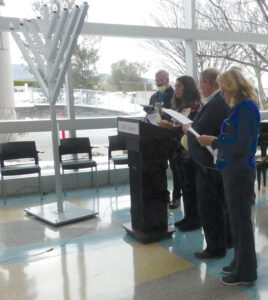
Menorah lit at UPMC Altoona
Trending
The feast of Hanukkah commemorates the preservation of the Jewish faith more than 2,000 years ago, when Judah Maccabee fought not only a Greco-Syrian tyrant who wanted to destroy Judaism but also fellow Jews willing to be assimilated, according to Rabbi Judah Kogen, speaking at UPMC Altoona's annual menorah lighting Tuesday.
"The story of Hanukkah is the age-old struggle of the Jewish people to remain Jewish in a non-Jewish world," Kogen told about 50 attendees.
In many places, that struggle has involved catastrophe for Jews, but in the U.S., Jews have fared well, largely due to this nation's commitment to pluralism, Kogen said after the ceremony.
In the Holy Land of the second century BCE, Judaism "could have been wiped out," said Bill Wallen, executive director of the Greater Altoona Jewish Federation.
"But 2,000 years later, we still exist," Wallen said.
In the U.S., Hanukkah's commemoration of the miracle of a single cruse of oil that burned for eight days in the reclaimed temple is nearly swallowed up in the context of the majority's overwhelming attention to the secularized Christian Christmas.
But that is not a problem, because despite that secular-Christian dominance, Jews "are still allowed to have our own beliefs," Wallen said.
That secular-Christian context has actually resulted in the expansion of Hanukkah's significance from its original status as a minor, non-biblical holiday, and the attachment of traditions like gift-giving -- although for both Christians and Jews, it can be hard to focus on the real, "spiritual meaning," Wallen said.
There needn't be tension between preservation of a people's culture and acceptance of the culture of another, according to Kogen.
Nor is there a problem with grafting elements of one culture onto another, according to the rabbi.
"Many wonderful things about America have become part and parcel of the Jewish community," Kogen said.
"There's nothing incompatible between being part of American culture" and being Jewish, he added.
"There are no fundamental contradictions between Jewish values and American values," because America is accepting of differences, he said.
Accepting other cultures is something that Americans don't need to "think twice" about, according to Kogen.
America has actually had "a spotty history" on immigration, Wallen said.
In the 1800s, when industry needed labor, the nation welcomed immigrants to fill its enormous labor needs, Wallen said.
But at other times, including periods of "nativism" in the 1920s and 1930s, there were "harsh" restrictions, he said.
Those applied especially to eastern and southern Europeans, including Jews, Poles, Italians and Greeks, he said.
When cultures mix, there is a tension between maintenance of existing cultures and the tendency to mix and assimilate, according to Wallen.
That applied to the Jews in Maccibeen times, because the "amazing" culture of the Greeks, with its architecture and literature, was highly "seductive," Wallen said.
Those currents and tensions are present in the U.S. now, with some in the dominant culture worried about "replacement," he said.
And yet, while not perfect, America "has been for the Jews, the best country, the most welcoming" -- a place where Jews have found opportunity, even as they have managed to maintain their cultural identity, according to Wallen.
Mirror Staff Writer William Kibler is at 814-949-7038.