
Area engineer awarded for pioneer nuclear contributions
Trending
The Three Mile Island accident during his freshman year in college put a Blair County native on a path that has made him an international leader in nuclear fusion research.
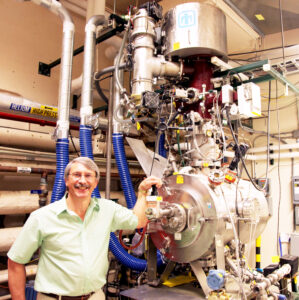
The Nuclear and Plasma Sciences Society of Institute for Electrical and Electronics Engineers recently announced that Dennis Youchison, a 1978 graduate of Hollidaysburg Area High School, is the recipient of the 2022 Fusion Technology Award.
A nonprofit organization, the IEEE is the world's largest technical professional organization dedicated to advancing technology for the benefit of humanity.
The award cited Youchison's pioneering contributions to the development of components in reactors facing the plasma where nuclear fusion occurs and his key role in the nurturing and early implementation of public-private partnerships in the U.S. fusion energy program for the Department of Energy.
Youchison grew up in the Cross Keys area and said he first thought about becoming a lawyer in junior high.
"During high school, I fell in love with physics, particularly nuclear science," Youchison said.
After graduating from high school, he decided to attend Duquesne University and study physics.
During his freshman year, on March 28, 1979, a reactor at Three Mile Island partially melted down, the most serious accident at a commercial nuclear plant in the United States.
Youchison then transferred to Penn State to major in nuclear engineering.
"I thought I had better get into nuclear engineering; I thought maybe they needed some critical help," said Youchison, who had an internship at TMI after the accident.
"It was an interesting time, nuclear power was under attack by the public. I was in the emergency planning department. It was a lot of fun, I got to be in both control rooms and actively participate in the drills. I thought that was neat. I became interested in fusion power in my senior year as an undergrad," Youchison said. "I could see fusion was a better way to nuclear power, we are now on the cusp of it."
Youchison said highlights of his career included time spent at Sandia National Laboratories in Albuquerque, N.M., from 1993 to 2015 and at Oak Ridge National Laboratory in Oak Ridge, Tenn., from 2015 until his retirement this summer.
"Work at Sandia National Laboratories in high-heat flux testing was my personal engineering highlight, taking it to a new level. Developing materials that would withstand thousands of degrees without cracking or melting," he said. "We were involved in the ITER project. It is the largest international scientific collaboration in the world. I was on the ground floor of that. That one project spanned my entire career, I would never have imagined a project that would span 30 years."
The ITER Organization is an intergovernmental organization that was created by an international agreement signed in 2006, and formally established in 2007 after its ratification by all parties.
The purpose of the ITER Organization is to provide for and promote cooperation among its members for the benefit of the ITER Project, an international collaboration to demonstrate the scientific and technological feasibility of fusion energy for peaceful purposes.
It acts as the overall integrator of the project and nuclear operator of the ITER facility.
At Oak Ridge, Youchison was the founding director of the Innovation Network for Fusion Energy -- a Department of Energy initiative to provide the fusion industrial community with access to the technical and financial support necessary to move new or advanced fusion technologies toward realization.
The program grew and flourished under his leadership.
"People have been working on this for a long time. We may not see a large-scale plant in the next 10 to 20 years. Eventually, fission will be replaced by fusion. Fusion is nuclear power done right," Youchison said.
Youchison played a key role at Oak Ridge, said Phillip Ferguson, a nuclear engineer and Material Plasma Exposure Experiment Project director who worked with him at the lab.
"He walked in the door as a proven leader and immediately made an impact. He contributed to the design of U.S. components as part of the ITER project, and we knew the work would be high quality. His experience working with industry made him ideal as the founding director of the Innovation Network for Fusion Energy," Ferguson said.
"This prestigious (2022 Fusion Technology Award) honors only the best and the brightest in fusion technology who have contributed over many years to the field, and that definitely describes Dennis."
Youchison, who now lives in Albuquerque, N.M., is a recognized and highly regarded leader in the field of high heat flux testing and has provided leadership in fusion science and technology, most recently as the director of the Innovation Network for Fusion Energy program.
Youchison, 62, who holds bachelor's, master's and doctorate degrees from Penn State in nuclear engineering, was nominated for the award by Douglas Wolfe, professor of materials science and engineering professor of engineering science and mechanics professor of nuclear engineering, professor of additive manufacturing and design metals, ceramics, coating processing department head, The Applied Research Laboratory at Penn State.
Wolfe has known Youchison for almost 20 years and has worked closely with him in the area of high heat flux evaluations for fusion technology.
"Dennis' commitment to fusion technology is unparalleled. Dr. Youchison was instrumental in working with us here, at the Penn State University, to establish a high heat flux facility in order to continue to have high heat flux testing capabilities within the U.S. for fusion technology. I can confidently say that without Dr. Dennis Youchison's efforts, there would no longer be a facility within the U.S. capable of testing/evaluating materials under high heat flux conditions expected in fusion technology," Wolfe said.
Youchison said he enjoyed growing up in Blair County and fondly remembers the experience he had in the Hollidaysburg Area School District.
He said he had some great teachers such as James Hancuff and Pat Cummings.
He said his biggest role model/mentor was Robert McGrath, assistant professor of nuclear engineering at Penn State.
"I clicked with him, he enticed me into fusion. He was a dynamic young professor and I enjoyed that," Youchison said.
Youchison said he is working to get a high heat flux testing facility at Penn State.
"I got some equipment at Sandia and now am assisting to get funding to get this set up so they can do research and testing support at Penn State. My goal is to preserve this technology by getting it in the hands of young people at the university," Youchison said.
Youchison makes it back to the area about once a year to visit his brother, Joseph, and keeps in touch with childhood friends like Dave Harker.
"I've known him since third grade, and we have remained good friends. He is a brilliant man, he excelled in areas where I didn't. That never changed our friendship. He was always dedicated, honest and hard working. He doesn't brag. He lives a pretty simple life," said Harker, who retired from the maintenance department at Saint Francis University.
Youchison said the key to his success has been the "three Ds" -- dedication, determination and discipline.
"I made a lot of personal sacrifices, it has to be something you want to do more than anything. Fusion was one of those things, it was the kind of challenge worth devoting a lifetime to," Youchison said.
Youchison will receive his plaque and award during the 2023 IEEE Symposium on Fusion Engineering conference at the University of Oxford in England.
Mirror Staff Writer Walt Frank is at 814-946-7467.