
Pumpkin growers see colorful crop
Some farmers report smaller than usual size
-
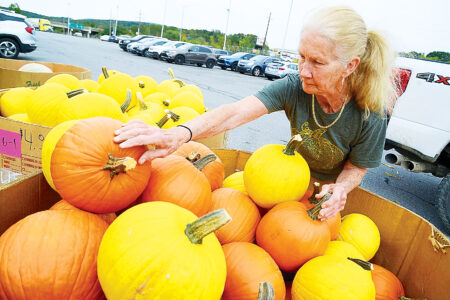
- Mary Ann Nagle of Patton looks at the pumpkins for sale at Imler’s Poultry in Duncansville. Mirror photo by Patrick Waksmunski
-
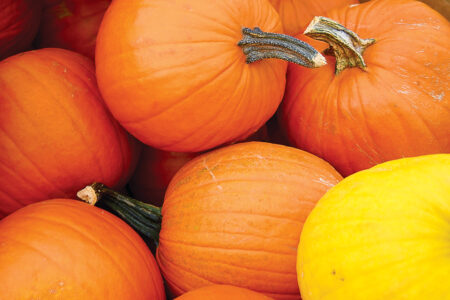
- Pumpkins sit in a sale bin at Imler’s Poultry in Duncansville. Mirror photo by Patrick Waksmunski
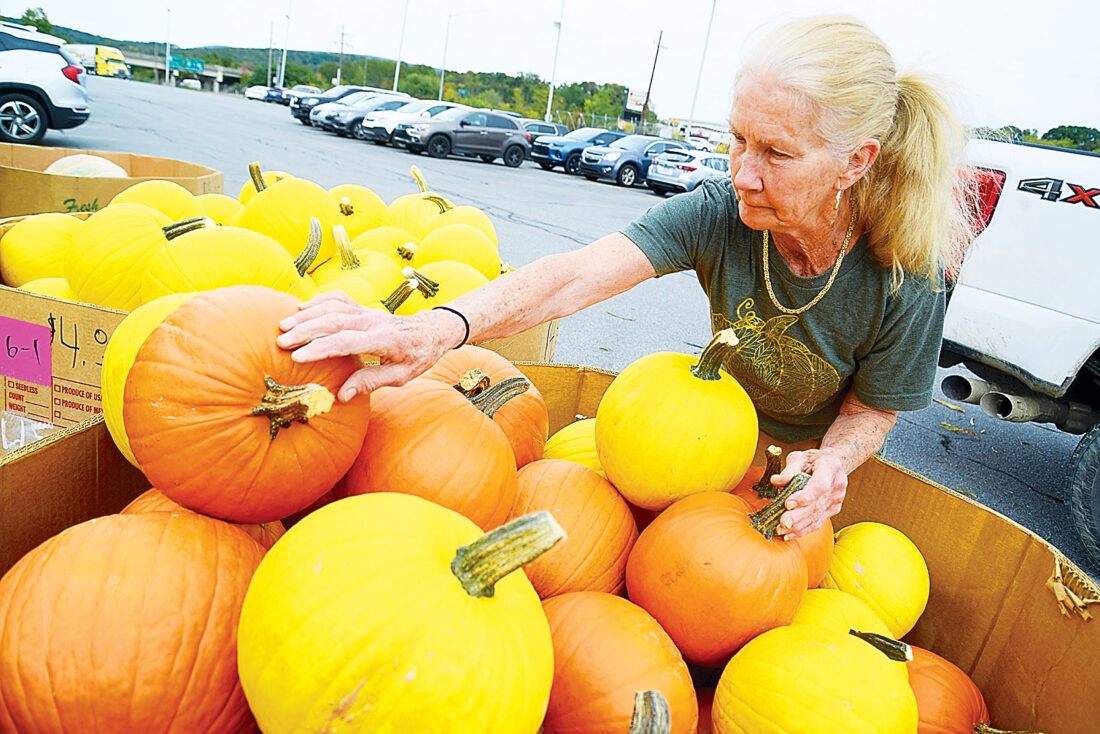
Mary Ann Nagle of Patton looks at the pumpkins for sale at Imler’s Poultry in Duncansville. Mirror photo by Patrick Waksmunski
Like all other agricultural products, growers plant seeds and hope for optimal weather to yield a hearty crop.
This year, however, pumpkin growers are giving mixed reviews with some reporting an above average crop while others are a bit disappointed in the size of the fruit.
“For the most part, I think we will have a good pumpkin crop,” said Penn State Extension Educator Robert Pollock. “Drier weather is better because we see less disease so plants stay healthier longer and can produce more fruit of a larger size and quality.”
That seems to be the case at JB Tree Farm, where the crop is “absolutely unbelievable,” said co-owner Evelyn Bookhammer.
“We have bigger ones than we usually have,” she said of the farm along Route 22 near Alexandria.
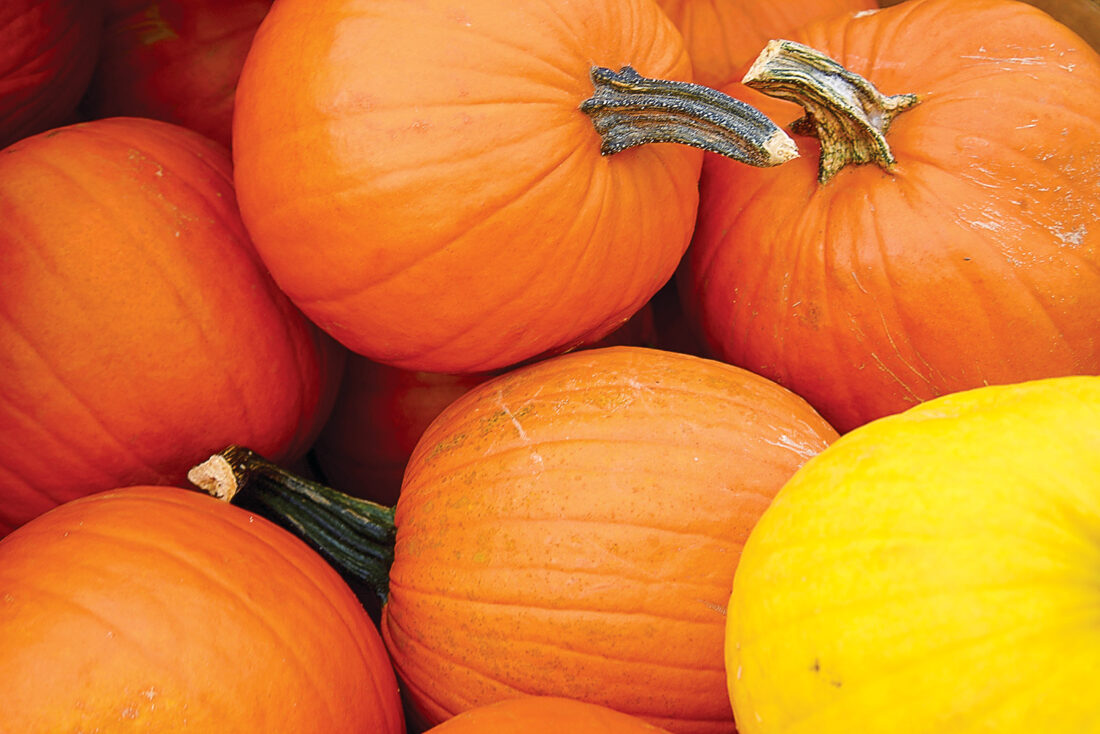
Pumpkins sit in a sale bin at Imler’s Poultry in Duncansville. Mirror photo by Patrick Waksmunski
Bookhammer credits an overall good balance between sun and rain that resulted in healthy plants and produce.
“Last year, there was a fungal infection at some places. We’ve only had one or two rotten ones so far,” she said.
While there is never a perfect year in farming, Jason Coopey of Way Fruit Farm said his crop is pretty good this year, too.
The farm on Route 550 near Port Matilda saw an average year last season, after a dismal 2020 in which it had very few pumpkins.
“This year is above average,” he said. It wasn’t a perfect year, “but it was good enough,” Coopey said.
Statistics show an improvement in the crop statewide, as in 2021 Pennsylvania pumpkin producers harvested an estimated 81.6 million pounds, valued at $22.3 million, according to King Whetstone, director of the USDA’s National Agricultural Statistics Service, Northeastern Regional Field Office.
The harvest was up 21% from 2020, with producers seeing an average of 12,000 pounds per acre on the 6,800 acres of pumpkins planted last year, he said.
Though this year’s totals won’t be known for months, it’s hoped the crop maintains its growth pattern.
At Harner Farm near State College, the dry weather from July until the end of August resulted in a crop of smaller-sized pumpkins, said owner Chris Harner.
“We have about the same number of pumpkins, but they are smaller,” he said, noting the volume is about the same as in years past.
“We didn’t have the rain during the critical period so they ended up smaller than normal,” he said.
Grower Laverne Nolt agreed the dry weather had an effect on the crop.
“It got real hot when pollination was going on,” he said, but overall the crop looks pretty good.
“The color is good this year but the size is a little smaller, probably because of the dry weather,” the North Woodbury Township grower said.
The pumpkin color is definitely good this year, said Don Leidig Jr. of Leidig’s Farm near Tyrone, adding that the yield is down but the pumpkins are better.
“When you have a dry year, it is better because there is less disease than when it is wet,” he said. “The size is definitely down a little, but the color is good.”
The pumpkins “are beautiful” this year, Coopey said. “Everything turned orange very early.”
Harner agreed, adding that not only is the color great, but the pumpkins have nice stems and thick rinds.
“Because it was so dry, we didn’t have the disease issues we have, the quality is good,” Harner said.
Dry weather does have an impact on the crop, said Pennsylvania Farm Bureau spokesman Will Whisler.
“The dry season’s biggest impact has been relative to yield. There’s usually the initial set of fruit that comes through and as it matures and grows it produces more flowers and fruit. Everything was so dry this year that the amount of additional fruit that has been produced has been minimal,” he said.
Because of the drier conditions, downy mildew and powdery mildew were kept in check, as was a soil-borne pathogen that rots fruits like pumpkins from the bottom when there is a lot of moisture in the soil.
“It was a better year as far as disease, but yields were still down,” Whisler said.
“There are disease issues every year,” Pollock said. “We tend to have less disease pressure on drier years. Pumpkin types and varieties vary in their disease susceptibility, so a grower can have problems in some fields and not in others.”
Field location and soil types can also influence diseases, Pollock said.
The dry stretches this summer were broken up by just enough storms to help the pumpkins grow, Coopey said, noting that in 2020, there was no moisture and it never rained.
“When you get a half to three-quarters of an inch of rain, it is enough to keep things agricultural growing,” he said.
Thanks to an irrigation system, JB Tree Farm doesn’t have to rely on rain, Bookhammer said, but it was still welcome.
“We had a dry spell in July, it was hot and dry for about two and a half weeks, but since then we have had a decent amount of rain,” she said, adding that one rain a week since the dry spell has been “a blessing.”
Way Fruit Farm’s biggest problem wasn’t necessarily the weather, Coopey said.
Instead, his biggest problem has been deer.
“They love them,” he said.
With Halloween still a couple of several weeks away, shoppers will be able to find pumpkins in all shapes and sizes, growers said. Their best advice to customers: know what size and color you want and don’t carve them too early, as that exposes the fruit to bacteria and they start to deteriorate.
Pumpkins will keep firm a long time if they are not carved, Bookhammer said.
“Look for one with good color, no defects and a strong stem and that should get you through Halloween,” Harner added.
Mirror Staff Writer Walt Frank is at 814-946-7467.
Local News
UPMC behavioral health pod highlighted in visit by Pennsylvania Department of Drug and Alcohol Programs secretary
The secretary of the Pennsylvania Department of Drug and Alcohol Programs visited UPMC Altoona Tuesday to view its ...
Penn Cambria School District faces $4.6 million deficit, plans to raise taxes to Act 1 Index of 5%
CRESSON — The Penn Cambria School District is facing a budget deficit of about $4.6 million and plans to raise ...
Tyrone Borough Council fires 2 officers, appoints Kim Gurekovich borough manager
Two police officers were fired and a new borough manager was appointed during Monday’s Tyrone Borough Council ...

Puddle jumper
UPMC behavioral health pod highlighted in visit by Pennsylvania Department of Drug and Alcohol Programs secretary
The secretary of the Pennsylvania Department of Drug and Alcohol Programs visited UPMC Altoona Tuesday to view its ...
Penn Cambria School District faces $4.6 million deficit, plans to raise taxes to Act 1 Index of 5%
CRESSON — The Penn Cambria School District is facing a budget deficit of about $4.6 million and plans to raise ...