
Inspiration hits home: Blind man shares Beautiful Lives project
Program lands at SFU with basketball clinic for locals living with various disabilities
Trending
LORETTO -- Blindness is an extremely challenging obstacle for a person to deal with and a very difficult cross to bear, but Bryce Weiler, who has been blind almost since birth, said he has never honestly missed having a gift that so many others take for granted.
Weiler, 31, who lives in Clairemont, Ill., was born four months premature and became blind a few days after his birth, when he said, due to his body getting either too much light or too much oxygen in the hospital, the retinas in his eyes detached.
He has been blind ever since.
Weiler has taken a philosophical attitude toward what most people would consider a debilitating handicap.
"I've been totally blind for my entire life, so it doesn't really bother me,” Weiler said. "A person can do whatever he or she wants to do as long as they set their mind toward achieving it.”
Weiler is living out that belief in his daily life as a co-founder of the Beautiful Lives Project, an outreach program for which he has traveled all over the country to improve the lives of adults and children with any type of disability through participation in a wide variety of activities that range from athletic events to endeavors in painting, sculpture, pottery, cheerleading and dance.
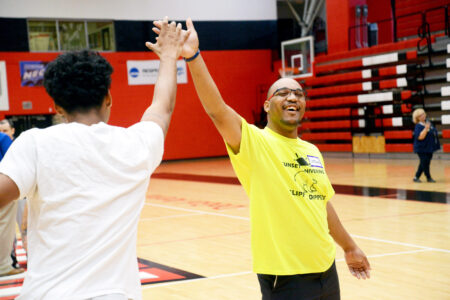
Weiler was on hand at Saint Francis University's DeGol Arena on Monday morning, partnering with members of the Saint Francis men's basketball team and its coaching staff, who conducted a one-hour clinic teaching basketball skills to people in the community with various types of disabilities.
On Monday evening, Weiler continued to inspire student-athletes by giving a speech about his life story in the Stokes-Twyman room in the Stokes Center.
The events came about after Weiler met Saint Francis coach Rob Krimmel for the first time when the Red Flash played at the University of Illinois last season.
"Bryce first reached out to me back in 2016, and we developed a little bit of a friendship at that time, via email and an occasional phone call,'' Krimmel said. "When the (coronavirus) pandemic hit (in 2020), that put the pause button on a lot of our interactions.
"But last year, we had Illinois on our schedule, and he was doing some color commentating on our game for the Illinois broadcast, and he reached out to me again,'' Krimmel said. "We visited before the game, and he said that he'd love to come to Saint Francis and speak to our student-athletes and bring the Beautiful Lives project to Loretto. And that's how this event came to be.''
Monday's event was a win-win for Weiler, his organization and Saint Francis.
"When you talk about a young man who is passionate about helping others, I guarantee you that there aren't too many people in the world who have the same passion that Bryce has,'' Krimmel said. "Bryce is trying to impact the world one person at a time, and he's doing a lot of it through sports. He's an unbelievable person who has an unbelievable vision to help others.''
At the same time, Weiler has benefited from the assistance of many other people, who helped to open doors for him.
"I can do whatever I want to do, and I try to surround myself with people who believe in me and who want to give back to others with disabilities,'' Weiler said. "These events show that people with disabilities can do whatever they dream of doing in their lives.''
Weiler is a fascinating case in point. Before co-founding the Huntington, N.Y., based Beautiful Lives Project in 2017, Weiler graduated with a bachelor's degree in sports management and sports communication from the University of Evansville in Indiana, and a master's degree in sports administration from the University of Western Illinois.
He has served as a color commentator/analyst on sports broadcasts for Evansville, Western Illinois and Illinois and for several minor-league baseball teams -- the York (Pa.) Revolution, the Lansing (Mich.) Lugnuts and New Britain (Conn.) Bees.
Weiler is also a disability consultant with Major League Baseball's Baltimore Orioles, partnering with that organization to offer programs on baseball instruction for people with disabilities.
According to Weiler, the Orioles have been a trend-setter with their use of braille -- a tactile writing system that is used by people who are blind or visually handicapped.
"The Orioles became the first team in sports to wear braille on their jerseys,'' Weiler said. "They helped me to run an event on their field in which 150 people who are either blind or visually impaired got a chance to play baseball at Camden Yards with the Orioles players and coaches.''
Saint Francis event brings smiles
A total of 18 adults from organizations serving people with various types of disabilities participated in the Beautiful Lives Project basketball clinic at SFU.
Their happiness was evident as they broke into groups with coaches and players at four different stations on the DeGol Arena court, where they participated in offense, defense, shooting, rebounding, passing and dribbling drills.
Skills of Central Pennsylvania brought seven participants to the event, including Tiffany, an Altoona woman who is enrolled in a vocational training program at Skills.
"Playing basketball is fun, and I like shooting the best,'' said Tiffany, who had just converted a 12-foot jump shot. "I like it here. It's fun up here.''
Kacee Baker, who is a marketing/communications coordinator for Skills of Central Pennsylvania, noted the enthusiasm of all the participants and their instructors.
"It's definitely really fun,'' Baker said. "As you look around the gym, you see that everybody seems to have smiles on their faces. Community involvement is important for our people, and this event is a way for them to connect with others with whom they normally would not connect.
"And events like this help the people interacting with those with disabilities to realize that people with disabilities are just like everybody else,'' Baker added.
Brad McCabe, a redshirt junior guard/forward from Nanasquan, N.J., was one of several Saint Francis players on hand.
"This is a great cause, and Coach Krimmel does a great job getting our players involved with the community,'' McCabe said. "We really have a great coaching staff with great people here, and if we didn't have such great people on our coaching staff, things like this wouldn't happen.''
Rolling with the punches
Weiler, of course, has had to become extremely personally flexible to achieve his success as a non-sighted person.
"My hearing is very good -- although I don't like loud noises or being in loud environments,'' Weiler said. "My sense of touch is also very good. I have used braille since the age of 5, and I use a voiceover program on my iPhone that tells me when I am speaking into it what I dictate or if I have any spelling errors, and which also tells me the number of an incoming call.''
A technological device known as JAWS -- an acronym for Job Access With Speech -- helps Weiler to recognize all the keys on his laptop computer.
"I know where everything is on the computer based on the dot on the F key and the dot on the J key,'' Weiler said.
Doing color commentary for sporting events has been another adventure and a challenge that has required an adjustment on Weiler's part.
"I study the style of the play-by-play broadcaster to determine whether he or she tells a lot of stories or gives a lot of statistics, and I will tailor my broadcast around what the play-by-play broadcaster I'm working with is doing,'' Weiler said.
"For example, if he or she doesn't tell a lot of stories then I won't research more on the players and coaches,'' Weiler added. "If the play-by-play broadcaster has trouble tracking trends and stats, I will focus on that in the game and pay attention to numbers and missed free throws.''
Active pregame preparation is also important in doing his sports commentary, Weiler said.
"If I'm doing a basketball game, I will go out on the court before the game and shoot free throws to figure out if the rim is too loose or too tight and how the ball bounces off the rim,'' Weiler said. "That helps me during the game when I hear the ball hitting off the front of the rim or hitting hard off the back of the rim.''
Allies helped Weiler since the start
Tom Benson, who is currently the assistant director of media relations and sports information at Evansville, helped open the door to Weiler's broadcasting career when Weiler was a student at the school and the two handled coverage of basketball games on the campus radio station.
"He is honestly one of the most impressive human beings I think I have ever met,'' Benson, who was interviewed by the Mirror last week, said. "Everything that he has overcome and everything that he has done to make this world a better place for others who are in a similar situation has been just extraordinary.''
Weiler started out as a production and board operator who provided halftime information at the Evansville games, before graduating to radio commentary.
"He would be able to provide some of the same color commentary that you hear in different sports all of the time, and it was mainly because he had listened to so many games himself,'' Benson said. "He kind of knew what the play-by-play broadcaster would say at certain points and he'd interject some of his thoughts.''
It was a matter of good teamwork that made the broadcasts go off smoothly.
"In providing play-by-play commentary with somebody who is blind, if I didn't do the job to the best of my ability, I was leaving him in a tough spot because he relied on everything that I said to paint the picture in his head of what was going on,'' Benson said. "So I had to try to provide that for him, and in turn, it made me a better broadcaster myself.''
Benson also helped Weiler overcome an initial stuttering issue.
"His nervousness in certain situations caused that stuttering, so I tried to put him into positions where he was uncomfortable and had to overcome those nerves quickly," Benson said. "Thankfully, that worked out for him, because his story has been so important to tell.
"The job that he has done with the Beautiful Lives Project has really been tremendous.''
Marty Simmons, the head men's basketball coach at Eastern Illinois was the men's basketball coach at Evansville when he met Weiler over a decade ago.
The two developed a friendship and Simmons eventually permitted Weiler to sit on the team's bench during its games.
"He loves sports, he loves basketball, and he'd come over and shoot free throws every day in our practice facility,'' Simmons said in a phone interview. "He would sit on the bench, and one of our managers would tell him what was going on during the course of the game.
"He's so positive and he just wanted to be around basketball and be around our team, and we certainly got a lot more than what we gave him from the inspiration that he gave us,'' Simmons added. "He's one of the most unique, inspiring young men that I've ever been around in my entire life.''