
Trending
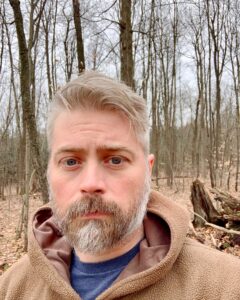
Regarded as one of the world's leading experts in paleontology, John Whitlock seeks to uncover the stories of a unique, prehistoric creature, specifically, its growth and feeding behaviors.
The Mount Aloysius College professor's primary area of interest is sauropod dinosaurs, which had long necks, long tails and small heads.
"They're actually the largest land animals ever," Whitlock said. "My work mostly focuses on what they ate, and, physically, how they acquired food."
In particular, it's these creatures' juxtaposing features that intrigue the Michigan native.
"One of the things that fascinates me is how huge these things were," Whitlock said. "They were massive, massive animals, but then, when you look at their heads, they're actually really small, about the size of a cow's, despite their bodies being between 30 and 40 yards long."
Beyond academia, Whitlock's field research furthers his mission for answers on the feeding habits of these creatures.
A research associate at the Carnegie Museum of Natural History, Whitlock works closely with other experts with whom his goals align.
Matthew Lamanna, the dinosaur curator at the Carnegie Museum, has seen Whitlock's expertise. He is a consummate professional with nearly second-to-none command of his area of study, Lamanna said.
Whitlock's work has been published by major outlets including the Smithsonian Magazine.
"He is among the leading experts," Lamanna said. "John is one of the world's foremost experts in (his area of study). He's got a very good analytical mind; like most scientists, he's a smart guy."
The specific sauropods Whitlock is interested in are called diplodocids.
"They weighed hundreds of tons but only ate plants," Whitlock said. "They've got these tiny, little heads, ate diet food and were the largest animals to walk on land. That, to me, was like, 'I've got to figure this out.'"
Whitlock has made various discoveries that have changed the way scientists understand this type of dinosaur.
Through his research, Whitlock found that the skull shapes of baby versus mature diplodocids were drastically different, which suggests the creatures relied on different food sources during different stages of their lives.
According to Lamanna, the younger creatures' skulls were shaped like parabolas, whereas adults' skulls were more rectangular.
This finding indicates that these creatures were able to coexist in the same ecosystems since they weren't competing over food sources.
It took extensive research that required traveling to Asia, South America and Europe, for Whitlock to unearth what paleontologists now know about sauropods; no one pitstop is like any of the others, he said.
"It's interesting because you go to different places, and, obviously, it's a very different experience," Whitlock said. "You go to Europe, for example, and you're working out of these museums from the 18th and 19th centuries. A lot of the facilities are very ornate and beautiful but also kind of old. Then, you go to Argentina, where the history of paleontology is a little more recent, but some of these facilities are smaller."
Argentinian law stipulates that any fossils found in the country are to stay in the province in which they were discovered.
As a result, Whitlock said, any given museum there contains a wealth of material to work with that museums in the U.S. might not necessarily have.
"I've seen an awful lot of what I've studied about these dinosaurs in Argentina," Whitlock said. "You go to all the provinces and all the little places in the country, so it's a very different experience than here and in Europe."
Whitlock's proclivity to unearth the unknown goes back to his graduate school days at the University of Michigan. There, he conducted a major project in which he cut up sauropod teeth into thin slices that he could shine light through to determine how quickly these creatures' teeth grew.
What started as an academic pursuit evolved into a burning desire to find out more.
"I've just had that data sitting around on my computer ever since," Whitlock said. "I've been wanting to do something extra with it."
And that, he did. Whitlock and Mount Aloysius alumnus John Price embarked on an offshoot of the graduate school project digging deeper into the anatomy of sauropods' teeth.
What began as a yearlong research project inspired Price to write a paper, which was submitted for publication in The Journal of Vertebrae and Paleontology, a professional publication.
"The experience was tremendous, and it changed my perspective on paleontology," Price said. "We did it piece by piece and it was interesting to uncover and discover."
"We're finding out what kinds of enamel and what kinds of tissue are there and what we can say about them from a biomechanical standpoint, and what kind of stress these teeth experienced," Whitlock said.
What he found illustrated further evidence that sauropods were even more atypical creatures than scientists had thought.
"The teeth of this animal are also kind of weird," Whitlock said. "Those little golf pencils, that's about the size and shape of their teeth. They don't have big chewing teeth -- they weren't even chewing at all -- and their teeth didn't match up. It's been a longstanding question: What were they using these teeth for? Were they grabbing a hold of branches and squeezing them to rip the leaves off? That's what we call branch stripping; it's a very different sort of stress, mechanically. As it turns out, the way that the tissues of the teeth are arranged, they're really not good at that. So, what we're leaning toward, is that these animals were taking bites much like any other animal."
These discoveries are more than just imperative to his own understanding, Whitlock said; he wants his work to inspire the next generation of paleontologists.
"(Whitlock) is very passionate about his students and is an outstanding guy," Price said. "He showed me attention to detail and gave me an open eye to be able to understand to the fullest extent."
"It's introducing things that, to me, were a lot of what got me into this," Whitlock said. "I hope to inspire students to be more interested in the world around them. It's about taking away from it an understanding of how the world works -- our bodies and the bodies of other organisms -- it's about fostering a fascination with nature, the planet and the place that we live."
Mirror Staff Writer Andrew Mollenauer is at 814-946-7428.