
Answering the call: 911 dispatchers making a difference

Jamie Huston works on the 911 dispatch desk in Bedford County on Monday. Mirror photo by Calem Illig
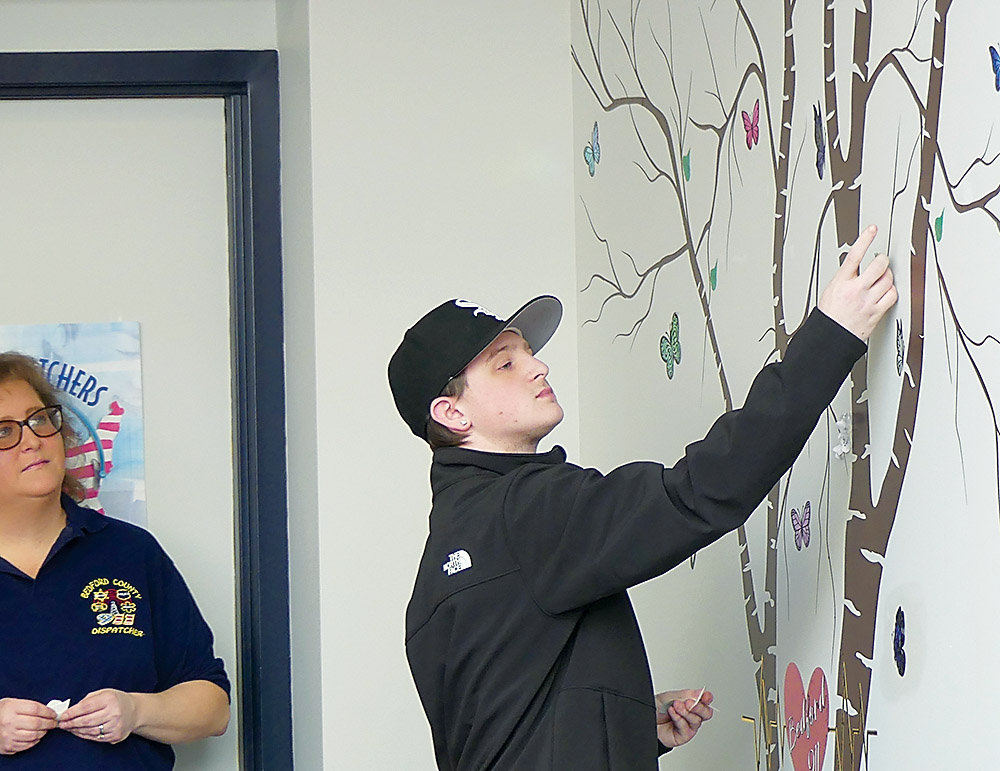
Bedford County 911 dispatcher Jacob Diehl places a leaf on the center’s Tree of Life on Monday. The display, with leaves marking lives saved and butterflies representing babies born with the help of dispatchers, commemorates the difference dispatchers have made in the lives of those they serve. Mirror photo by Calem Illig
Jamie Huston works on the 911 dispatch desk in Bedford County on Monday. Mirror photo by Calem Illig
Bedford County 911 dispatcher Jacob Diehl places a leaf on the center’s Tree of Life on Monday. The display, with leaves marking lives saved and butterflies representing babies born with the help of dispatchers, commemorates the difference dispatchers have made in the lives of those they serve. Mirror photo by Calem Illig
Trending
BEDFORD -- Nearly a dozen lives have been saved in the past two years with the help of a 911 dispatcher in Bedford County.
It's a job where "you never know what's going on at the other end" when you answer a call, dispatchers said, but being able to keep calm and in turn, calm down the caller, can be the difference between life and death.
Bedford County 911 dispatcher Jon Zimmers said one of the more frightening saves in his career involved an infant.
"When you hear that a child is not breathing, everything else goes on hold," Zimmer said. "For everyone in that room, nothing is more important than getting that child help."
Regardless of who is in need of help, Zimmers said that he and his colleagues focus solely on the caller and the situation with which they're presented.
Zimmers is thankful he was able to help the caller, and in turn, help save the baby's life.
His lifesaving response was among those lauded Monday at the 911 dispatch center in Bedford, where a Tree of Life was unveiled.
Leaves and butterflies
Throughout her many years on the job, Bedford County 911 coordinator Karen Waybright has watched her fellow employees perform countless miracles and help others save a life.
While those saves are just a part of the job, Waybright and other Bedford County 911 dispatchers will be recognized on the branches of a Tree of Life, where leaves mark lives saved and butterflies represent babies born with the help of dispatchers. While names are not used on the display, dispatchers can see, as the tree "grows," just how much they mean to the community.
The Tree, a vinyl-printed display outside the county 911 center in the Bedford County Courthouse complex, was unveiled in an emotional ceremony Monday, and officials said the purpose is to help commemorate those who answered the call and made a difference in a stranger's life.
"This has a deep connection with our dispatchers," said Dave Cubbison, emergency management director of Bedford County. "They get to see the tree every day when they come into work, and it should serve as a constant reminder of why their work matters and how much of a difference they truly make."
"This is a true celebration of life," Waybright said. "Our dispatchers go above and beyond every day on the job, and I'm happy that they can finally be recognized and appreciated for all the tremendous work that they do."
Zimmers said the Tree is "special for all of us. ... Everyone here is so dedicated to their work and loves to help others, and it's nice to be recognized and know that the people in your community care about the work you do."
Waybright got the idea for a Tree of Life when she took over as 911 coordinator in September 2020 and heard about Cambria County's tree.
In Blair County, Emergency Management Director Mark Taylor said the department holds private, internal ceremonies to recognize dispatchers.
Despite a lack of publicity, Taylor said those ceremonies are still important and "well deserving."
"I commend all of our dispatchers for the amazing work that they do," Taylor said. "They deal with very difficult situations from the start of their day to the end of their day, but they continue to work hard and be there when they're needed most. I can't say enough about all of our dispatchers."
Babies born
Sunday Jan. 23 was a peaceful morning at work for Anna Rogers, a 911 dispatcher at the Cambria County 911 center.
Rogers was helping train a new recruit to answer the 911 line and allowed him to take the call when she could hear a woman screaming in the background.
After the woman told 911 she thought her water broke, Rogers took over the line and provided a second hand of support for the woman, whose only help was a neighboring teenage boy who saw her in distress on her front porch.
Rogers instructed the frightened teen to take the woman inside, and the woman was heard on the phone saying her contractions were "only a minute apart."
"I knew this baby was probably going to come before the ambulance got there," Rogers said.
With the teen being the only hands-on support system for the woman, Rogers said she had to help him navigate his fears, and awkwardness, as well.
The boy could at one point be heard asking the woman if it was "OK for him to look," and Rogers said she followed protocol to provide instructions for the boy on how to deliver the baby.
Rogers told him to use his own shoestring to tie the umbilical cord and cautioned him to support the baby's head and shoulders. After about 10 minutes, the caller could be heard shouting with joy that the baby -- a boy -- was born.
"This obviously isn't something that happens every day," Rogers said. "It's not what you expect to do, but in the moment, you don't even think about it. All you're focused on is doing whatever you can for this baby."
Rogers said that, despite being a hectic situation, it was a "heartwarming" and "rewarding" experience.
"I love knowing that I was able to help somebody and that I was there to help them through their worst day," Rogers said. "It's really rewarding to know that you made a difference and that someone didn't have to go through something alone."
On the job
To become a 911 telecommunicator, recruits undergo an extensive training process.
According to Waybright, candidates work at their own pace and do not graduate the training program until they have mastered the job requirements.
Training includes simulations and live experience on the floor, and Waybright said the rigorous training schedule teaches recruits to think on their feet and navigate through unexpected obstacles.
While some may take longer, Waybright said it typically takes about six months until new dispatchers can handle job duties on their own.
"We want to make sure they are ready to do everything that the job entails," Waybright said.
Samantha Bees, also a Cambria County 911 dispatcher, was in the middle of her shift when she received a call from a woman in labor.
The woman was screaming in pain, and the woman said she could feel something moving.
After gaining more information from the woman, Bees discovered that the baby was crowning.
Realizing what was happening, the caller told Bees she was scared and didn't know what to do.
Aside from a 3-year-old child in the house, the caller became even more anxious because she felt alone.
Before Bees could help deliver the baby, she knew she first had to reassure the woman that she wasn't alone and that everything was going to be OK.
"She was very scared, and I just kept trying to tell her the whole time that 'you can do this,'" Bees said. "I wanted to let her know that I was right with her the entire time."
With Bees' help and reassurance, the caller was able to deliver the baby boy herself, and Bees said she was finally able to relax and celebrate at the sound of a healthy crying baby in the background.
"You have to be able to stay calm no matter what, even if people are stressed out or in distress," Bees said. "You have to be focused, and as situations like these have shown, you have to be able to think on your feet."
While 911 dispatchers have been able to welcome new life into the world, they have often been relied upon to stop another life from ending.
Among the long list of leaves on the Tree of Life are cardiac saves, which is when a dispatcher was able to successfully instruct someone over the phone on CPR techniques.
Dispatchers have also been able to find the root of many other emergencies, such as strokes, seizures and diabetic shock.
"We can diagnose that over the phone and instruct people on what to do next," Zimmers said. "Until a paramedic gets on scene, there are a number of services we can provide over the phone."
As with any first responder, working as a 911 dispatcher can take an emotional toll.
Though there are many saves and happy endings, there are also unavoidable tragedies and situations that cannot be fixed, such as suicides, homicides, fatal accidents and cardiac arrests.
"They can't be seen, but they can be heard, and they go through a lot of stress and emotions when they're trying to help people," Waybright said.
Dispatchers said it is not uncommon to encounter a tragic incident while on the job, but their drive to make that next save and make an impact keeps them coming back to work every day with a smile.
"You never know what's on the other end of that phone when you answer," Bees said. "We always stay prepared. There are good days at work and bad days, but we have to be strong and be there for those that need us."
Mirror Staff Writer Calem Illig is at 814-946-7535.