
Trending
Moving to a new place can be intimidating, but adding in a language barrier makes the situation all the more difficult. Day-to-day tasks can become frustrating and difficult when people are immersed in a country where they do not speak the language, local leaders said.
But help is available in schools and through church outreach programs, such as the Altoona English and Culture Club, an English as a Second Language program offered weekly at the Altoona Alliance Church.
Volunteers with the program said it started as a way to "love thy neighbor" like the Bible instructs.
The church, located on Pleasant Valley Boulevard, hosts classes at seven different levels.
Lori Crownover, program director, said people coming to America from another country need to know English to be able to get a job, do business, talk with neighbors, visit a doctor and to complete other day-to-day tasks.
The church-based ministry offers classes for beginners with no English skills up to those who are at the top, conversational level.
The program is in its fourth year and has had about 90 international students participate.
"You wouldn't really think that Altoona would have that many, but there's probably 13-15 different countries represented by those who come through these doors," Crownover said.
Volunteer Kimberly Long said working with the program is a passion.
"I think it was a calling, it just seemed really interesting to me," Long said.
Long teaches the literacy level class, which she said is a little easier when the teacher and student are one-on-one. The goal of all of the classes is to gain conversational English and confidence, she said.
Her class starts with learning the alphabet and being able to introduce names at a pace that's best for the student.
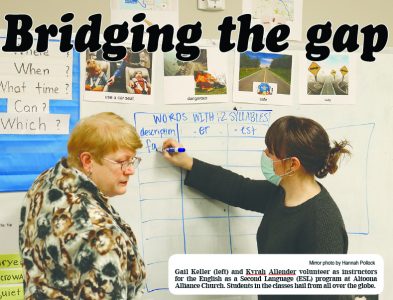
Gail Keller and Kyrah Allender teach an intermediate-level class using listening comprehension to gauge the listener's understanding of conversations. They also use illustrations of vocabulary words and call out new words and have students respond.
Allender, who is in a master's program to eventually teach in schools, said members of their class hail from Mexico, Thailand, Sudan and more.
"I can't imagine how hard it would be for people who are moving from a non-alphabetic country. They have a totally different alphabet," Allender said, noting that Spanish speakers have similar letters, while others who speak Arabic or other languages have to learn a completely new system.
Students are able to make connections to real life, which betters their understanding of, what to them, is a foreign language.
A recent class focused on commutes and driving to work or school. The students talked about whether or not they liked sitting in traffic and they talked about their children who used car seats.
Easing daily activities
During the classes, students, who range in age from 22 to 75, are not only learning English, they're also forming relationships.
Crownover said the classes are run by 25 to 30 trained volunteers, who come from all walks of life and from other churches and organizations.
"The teachers don't just teach English, it's whatever they might need in their life," Crownover explained.
Mentorship or advice might be in the form of helping the student figure out day-to-day tasks like where to get their car serviced or filling out paperwork for citizenship applications.
Volunteers help students "navigate American culture."
Crownover said one student was struggling with a green card and volunteers helped the person through the process.
"I tell my family that I don't really have family here, but you guys are my family," that student said.
The program offers a rolling admission, with classes offered from 6 to 8 p.m. Mondays during the school year. Once students sign up, they are interviewed and put into a class at their level, according to Crownover. While a donation is accepted to help cover the costs of books for the class, it is not required.
Students are grouped in similar learning levels, which helps to lessen anxiety.
Some students are parents of young children -- who are learning English at school -- so the program offers child care, too.
While the number of students in a class varies throughout the year, volunteers from 10 Altoona-area churches are on hand each week.
"It's really a collaborative effort," Crownover said.
The teacher-volunteers do not need to speak both English and the student's native language, which actually aids in the student's learning.
Crownover, a retired elementary school teacher with an ESL certificate and master's degree, said research has shown that ESL students progress faster if they're just speaking English during class time.
Learning English can be exhausting, though.
That's why students are in class from 6 to 7 p.m. and then take a half-hour break together, over another common language -- food.
"The cultures are extremely hospitable," Crownover said. "They'll make a lot of food for you if you go to their house, so we try to do the same thing."
The food and fellowship offer a time of rest, as well as an opportunity to practice conversational English.
People do leave the program, some because they complete the coursework, others because they move away or change jobs.
"Sometimes you have people who will come for a month and then they'll change jobs and we won't see them, which is always super sad," Crownover said.
When someone leaves the program, both the volunteers and the students miss each other.
Crownover said a student who was with the program since its inception had to move out of the area last year. That student typed a thank you note on her phone to show the volunteers as she wept with gratitude, Crownover recalled.
ESL in schools
While the Altoona English and Culture Club is geared toward adults, students who move into the area find help in school.
School districts are required to have ESL teachers even if there is no student in need of the service, said Hollidaysburg Area School District ESL teacher Juli Claycomb.
If a student moves into the district, officials test the student's language ability and comprehension and begin educating within 14 days, she said.
Claycomb estimated the district has 20 students whose native tongue is not English, but with the pandemic, numbers have gone down.
"It's been a trying year," she said, noting that the families of those students often have restaurants and salons that have had to close down at some point in the past two years. Some of the kids are remaining at home with cyberschool.
"COVID has really affected the population numbers, but I'm hoping that changes," she said.
Claycomb said Hollidaysburg has a couple of ESL students per grade level. She covers the elementary level, while Cheri Grimaldi teaches secondary learners.
The Altoona Area School District has one full-time teacher at the elementary level, one at the junior high and one at the high school level who teaches ESL in addition to other class loads, according to district spokeswoman Paula Foreman. The district's ESL program serves about
30 students.
ESL teachers don't always speak the students' first language. While it is beneficial, that's not necessary to teach them, Claycomb said.
Once students are tested, Claycomb said they are either taught one-on-one or Claycomb goes with the student to class to assist them. The students are learning the same content in either setting, just with some accommodations, she said.
"As their English develops, we try to keep them in the classroom more," she said. "When they're young, they pick it (language) up so quickly."
Claycomb said she labels everything in the classroom in English and in the home language, and relies on a routine to create a better learning environment.
"English is one of the hardest languages to learn," she said. "If they know the routine, it makes them comfortable."
"The first couple of weeks, they're usually silent, just taking everything in," Claycomb said. "You think that they don't want to learn, but then all of the sudden they'll just blossom."
Claycomb said language learners acquire their skills in two ways, academically and conversationally.
Conversational English, known as BICS or Basic Interpersonal Communication Skills, is everyday conversations, like things one would talk about Monday morning at work. Students pick these skills up quickly, usually taking between one and three years to fully understand, she said.
CALPS, or Cognitive Academic Language Proficiency, is basically everything students learn in school. This type of language takes five to seven years to be proficient, while some kids may pick it up in three, she said.
Teachers may see ESL students interacting and communicating with their peers out on the playground but do not see that same level in the classroom.
"It's because it's two different types of language they acquire," she said.
In her experience, students are typically better with math-based courses than English/language arts classes because math has universal numbers.
Claycomb said kids will also pick up American cultural phrases like idioms or slang faster, but may not always understand what the words mean.
The initial quietness or timidness of the ESL students in the classroom doesn't reflect a lack of interest in learning, but it is building up the confidence of the student, Claycomb said.
"When they get that confidence, whether they know the content or not, that's what makes them shine," she said. "It's really cool to watch, they are so quiet and then come out and make friends. It's just neat to watch the other kids accept them."
Other cultures see education as a cherished privilege and a pathway to a better life, Claycomb said, and the students are motivated to learn.
"They value education so much, they are some of the best students in our district. They want success," she said.
Claycomb said the best part of her job is getting to know the families and learning about their cultures.
She, too, talked about the common language of food and said students' families invite her to dinner and cook food from their homeland and share cultural customs.