The big ride
Patrick McGinnis goes cross-country on two wheels
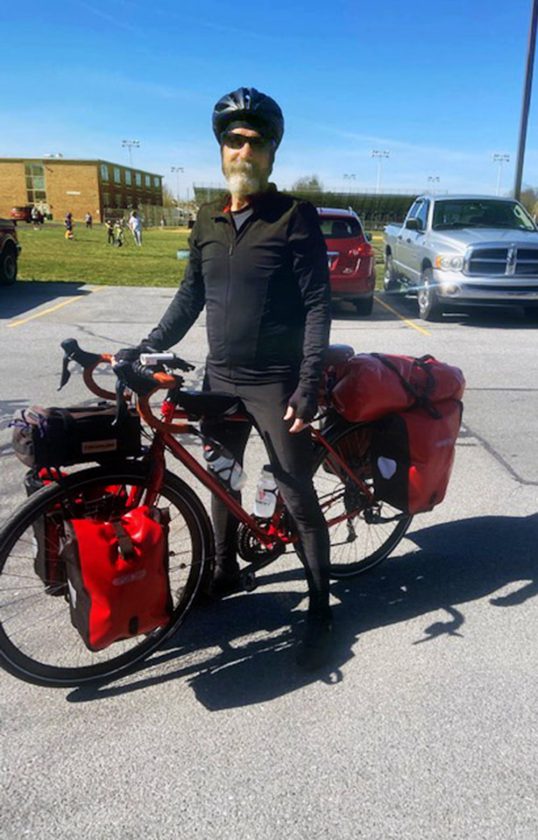
Patrick McGinnis poses with his bike in front of the Blair Regional YMCA.
Patrick McGinnis began riding bicycles seriously about 10 years ago.
Since then, he’s ridden up the steep “wall” near the Horseshoe Curve hundreds of times, he’s ridden over 100 miles a day more than 100 times, he’s ridden in the “Dirty Dozen” event up the nastiest hills of Pittsburgh and he’s ridden in many competitive races.
But he’s embarked now on an adventure that trumps all of those — one that upon completion will serve as an identifying accomplishment for the rest of his years, which currently number 63: He’s riding across the country, having started May 20 under the Golden Gate Bridge in San Francisco, with hopes of arriving in Virginia Beach, Va., two months from now, 3,800 miles later.
When driving a car or riding on a bus or train, one is the beneficiary of society’s complicated machinery and fuels, but on this trip, McGinnis is using a simple machine and providing the power to propel it, thus earning his way across the country in a way that the driver of the car or the rider of public transportation could never claim.
It will require the expenditure of about 247,000 calories, at 65 calories per mile, burned one pedal-push at a time — a continuing payout of energy that becomes easier to imagine when viewing the pictures of empty Nevada highway that McGinnis has posted on his “Salt to Salt 2021” Facebook page — scrubland to the sides, mountains in the distance, yellow lines in the middle.
It’s a massive undertaking, but executing it should be straightforward, according to McGinnis.
He hopes to average 70 to 80 miles a day — less in the mountains — and that’s eminently doable, based on what he has done routinely for the last decade around Altoona, he said.
“The idea of doing (that many) miles a day is really not that over the top,” he said — although his loaded touring bike weighs about 80 pounds, 65 more than his regular road bike.
Planning
For years, McGinnis has been interested in a long-distance ride, but the circumstances of his life didn’t allow it.
But his wife — his childhood sweetheart from Bellwood, Rosemarie Shank McGinnis — died a little more than a year ago.
Then he retired at the end of April from his 40-year career in social work.
And the music scene — he’s a musician — hasn’t fully reopened yet after following the COVID-19 closures.
Those have all contributed to “changed priorities,” McGinnis said recently, sitting in the living room of his house on Crawford Avenue, a few days before he left for San Francisco.
“Things I would have put off” became doable,
McGinnis said. “I had the freedom and flexibility to take this on.”
He actually began planning six months ago.
The logistics turned out to be more daunting than “the physical part,” he said.
He turned for help to a group called Adventure Cycling, which, in addition to organizing tours, provides maps of routes for people like McGinnis who plan to ride independently.
The routes are well-established, and they’re vetted for safety and reasonable distances between provisioning and rest stops.
He bought a set of 13 maps, each covering a little more than 300 miles.
The set combines the California-to-Colorado part of one route, and the Colorado-to-Virginia part of another.
Before heading to San Francisco, he disassembled and boxed his bike and sent it via UPS to a participating bike shop in San Francisco, where workers reassembled it to be ready for him to pick up when he arrived.
He’s not on a hard schedule.
“It takes as long as it takes,” he said.
He’s carrying a tent, a sleeping bag, a water purification system and each day, enough food until the next day — unless provisioning stops are far away, in which case he’ll carry enough food for two or three days.
“Some sections in Utah are pretty remote,” he said.
He’ll resupply at grocery and convenience stores.
He’ll sleep in public campgrounds, state and national parks, in the backyards of people he meets along the way, as a guest of host families that participate in a network of people who agree to accept and provide accommodations for travelers like McGinnis; in motels — and whenever necessary, in “stealth” encampments, concealed somewhere near a road.
He’s carrying two $70 battery banks that, along with a few standard chargers, he’ll use to recharge his phone, his GPS system and his bicycle lights.
He can afford to be “off the grid” for two or three days if necessary, when starting with the battery banks and devices fully charged.
He can recharge in campgrounds, hotels, restaurants and convenience stores, he said.
Anxiety
He was a “little bit anxious,” before starting, he said.
“I fully expect I’ll have a couple of difficult days in the Sierra Nevada and the Rockies,” he said.
The initial challenge will be finding a comfortable pace, setting a routine, he said.
Most of the worries have come from others, who fear that people will try to run him over or assault him, he said.
That’s no more likely than around here, he said.
He expects to interact with people.
“By and large, people are decent,” he said. “Benevolent and kind.”
He himself is “kind and reasonable,” so he expects those interactions to be pleasant.
He’ll be traveling with “an open mind, an open heart,” he said.
He’s a songwriter, and figures the trip will provide material.
People who’ve done it have told him to expect to be “impacted in ways you can’t imagine,” he said.
He’s looking forward not only to the spectacular scenery in Utah, but the endless flat, straight highways of the Great Plains and the Mississippi, where he’ll stop for a while.
He’s curious to experience local cultures, and intends to seek out the unique places — the equivalent of Tom and Joe’s or Texas Hot Dogs here, he said.
He plans not to let the magnitude of the effort overwhelm him.
He won’t be looking forward to Virginia Beach, but “where am I going to be at the end of the day,” he said.
The riding
He’s confident he can handle the uphill grades of the Rockies, which won’t be steeper — although they’ll be much longer — than what he’s experienced around here.
The grade of the “wall” above the Horseshoe Curve is about 18%, and the entire mountain climbs locally are, at most, a couple of miles, but in Colorado, a grade of 10% to 12% can last for five hours, he said.
He’ll need to be careful not to stop where it can be hard or impossible to clip into his pedals and get started again, he said.
If and when he stops on long upgrades, he’ll need to look for “neutral elevations,” such as at the apex of a switchback, he said.
At worst, he might need to walk his bike to a favorable spot, he said.
He’s a good climber, being light — about 160 pounds — with a good weight-to-power ratio.
He also refrains from “negative self-talk,” he said.
“Hills are my friend,” he said. “You say that long enough, you even start to believe it.”
Descending is radically different.
He’s a cautious descender, not like the “adrenaline junkies” he knows who are willing to go 60 mph or more, putting them “at the mercy” of their bikes, of the road conditions and of animals darting out in front of them, he said. Accidents at such speeds can be fatal, he said.
The descents in the Rockies can be 30 miles long and take an hour, he said.
He’s gone fast downhill on occasions, putting him at “the edge of my comfort zone,” he said. He’s been up to 50 mph on Sugar Run Road, heading toward Eldorado, and on Route 453, heading toward Tyrone.
“You can’t panic,” he said. “You’ve just got to manage it.”
He has mechanical disc brakes, which are more secure than pad brakes, he said.
Others
He’s gotten mixed responses from people about the trip.
“That’s just crazy,” say some.
“Awesome,” say others.
“I don’t think it’s crazy at all,” McGinnis said.
He just can’t do it, daughter Lyndsi, 36, told him flatly.
“Well, yeah, I can,” McGinnis said.
His GPS tracker is a concession to her worries.
Daughter Lauren, 32, is OK with the trip.
“She’s a bit more of a free spirit,” McGinnis said. “She gets it.”
“I have a bit of an eccentric side,” he said.
Riding across the nation is “an accomplishment no matter when you do it,” said John Frederick of Antis Township, who rode across the country at age 21 and who recently wrote a book about that trip.
“To tackle it in later years is especially noteworthy,” Frederick said. “Part of me is jealous that he gets to do this.”
Mirror Staff Writer William Kibler is at 814-949-7038.
Local News
Uncertainty hangs over possible US-Iran peace talks as ceasefire deadline nears
Unclaimed property returned to Blair County employers
Pennsylvania Treasurer Stacy Garrity announced that more than $160,000 worth of unclaimed property was found for ...
Spring swinging

Pennsylvania Superior Court rejects convicted child sex abuser’s appeal

Local veteran advocates plan modern military history museum