
Professor shifts paradigm in therapy amid COVID-19
Manfred publishes guide to virtual treatment for kids
Trending
Since her career in pediatric clinical services began, Penn State Altoona professor Heidi Manfred has sought to improve the quality of mental health services for children.
When COVID-19 hit last year, she had a chance to do so when her young patients were most in need.
"For children and adolescents who are already experiencing anxiety, depression, obsessive-compulsive tendencies and post-traumatic stress reactions, the pandemic may have increased the intensity of their symptoms and behaviors of concern," Manfred said. "Many children, without necessarily having a previous mental health diagnosis, have and are continuing to have an increase in depression, anxiety and general feelings of stress during this pandemic."
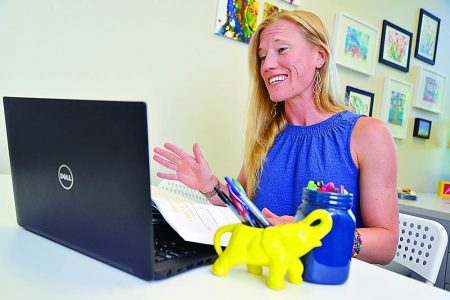
As workplaces across fields shifted into a virtual format, she gathered years' worth of her ideas for activities to implement in child therapy sessions, compiling them into a guide for others in her field to use with patients via Zoom.
In her new workbook, "Virtual Therapy for Kids: 60 Activities for Therapists Providing Remote Interventions," Manfred is changing the paradigm amid the pandemic, serving young patients through a new approach that encompasses a range of life skills. The book, which was released last July, covers treatment topics including anger management, decision making and coping skills, doing so in a way Manfred said is fun yet effective.
"It's not just a fun activity, it's actual therapeutic intervention and discussion questions, too, so the service provider can talk to that child and that family and give follow-up questions and feedback," Manfred said. "It's something I've done for many years, but just adapted to make it work in a virtual format."
A licensed behavior specialist, Manfred got the idea for the book in spring 2020.
"I read an article about therapists trying to figure out how to meet the needs of individuals they're working with, and there was one story that brought me to tears," Manfred said. "It talked about this therapist and how this family was struggling and this individual was struggling, and I thought, 'I should, somehow, do something.'"
With her schedule uncharacteristically open as last summer approached, Manfred put pen to paper.
"I just had one class, so I had my mornings free for the month of May," she said. "I thought, 'if I dedicate myself every morning for the month of May, I think I can pump out this workbook.'"
Manfred's goal was to write the book in four weeks: It took six, but she had a plan and executed it.
"So I set up a structure -- I said, 'this is how I'm going to make it and this is how I'm going to do it,' and I just figured it out," Manfred said. "I thought, 'I'm getting pretty good at this Zoom thing, and I can take everything I have and I know I can figure out how to adapt this to make this work over Zoom.' I'm pretty creative and I can organize things in a way that I know is going to make sense for other people."
Manfred's book includes a section devoted to family time, which she said is designed to strengthen families and make children more comfortable expressing themselves to their caregivers.
"Family is really important, too," Manfred said. "By having family members join together for therapeutic activities, it allows everyone to get to know each other better and to feel comfortable expressing themselves. Family interventions are quite valuable in learning to work together as a team and expressing commitment to each other."
The COVID-19 crisis, Manfred said, brought families closer, both in proximity and emotionally, and implementing virtual therapy can help make the most of the opportunity to learn and grow.
"During a pandemic when more families are home together, it is the perfect time to work on therapeutic goals in a non-threatening virtual setting," Manfred said. "Parents who normally work away from the home or family members who maybe don't feel comfortable going to a traditional office setting are more likely to take a break from work or sit down in a virtual session from the ease of their own home without the perceived pressure of being 'judged' by a therapist or social worker in that office setting."
Manfred said the book has been well-received.
"I've only had positive feedback from it," she said, adding that colleagues have praised the book for being user-friendly.
"I did all the photographs showing me, what it looks like on my end and then what it looks like on the child's and family's end, so you can see I wrote it for the therapist," Manfred said. "People really like that because it's one thing if you just read something, but if you actually look at the pictures -- all the activities -- I give an example of what it looks like when the kid does it and what it looks like when they're working on it." Manfred's book even got experts' attention across international borders.
"It seems like Canada likes it as well, so they must be doing a lot of virtual therapy up there, which is fun to think about," Manfred said.
The book, Manfred hopes, will have a positive impact on both therapists and their patients, helping them effectively navigate treatment amid an unprecedented crisis.
"I hope, from a provider standpoint, it empowers providers to not give up but find an alternative to provide service," Manfred said. "And I hope, for individuals, that it gives them more freedom and opportunity, and that it's going to empower them to see different ways. No matter what situation we're in, we can still accomplish treatment goals."
Mirror Staff Writer Andrew Mollenauer is at 814-946-7428.
The Manfred file
Name: Heidi Manfred
Age: 40
Hometown: Altoona
Occupation: Penn State Altoona Human Development and Family Studies professor
Education: Geneva College, Bachelor of Science in Human Services; Mount Aloysius College, Master of Science in Health and Human Service Administration
Family: Spouse, Matthew; children: Edith, 15; Abraham, 13; Reuben, 11; and two retired racing greyhounds, Kipchoge and Dibaba