
Ross takes plea deal
Accused killer pleads no contest
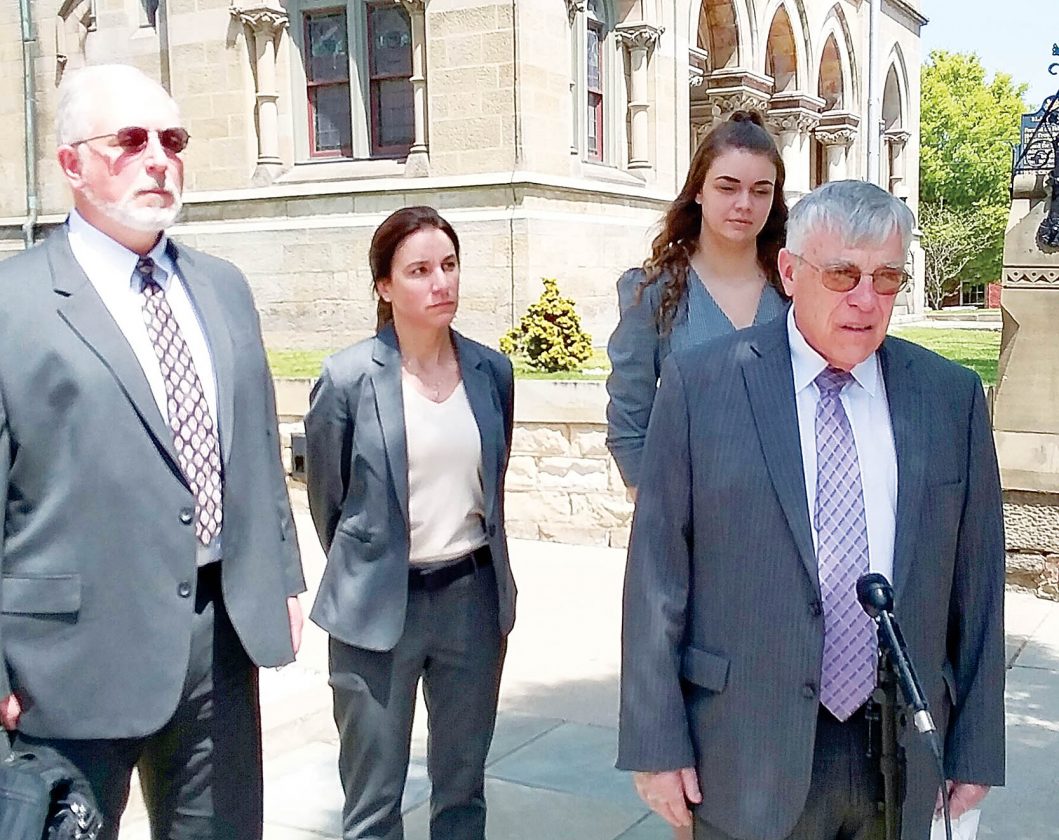
Retired Blair County District Attorney Richard Consiglio (right) speaks Tuesday about reasons behind accepting a no contest plea from Paul Aaron Ross of Hollidaysburg to third-degree murder and sexual assault offenses in the 2004 death of Tina S. Miller of Hollidaysburg. With Consiglio are (from left) retired state police investigator Dave Aiello, state police trooper Dana Martini and Assistant District Attorney Katelyn Hoover. Mirror photo by Kay Stephens

Miller

Ross
Retired Blair County District Attorney Richard Consiglio (right) speaks Tuesday about reasons behind accepting a no contest plea from Paul Aaron Ross of Hollidaysburg to third-degree murder and sexual assault offenses in the 2004 death of Tina S. Miller of Hollidaysburg. With Consiglio are (from left) retired state police investigator Dave Aiello, state police trooper Dana Martini and Assistant District Attorney Katelyn Hoover. Mirror photo by Kay Stephens
Miller
Ross
Trending
HOLLIDAYSBURG -- A Hollidaysburg area man rendered no contest pleas Tuesday to third-degree murder and three sexual assault offenses in the 2004 death of a Hollidaysburg woman.
The plea ended a Blair County trial on Tuesday when the verdict was close to being announced.
President Judge Elizabeth Doyle imposed the recommended prison sentence of 42 years to 84 years on Paul Aaron Ross, 48, with credit for time served of about 16.5 years. That leaves Ross with about 25.5 more years in prison to reach his minimum sentence.
"This plea is some small kernel of justice for (Miller), whose soul has been crying out for justice for 17 years," retired District Attorney Richard Consiglio, lead prosecutor, said outside of court Tuesday.
Consiglio said he agreed to the plea because Miller's family wanted him to accept it and because it eliminated the possibility of Ross' acquittal.
"The last thing I wanted was for him to walk away from this because he's an animal," Consiglio said. "This has been one of the worst cases I've ever seen."
Defense attorney Thomas M. Dickey said the negotiated plea allowed his client to avoid the penalties he would face if the jury returned convictions of first-degree or second-degree murder.
"This was a good resolution for three reasons," Dickey said. "My client avoided the risk of having to face the death penalty if convicted of first-degree murder. It eliminated the risk of life in prison without parole if convicted of second-degree murder. And thirdly, Tina Miller's family will get closure and finality."
As part of the negotiated plea, Ross agreed to waive all direct appeal rights. That should prevent a repeat of what happened after Ross' 2005 trial in Miller's death. After convicted of first-degree murder and sentenced to life in prison, Dickey initiated appeals, prompting the state Superior Court, in 2011, to vacate Ross' conviction and sentence and award him a new trial.
The appellate court's ruling generated about a decade of legal debate, including the highly controversial use of bite mark evidence that Consiglio abandoned last year in a move that let the case move toward trial.
The new trial, originally scheduled in December but canceled after COVID-19 cases increased, began April 13.
Ross' plea
President Judge Elizabeth Doyle, who convened court Tuesday outside the presence of the jury to review and accept Ross' proposed plea, announced during that proceeding that the jury had submitted its verdict slip.
She said that if she accepted Ross' plea and imposed the agreed-upon sentence, those verdicts would be nullified.
She asked both Dickey and Consiglio if they still wanted to proceed.
Dickey, after consulting with Ross, said yes. Then Ross offered his own confirmation to Doyle.
Consiglio said yes, too, after consulting with Miller's mother, Pamela Sunderland, who was in the courtroom. He also advised Doyle that Miller's sisters, Susan Park and Robin Miller, were in favor of the proposed plea.
Sunderland, who became emotional as proceedings wrapped up, declined to comment.
When the jurors returned to the courtroom, Doyle advised them that their hard work -- which included listening to 50 witnesses during nine days of testimony and deliberations that stretched over 12 hours on Monday and Tuesday -- had helped bring about the plea that Ross entered in exchange for a prison sentence of 42 years to 84 years.
"It's the certainty," Doyle said when attempting to explain why the prosecution and defense would settle on a plea instead of waiting for verdicts.
"Don't feel your efforts were for naught," the judge told the jurors.
She also praised them for their attentiveness during the lengthy trial and called them one of the best juries she's ever had.
Consiglio, who was in the courtroom when Doyle addressed the jurors, said he found it to be "doubly hard" to accept the proposed plea after learning that the verdict was available.
"But without knowing what was in that envelope," Consiglio said, "we couldn't walk away from the family's desire and the certainty of a third-degree murder conviction."
Dickey and fellow defense attorney Thomas Hooper assisted Ross with his completion of a no contest plea questionnaire, indicating that he understood that his actions would end the trial. By pleading no contest to third-degree murder, aggravated assault, involuntary deviate sexual intercourse and unlawful restraint, Ross admitted no guilt but acknowledged that sufficient evidence exists to result in convictions.
As Ross rendered his plea before Doyle, he answered questions and showed no emotion. When given the opportunity to speak, Ross declined.
At the state park
Trial testimony indicated that Ross and Miller were last seen together when they were dropped off at Canoe Creek State Park, near Ross' home, after partying in the early morning hours of June 27, 2004, at a Scotch Valley residence.
A few hours later, Miller's body was found partly submerged in a tributary to the lake at the state park. She was face down in the water with duct tape around her mouth and wrists.
An autopsy revealed that Miller suffered blows to her head, that she had been dragged through brush and that she had been sexually assaulted through her rectum to the point of mutilation. A capped beer bottle, found underwater near her body, was identified during the trial as the likely weapon.
Ross, who has maintained his innocence, told police that he and Miller had separated at the park. He said she used a cellphone to summon a boyfriend who picked her up in a white truck. Testimony indicated that she didn't have a cellphone. Consiglio at one point during the trial referred to the boyfriend as fictitious.
Challenges
to the evidence
Dickey challenged state police investigatory efforts, claiming they focused on Ross to the exclusion of other possible suspects and should have done more extensive investigatory work. He presented witnesses who criticized efforts police made in linking Ross to the crime scene, including those who identified footprints made by an Adidas Samba shoe, a style witnesses said Ross frequently wore.
Consiglio praised the efforts of state police investigators, including Dave Aiello, now retired and formerly of the Hollidaysburg barracks who took the lead in 2004 in investigating Miller's death.
The state police, Aiello said, did the necessary investigation work without going overboard.
During the trial, investigating state trooper Dana Martini assisted Consiglio and Assistant District Attorney Katelyn Hoover with the tracking and presentation of numerous pieces of evidence that state police collected for trial.
"We never stopped working on the Ross case," Martini said.
Mirror Staff Writer Kay Stephens is at 814-946-7456.