
Year of missed opportunities — Virus restrictions limit seniors’ learning, social experiences
Finale of college career leaves sour taste
Trending
While the Class of 2020 was the first senior class to deal with COVID-19, the Class of 2021 has had even more to acclimate to and even more to sacrifice.
Waynesburg University senior Kyle Rhodes said that he felt like everything he enjoyed about college was taken away and it became just like a job.
"Constant stress, anxiety and work that does not stop, and the best part is we do not even get paid for it; we pay them," he said.
When COVID-19 first became widespread in the spring of 2020, college campuses around the country and even around the world shut down to try to control the rapid spread of the virus. Students stayed home after spring break and the rest of the spring semester was virtual. Friendships became long distance, clubs were canceled, lunch plans were thrown out the window and athletic events were put on hold.
Class of 2020 graduates experienced the loss of the final months of their college careers. Their commencement ceremonies were virtual, and family plans to reunite and celebrate the graduation were spoiled.
Seniors in the Class of 2021 have been stripped of the full senior adventure, and it's something with which Samantha Hong, a senior at Juniata College, has had to wrestle with this year. "I look back and wish I really appreciated the fun I had with peers on the weekends," she said.
"Now that those options are not on the table anymore, I want them back so badly. I realize I took so many things for granted on this campus, down to the awkward smiles that we all would share passing each other walking to class," she said.
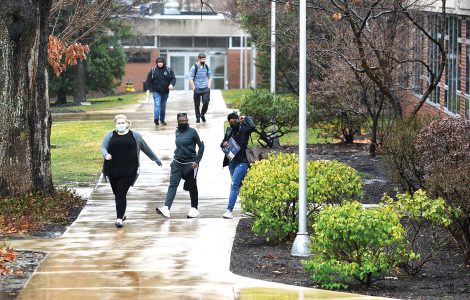
Instead of being able to enjoy the company of their peers for the remaining time they have on campus before entering the "real world," seniors are confined to their dorm rooms if they live on campus and have very few options of things to do even if they live off-campus.
Friendships also suffer, as the new Zoom hangouts can only offer so much.
Saige Perry, a senior at Mount Aloysius College, was able to find some positive in the midst of such a seemingly depressing situation. "We want to keep each other safe, and while we can still use technology to 'get together,' it has put a strain on some of my friendships," Perry said.
"That being said, some of the relationships with my roommates have grown stronger since we spend so much time together." She said she didn't expect to enjoy being around her roommates so much, but they all learned to rely on each other through this period since they were really the only physical contact they each had.
At a school like Penn State, community and connections are what make the school so attractive. So when campus was shut down, all social activities were axed as well.
Miranda Rhodes, a senior at University Park, mentioned all the gatherings that weren't possible because of the COVID-19 regulations. "THON was virtual this year, which was extremely sad because it is one of the best weekends in State College, and it was hard for the kids and their families, too," Rhodes said. "Another loss I've experienced is having classes in person. I miss walking around campus, going to the library to study and do work with friends and seeing so many people on campus."
She also expressed the impact losing football games and tailgates had on her and the rest of the university. She said it was hard not being able to take part in any of those events in her last eligible year.
Dark thoughts a worry
Mental health has been a much talked-about theme in the higher education world since the start of the pandemic, and many universities have taken steps to ensure resources are available to their students to navigate this new terrain.
A study done by the Centers for Disease Control and Prevention last summer found that young adults in the 18-24 age range -- college students included -- had high rates -- just over 25% -- of suicidal thoughts in the days prior to being surveyed.
Perry said that the loss of breaks during the semester takes a real toll on energy and morale. "During a normal year, we would have a midterm break, but to try and keep students on campus, we have lost those breaks," she said. "It's really tiring and draining to go through the full semester without a break, and it's hard to go such a long time without seeing my family."
In a highly social society, the age of social distancing and quarantines brought with it a severe blow to the mental health of the generation just arriving to the workforce.
The finale for their college career leaves a sour taste in their mouths when they cannot even experience their graduation ceremony in person. Most colleges have decided to move their commencements to completely virtual, and that does not give seniors any real sense of finality. Miranda Rhodes said one of her hopes as the semester and her college life winds down is that she will be able to have an in-person graduation at Penn State, as the university has not announced its final plans yet.
An unspoken role most seniors have is mentoring or just interacting with underclassmen and preparing them for their future years in college.
Hong said this aspect of the senior experience is crucial at Juniata. "Pre-COVID, underclassmen and upperclassmen would mix and meet on the weekends and other social gatherings, like school traditions," she said. "This was a time that seniors could take to mentor underclassmen and pass down Juniata culture and traditions -- an opportunity to really show our peers what it means to be a true Juniatian."
Hong said that chance was yet another experience taken away this year and she was sad that she wasn't able to take part in that tradition and invest in the younger students.
Finding solace
In the midst of all the uncertainty and negative impacts, however, some students have been able to find positives. Some have discovered new hobbies or outlets that bring community. "In an attempt to get regular exercise with gyms being closed, I have turned to running," Perry said. "This has led me to feel a very strong support system through other runners even if we are socially distant."
Unexpected relationships can form and evolve during this period, like with Perry's roommates. She said she was forced to find new outlets because of her limited options, but it turned into a positive experience.
Hong found joy in seeing how the Juniata community rallied in response to the pandemic and cared for each other. "Once we were put to the test, and I saw the work and effort we all had to put in to keep each other safe and happy, I saw Juniata again," she said.
For some seniors, this has been a time for self-reflection. Miranda Rhodes said the pandemic has given her time to work on herself and make decisions about where she wants to go with life after graduation and the pandemic, but others like Hong feel like even that has been stripped away. "Now is when I should be planning my future and solidifying the next stage of my 'plan,'" she said. "But, instead, I am met with the unknown and fog."
Kyle Rhodes agreed, saying, "Here I am as a senior and it is hard to enjoy my last year of college."
Comparisons aside, it is safe to say that this generation of college students and specifically seniors have had an experience quite unlike any other in history. As they graduate, they will be faced with a world that is very unfamiliar and one that is still learning how to function outside of the traditional norms. That prospect can be both frightening and exciting. "I am so happy and proud of myself for getting through these past four years, but it is also scary to have to enter an entire new world that no one really knows how to navigate yet, or even what it will look like," Hong said.
Mirror Staff Writer Nate Powles is at 814-946-7466.