
Families restructure child care during pandemic
Trending
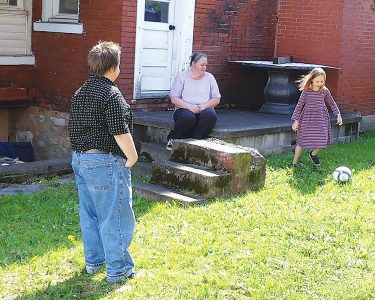
Carey Pierce, a mother of four, is balancing her family's safety, education and income.
Pierce, 43, lives in Altoona with her children and husband. After three years working as a caretaker, she found herself between jobs in May. When a local organization offered her a new position, she decided to leave the workforce entirely.
Pierce is among the hundreds of thousands of Americans who have stopped working to take on full-time child care since the pandemic began. Her family made the decision a few weeks after schools closed.
"Toward the end of the school year, no one knew what was going on," Pierce said. "After the second or third week, I asked my husband, 'How are we going to take care of the children?'"
Pierce sat down with her 8-, 11-, 13- and 19-year-olds and laid out the risks of COVID-19 and what that meant for the family.
"My husband has lung issues, so I was afraid of bringing something home that could kill him," she said.
They briefly considered asking their oldest child to watch his younger siblings, but realized that type of responsibility may be too much for a teenager, particularly in caring for a sibling with autism.
So, Pierce decided to take on full-time care of her children. She said fortunately her husband has been able to continue to work in an environment with little risk of exposure to the virus.
In July of this year, there were 5,000 fewer people employed in Blair County than the same month in 2018 and 2019, according to the Bureau of Labor Statistics most recent numbers.
About 29% of all adult employees from Blair County are working parents, according to Jeff Barr, an economics instructor at Penn State Altoona. There were 5,650 households of two working adults with children, and about 3,180 working single parent households with children in the county.
"These two groups of working adults make up an important part of the local labor force," Barr said. "For these households, child care presents an especially difficult challenge."
Parents have lost a means of affordable child care as schools across the country have grappled with mandated closures and the decision to implement hybrid models to mitigate the virus's spread.
Pierce's 11- and 13-year-olds are doing all virtual classes as per the Altoona Area School District's hybrid education model. The family decided to enroll their 8-year-old in the Altoona Elementary Cyber Academy. Pierce said she looks forward to when her kids can safely go back to school.
Barr said losing school-provided child care leaves some parents with only the option of private child care, which "may cost as much as someone's entire paycheck."
The average cost of infant care for one child in Pennsylvania is $11,842, according to the Economic Policy Institute. For a person working a full-time, minimum-wage job, that amount would be more than 78% of their income. The U.S. Department of Health and Human Services deems child care "affordable" if it costs 7% or less than the family's total income.
Even for those families of median income -- which is just shy of $68,000 in the state -- private infant care would be 17.5% of their yearly earnings for one child. In Blair County, the average number of kids in a family household with children is two.
Paying for private child care, Barr said, "will look better in economic statistics for output, but it would be a very bad use of society's resources" — predominant economic statistics like GDP would count child care done by schools and official centers, but not by parents. "There is an additional value of education in allowing parents to work," Barr said.
Compounding this challenge -- more than half of state residents with children in the household experienced a loss of employment income since the pandemic began, based on the U.S. Census Bureau's Household Pulse Survey, released on Sept. 23. That number rises to two-thirds for households making less than $25,000.
Pierce said the worst months for the family were in June and July when her husband's hours were reduced. She said the family fell behind on utility payments and rent for their home of 11 years.
"Thankfully, the utility company didn't shut us off," she said. The family was able to set up a new payment arrangement with their providers, and Pierce said their landlord has been "supportive and understanding." She said the family applied for CARES Act help, but hasn't received word on it yet. Their backup plan is to pay $300 extra a month to catch up on rent payments.
Pierce said during the summer she did take a job at a local retail store, but because of client hygiene practices, she decided not to continue. She is still concerned about the virus and local case numbers and is not yet comfortable returning to work as a caretaker.
Though she said the mental stress of her new role can be overwhelming -- "teachers aren't paid enough," she added -- things have gotten better for the family since the first week of school.
"They're my kids. There really isn't anything I wouldn't do for them," she said.
Mirror Staff Writer Dom Cuzzolina is at 946-7428.