
Schools finding ways to feed students
Hybrid learning model can cause worries for area children facing food insecurity
Trending
Local schools with hybrid learning models have faced another health-related challenge over the past months: how to continue to get kids lunches and breakfasts.
According to 2018 numbers from Feeding America, between 17% and 20% of children in Blair, Huntingdon, Bedford and Cambria counties experience food insecurity -- meaning they do not have enough food to be healthy or that they lack nutritious foods. Nearly 4,500 children were considered food insecure in Blair County that year. The organization believes those county percentages have risen to nearly 30% because of the pandemic.
The National Conference of State Legislatures reported in 2015 that 22 million U.S. kids get a free or reduced-price school lunch on an average school day, while 12 million get a free or reduced-price school breakfast.
Paula Foreman, community relations director for the Altoona Area School District, said the district has always been "keenly aware" of the importance of the school food program for its students. She said from March through July, the district served 87,284 meals.
Foreman said 63.8% of Altoona students qualify for free and reduced-cost lunches. Between 45% and 50% of Tyrone Area students qualify, according to Tyrone Superintendent Leslie Estep, while 39% of Hollidaysburg Area students qualify, according to HASD Food Service Director Betsy Snyder.
Though many children rely on school meals, No Kid Hungry -- a national campaign run by Share Our Strength -- says access to those meals, particularly during the summer, has been limited, in part due to certain requirements by the U.S. Department of Agriculture's child nutrition program.
However, earlier this year, the USDA began to change requirements for its child nutrition programs in response to the COVID-19 pandemic.
The first was a waiver of its "congregate feeding requirement" on March 20, temporarily ending the requirement for students to eat at a designated area and allowing for pickup and delivery of foods.
With this change, Foreman said Altoona was able to deliver bagged lunches to 32 off-site locations for children in the community. She said when the school year transitioned to the summer food program, the district began offering weekly pickups at school district locations.
The second was a decision last month to extend summer meal programs until Dec. 31 with the goal of reducing the "time consuming process of verifying and documenting enrollment" for those offering programs. That means districts can continue to serve meals to anyone 18 years old or younger, regardless of the person's status on receiving free or reduced-price lunches.
Before that decision, only C.W. Longer would have qualified for the summer meals program, according to Snyder. However, with this waiver, the program now covers every school in the district.
"School food service directors all over the nation are working together by sharing ideas, creating new programs and learning new regulations to best meet the needs of our students," Snyder said.
On Sept. 8, the Tyrone Area School District launched its meal pick-up program for students on virtual learning days at home or in a full cyber program.
"With the pre-K, middle and high school students on a hybrid schedule, we were concerned about how we might be able to provide meals to them under the regular meal guidelines," Estep said. "The extension of this program has given us that opportunity."
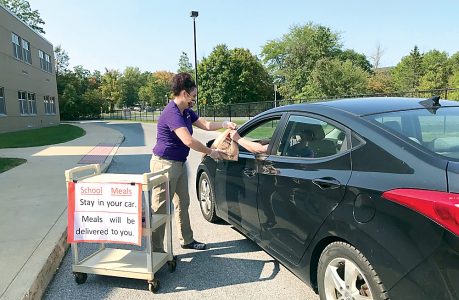
Tyrone district's pick-up program assigns separate days for students in each of the district's rotating at-home or in-school groups. Students or parents place their order via a Google Form on the district's website before 3 p.m. the day before a meal pick up. Then, either students pick up their meals during eighth period, or parents pick up the meals between 2 and 3 p.m. at the school. When parents arrive, staff members bring a bagged lunch to parents in their cars, which includes two or three days of breakfasts and lunches (depending on the distribution schedule).
The Altoona district had its first meal distribution last Wednesday, which Foreman said offered 3,110 meals for pickup to 311 children.
"We have orders for 506 students for the pick up on Sept. 23, so our numbers are starting to increase," she said late last week.
Foreman said that every Monday morning, there will be a link posted on the AASD website for food pre-order, which must be done by 10 a.m. Friday. Pickup will occur the following Wednesday.
The Hollidaysburg school district plans to launch its pickup program soon. Snyder said free meals will be available for students to take home at the conclusion of their in-person day and will be available for cyber academy or homeschool students on a weekly pickup system.
"It's important to know that students who typically pay for their meals will not be taking away from someone who needs it more," Snyder said. "All students are encouraged to participate."
Foreman said the caveat is that if an Altoona child in K-5 is receiving free meals in school, he or she is not eligible for the pickup program.
Estep said Tyrone Pre-K students are still required to have meal options on each scheduled school day, per Pre-K Counts guidelines. However, she said meals are being sent home with those students on their last day of in-person instruction for the week.
Foreman said helping to feed local children and families has been a community effort between schools and many local organizations since the pandemic started.
"We live in a community that recognizes the needs of our families and has truly stepped forward in a great way to provide food assistance during this time," she said.
Mirror Staff Writer Dom Cuzzolina is at 946-7428.